



Premium File
99 Q&A
$76.99$69.99
Arista ACE-P-ALE1.04 Exam Questions & Answers, Accurate & Verified By IT Experts
Instant Download, Free Fast Updates, 99.6% Pass Rate
99 Questions & Answers
Last Update: Sep 27, 2026
$69.99
Arista ACE-P-ALE1.04 Exam Screenshots
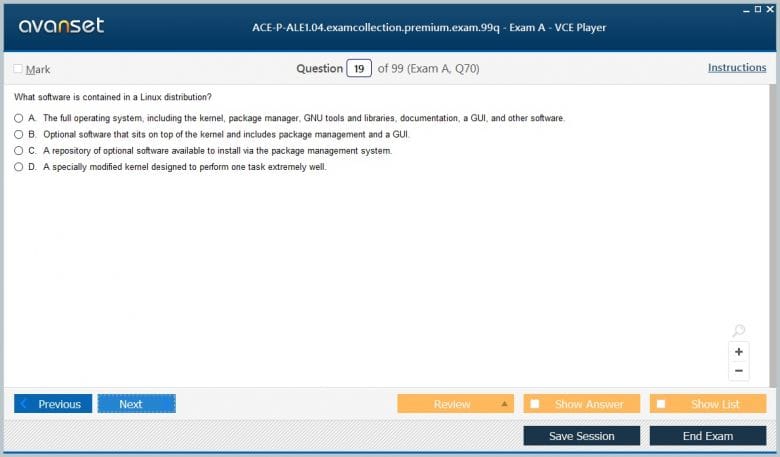
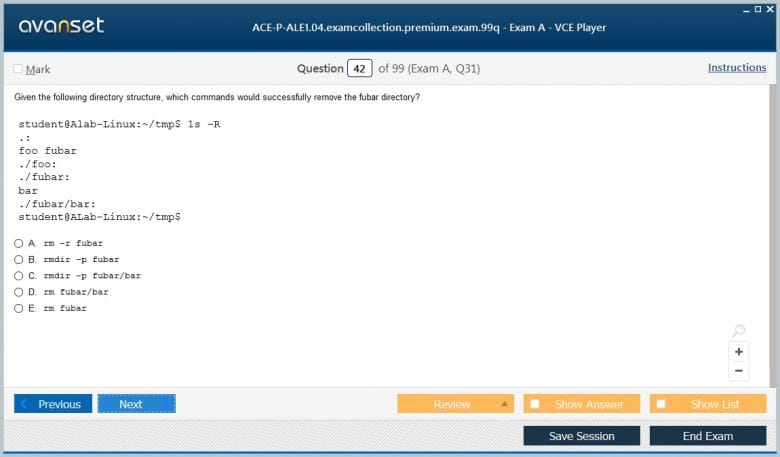
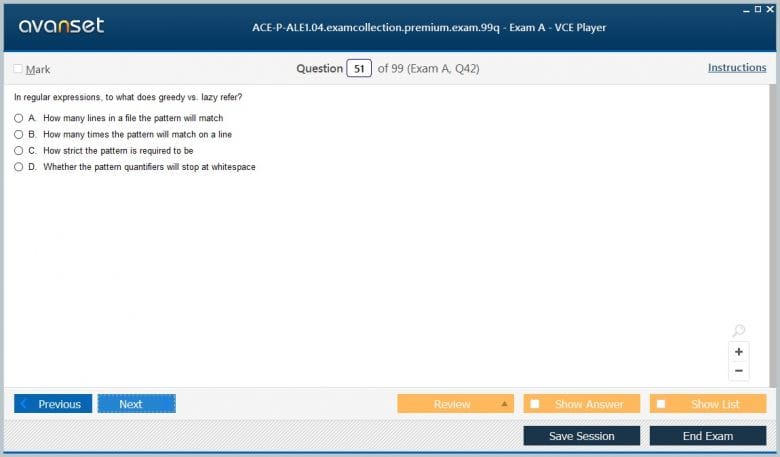
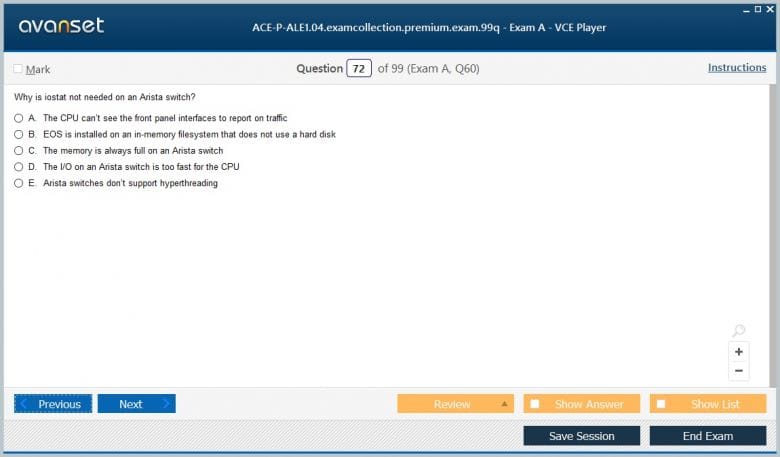
Arista ACE-P-ALE1.04 Practice Test Questions in VCE Format
| File | Votes | Size | Date |
|---|---|---|---|
File Arista.Pass4sure.ACE-P-ALE1.04.v2026-10-09.by.Jeremy.48q.vce |
Votes 3 |
Size 44.61 KB |
Date Oct 11, 2026 |
Arista ACE-P-ALE1.04 Practice Test Questions, Exam Dumps
Arista ACE-P-ALE1.04 (Arista Linux Essentials Exam) exam dumps vce, practice test questions, study guide & video training course to study and pass quickly and easily. Arista ACE-P-ALE1.04 Arista Linux Essentials Exam exam dumps & practice test questions and answers. You need avanset vce exam simulator in order to study the Arista ACE-P-ALE1.04 certification exam dumps & Arista ACE-P-ALE1.04 practice test questions in vce format.
ACE-P-ALE1.04 is an older Arista ACE code associated with Arista Linux Essentials. It reflects a period when the ACE program included separate skill-focused material for network engineers who needed to understand the Linux environment beneath and around Arista EOS. In 2026, however, candidates should treat this code as historical. Arista Academy's migration material states that previous L1-through-L5 courseware and examinations reached end of life at the close of 2025, while the current program uses new Foundations, specialist, professional, and expert tracks.
The distinction matters because third-party pages can continue labeling ACE-P-ALE1.04 as current after the vendor has reorganized its certification program. Arista certifications now follow the newer Academy track structure, so current scheduling decisions should come from the live program rather than from the continued circulation of the legacy code.
Linux knowledge still has practical value on Arista platforms. EOS is built on Linux, automation tools often run in Linux environments, and engineers benefit from understanding files, processes, permissions, networking utilities, and the shell. The enduring purpose of Linux Essentials is therefore clearer than the status of the old exam code.
A network engineer does not need to become a full-time Linux administrator to benefit from shell competence. Basic commands for locating files, viewing content, searching text, copying or moving data, creating directories, checking disk usage, and understanding paths make troubleshooting much faster. Relative and absolute paths should be intuitive rather than something a candidate has to reconstruct under pressure.
Permissions are equally important. Linux distinguishes read, write, and execute rights across owner, group, and others, with ownership and mode changes controlling access. Candidates should understand the practical consequences: a script may exist but fail because it is not executable; a service may be unable to read a file because ownership changed; a directory's execute permission affects traversal differently from a file's execute permission.
Symbolic links, file metadata, timestamps, and common text utilities help engineers inspect systems without altering them unnecessarily. A strong operational habit is to gather evidence first, then change the minimum necessary state. That principle fits network troubleshooting as well as Linux administration.
Linux exposes running work as processes with identifiers, ownership, resource use, parent-child relationships, and states. Tools such as ps, top-style monitors, and process inspection commands help determine whether a task is running, consuming excessive resources, or failing repeatedly. Signals provide controlled ways to request termination or other process behavior.
Shell job control adds foreground and background concepts. An engineer may need to start a long-running task, suspend it, resume it, or prevent an interactive session from becoming the sole lifetime of a process. These behaviors are easier to remember when candidates understand the relationship between the shell and the processes it launches.
Service management varies across Linux generations and distributions, so historical exam material may reference mechanisms that are less prominent today. The durable knowledge is how to determine what starts a process, where configuration and logs live, what dependencies exist, and how to verify status before restarting something blindly.
Linux systems separate users and groups to control privilege and ownership. The root account has extensive authority, so mature operations minimize unnecessary root activity and use controlled privilege escalation. Candidates should understand home directories, user and group identity, password handling, file ownership, and the risks of broad permissions.
SSH is especially relevant to network engineers because secure remote access and automation often depend on it. Password authentication and public-key authentication have different operational characteristics. Key pairs should be protected, authorized keys should be managed deliberately, and host identity matters when preventing man-in-the-middle connections.
Legacy Linux Essentials material may also discuss PAM or other authentication components. The exam-specific depth may have changed, but the principle remains: authentication verifies identity, authorization limits what that identity can do, and operational security depends on both. A successful login is not a justification for unlimited privilege.
One of the distinctive uses of Linux knowledge in Arista training is understanding how a general-purpose operating system and a network switch differ in startup and service behavior. Boot loaders, kernels, filesystems, startup configuration, and service initialization help explain how a system moves from power-on to an operational state.
For EOS engineers, the useful outcome is not memorizing every Linux distribution's boot sequence. It is understanding that network software, hardware drivers, persistent configuration, and management services have dependencies and states that can be inspected. When a device behaves differently after reload than before it, the engineer should think about what state was persistent, what was generated dynamically, and what failed during startup.
Historical ACE material sometimes emphasized comparing a PC boot process with an Arista switch. That comparison remains educational because it demystifies the device. EOS is a network operating system with strong separation and resilience features, but it still runs on computing hardware and uses operating-system concepts that Linux-trained engineers recognize.
Linux command-line tools are powerful because they can filter large amounts of text quickly. Searching logs for a timestamp, extracting matching lines, sorting output, counting occurrences, and chaining tools through pipes can reveal patterns that are difficult to see manually. Redirection makes it possible to capture evidence without repeatedly rerunning commands.
Candidates should be comfortable with standard input, standard output, and standard error, plus basic use of Linux input/output and pipes. A pipeline is not magic; one command's output becomes another command's input. Understanding that flow makes complex-looking shell examples much easier to debug.
Regular expressions and tools such as grep can be useful at a basic level, but precision matters. A loose pattern can match too much and lead to false conclusions. Operationally, the goal is to reduce a large evidence set to the lines relevant to the hypothesis being tested.
The underlying Linux environment has its own interfaces, routes, sockets, DNS behavior, and process bindings. Engineers may use Linux networking tools to inspect connectivity, name resolution, listening services, routes, and local traffic. These views complement rather than replace EOS's supported networking commands.
A useful troubleshooting habit is to know which plane is being inspected. A problem with a Linux-hosted management service may require host networking evidence, while a forwarding problem in the switch data plane belongs primarily in EOS networking state. Mixing those layers can waste time and create unnecessary risk.
The historical ACE-A1.2 associate exam provides the neighboring networking context: Layer 2, Layer 3, EOS operation, and troubleshooting. Linux Essentials made more sense when paired with that networking knowledge than when studied as an isolated operating-system exam.
Variables, quoting, conditionals, loops, exit status, and command substitution allow shell scripts to automate repetitive tasks. Even a short script benefits from predictable input handling and clear error behavior. Network engineers often begin automation with shell tools because they are available almost everywhere.
Candidates should understand the difference between a convenient one-liner and maintainable automation. As a task grows in complexity, a more structured language such as Python may be easier to test and maintain. The purpose of shell knowledge is not to force every automation problem into Bash; it is to understand the environment in which many network tools and scripts run.
Security also matters. Scripts should not expose passwords in command histories or files, assume untrusted input is safe, or run with more privilege than required. A fast automation that creates a credential leak or widespread configuration mistake is not an operational improvement.
Linux software is made of files and dependencies managed through packaging systems and repositories. Different distributions use different package formats and tools, so an old certification may emphasize commands that are not universal. Candidates should focus on the model: packages install versioned files and metadata, dependencies link components, and updates can change behavior across the system.
Filesystem capacity and mount state can also affect applications. A process may fail because the expected filesystem is unavailable, read-only, or full. Permission and ownership problems can look like application failures even when the binary itself is healthy. These are examples of why Linux fundamentals help engineers interpret symptoms before blaming network configuration.
On production network equipment, software changes should follow vendor-supported procedures. Linux familiarity must not become an excuse to modify the underlying system casually. The engineer's task is to use platform knowledge to understand and diagnose, while respecting the support and upgrade model of EOS.
Arista's 2026 Academy migration moved away from the previous L1-through-L5 structure. The current associate-level route is Network Foundations leading to the ACE Associate L1 badge, while specialist tracks cover areas such as Data Center, Campus, Routing, and Automation. Current exam codes use the newer AN- naming scheme.
That means ACE-P-ALE1.04 study material should be screened carefully. Linux concepts can remain correct for years, but exam objectives, product versions, certification prerequisites, and program names can become obsolete. Third-party claims that the old code remains active should not override Arista's published migration.
For a learner who already has an ACE-P-ALE1.04 question set, the safest use is diagnostic. Identify which Linux skills are weak, practice them in a lab, and then map the resulting knowledge to the current role or Arista track being pursued. Do not assume that passing an old-style practice test predicts performance on a current Arista certification.
The lasting value of the old module is its operational mindset. Files, processes, permissions, authentication, logs, shell pipelines, networking utilities, and scripting are practical tools for engineers working around modern network systems. They make automation less mysterious and troubleshooting more evidence-driven.
The key is to keep the historical and current layers separate. ACE-P-ALE1.04 identifies an older Arista exam context; Linux skills remain relevant; today's Arista certification structure has changed. When those facts are stated clearly, the legacy material can still serve readers without misleading them about current exam availability.
Preparation should therefore emphasize hands-on Linux competence and then reconnect it to current Arista objectives. A learner who can inspect a system safely, understand the state being observed, and automate repeatable checks has acquired something more durable than an old exam code.
Go to testing centre with ease on our mind when you use Arista ACE-P-ALE1.04 vce exam dumps, practice test questions and answers. Arista ACE-P-ALE1.04 Arista Linux Essentials Exam certification practice test questions and answers, study guide, exam dumps and video training course in vce format to help you study with ease. Prepare with confidence and study using Arista ACE-P-ALE1.04 exam dumps & practice test questions and answers vce from ExamCollection.
Purchase Individually
Site Search:

SPECIAL OFFER: GET 10% OFF

Pass your Exam with ExamCollection's PREMIUM files!
SPECIAL OFFER: GET 10% OFF
Use Discount Code:
MIN10OFF
A confirmation link was sent to your e-mail.
Please check your mailbox for a message from support@examcollection.com and follow the directions.

Download Free Demo of VCE Exam Simulator
Experience Avanset VCE Exam Simulator for yourself.
Simply submit your e-mail address below to get started with our interactive software demo of your free trial.