



Premium File
127 Q&A
$76.99$69.99
Arista ACE-A1.2 Exam Questions & Answers, Accurate & Verified By IT Experts
Instant Download, Free Fast Updates, 99.6% Pass Rate

ACE-A1.2 Premium File: 127 Questions & Answers
Last Update: Sep 12, 2026
ACE-A1.2 Training Course: 105 Video Lectures
$74.99
Arista ACE-A1.2 Exam Screenshots
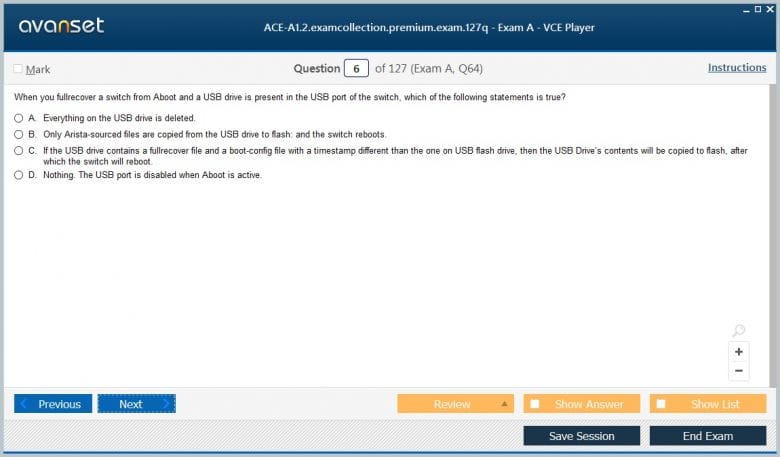
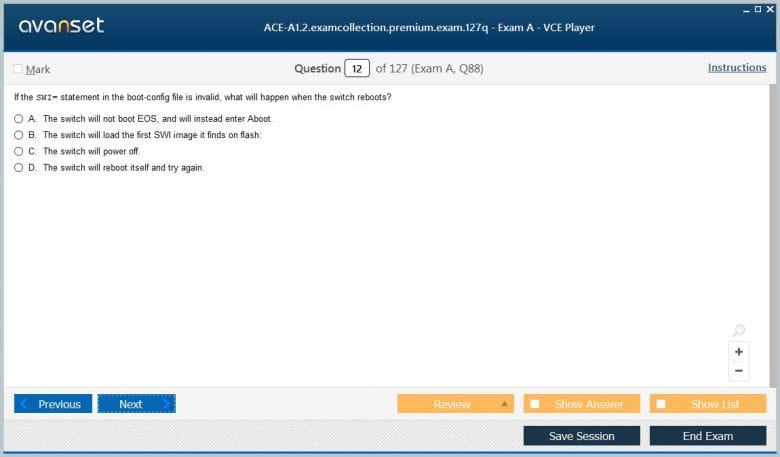
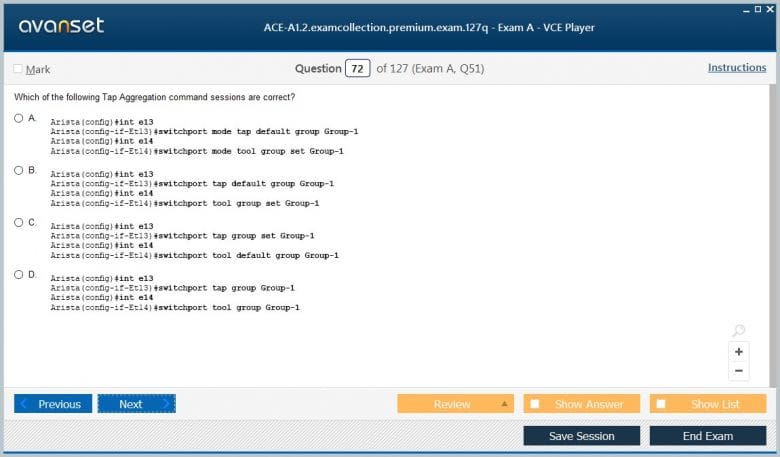
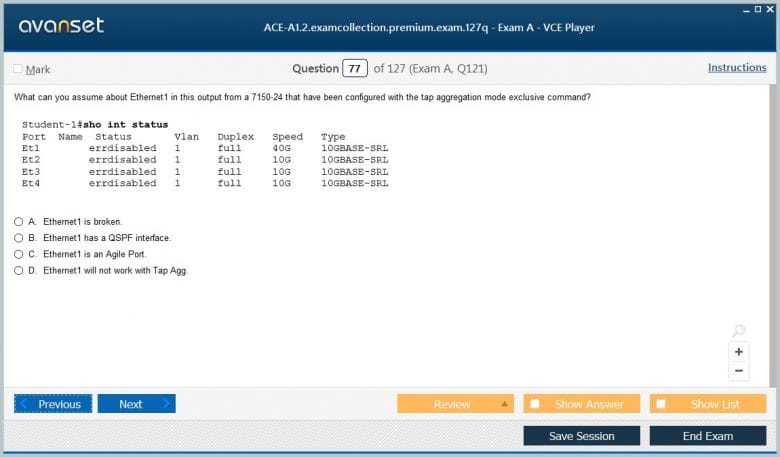
Arista ACE-A1.2 Practice Test Questions in VCE Format
| File | Votes | Size | Date |
|---|---|---|---|
File Arista.prep4sure.ACE-A1.2.v2026-08-24.by.liuyang.70q.vce |
Votes 1 |
Size 184.13 KB |
Date Aug 23, 2026 |
File Arista.Pass4sure.ACE-A1.2.v2019-03-03.by.Cliff.75q.vce |
Votes 3 |
Size 172.67 KB |
Date Mar 10, 2019 |
File Arista.Testking.ACE-A1.2.v2017-04-05.by.Yun.61q.vce |
Votes 8 |
Size 194.95 KB |
Date Apr 05, 2017 |
Arista ACE-A1.2 Practice Test Questions, Exam Dumps
Arista ACE-A1.2 (Arista Certified Engineering Associate) exam dumps vce, practice test questions, study guide & video training course to study and pass quickly and easily. Arista ACE-A1.2 Arista Certified Engineering Associate exam dumps & practice test questions and answers. You need avanset vce exam simulator in order to study the Arista ACE-A1.2 certification exam dumps & Arista ACE-A1.2 practice test questions in vce format.
ACE-A1.2 belongs to an earlier generation of Arista's ACE training and certification program. It was associated with Arista Certified Engineering Associate-level knowledge, including EOS operation, command-line work, and core Layer 2 and Layer 3 networking concepts. It should not be described as a current Arista exam in 2026: Arista Academy has replaced its previous L1-through-L5 program structure with new certification tracks, and the current associate-level exam is the Foundations exam AN-FN-OP01.
That transition is important for anyone studying older ACE material. The historical code can still explain the skills that made the associate level useful, but scheduling and preparation decisions should be based on the current Arista Academy program. Arista certifications have moved to the newer track structure, so an older code is a historical reference point rather than proof that the exam remains active.
Arista's current Foundations track covers Network Engineering Fundamentals, Arista EOS Fundamentals, and Layer 2 Switching Fundamentals and awards the Arista ACE Associate L1 badge. That is the clearest modern successor context for a learner who encounters ACE-A1.2 today.
Arista EOS is a Linux-based network operating system, but an associate-level engineer primarily needs to understand how to configure, verify, and troubleshoot the network through EOS interfaces. Comfort with the command-line hierarchy, configuration mode, interface context, show commands, configuration persistence, and basic system state allows the engineer to work deliberately rather than copying command sequences without understanding them.
Candidates should separate configuration from verification. Entering a VLAN or interface command is only the first step. A competent operator confirms the intended state using relevant show commands, checks counters and status, and understands how running configuration relates to the stored startup state. Troubleshooting becomes faster when each change is followed by a specific verification target.
EOS also supports programmatic interfaces and Linux access, which historically distinguished Arista training from a purely appliance-oriented model. At an associate level, the important concept is that the network operating system exposes structured state and automation possibilities while still requiring sound networking fundamentals underneath.
The current Foundations exam explicitly includes Layer 2 switching fundamentals. That continuity is logical because VLANs, Ethernet forwarding, trunks, loop prevention, and interface behavior are basic to most Arista deployments. A candidate who cannot explain how a switch learns MAC addresses will struggle to diagnose many higher-level problems.
A switch builds its forwarding table by observing source MAC addresses on arriving frames. For known unicast destinations, it forwards toward the learned port; for unknown destinations, it may flood within the relevant VLAN. VLANs create logical broadcast domains, while tagged trunks carry traffic for multiple VLANs across a link. Native or untagged behavior must be understood because mismatches can create confusing connectivity symptoms.
Spanning Tree concepts matter because redundant Layer 2 paths can create loops. The learner should understand why a root bridge is elected, why some ports forward while others block or discard, and how topology changes can affect traffic. Memorizing port-state names is less useful than being able to reason about why a redundant link is not currently forwarding.
Layer 3 fundamentals begin with addressing. Candidates should be comfortable with IPv4 prefixes, subnet masks, network and host portions, default gateways, and longest-prefix matching. Subnetting is not an academic side topic; it affects interface configuration, route selection, address planning, and the ability to recognize when two devices should communicate directly or through a router.
A routing table expresses reachable prefixes and next hops. Connected routes appear from configured interfaces, while static or dynamic routes may add other destinations. Troubleshooting starts by asking whether the source has a route, whether the next hop is reachable, whether the return path exists, and whether policy or filtering changes the result.
The best associate-level practice is to move between a diagram and device state. Given two VLANs and a routed boundary, predict the expected ARP and forwarding behavior. Then use show commands to verify interfaces, VLAN membership, MAC learning, IP configuration, and routes. This builds the habit of testing each layer rather than guessing.
An interface can fail for physical, configuration, protocol, or policy reasons. Link state, speed and duplex, errors, transceiver information, VLAN mode, IP addressing, and counters narrow the problem. A physically down port is a different investigation from a forwarding port that receives frames but cannot reach a routed destination.
Candidates should practice identifying the smallest fault domain. If only one host fails, inspect local attachment and endpoint configuration. If an entire VLAN fails across a trunk, inspect tagging and allowed VLANs. If multiple subnets lose remote connectivity while local switching still works, routing or upstream reachability becomes more likely. Structured isolation is more effective than changing multiple settings at once.
Arista's modern Foundations curriculum reinforces this layered thinking. The exam may use current terminology and platform expectations, but the durable associate skill is the ability to connect observed state to Ethernet and IP behavior.
EOS uses Linux under the hood, and the older ACE ecosystem included separate Linux-focused training such as Arista Linux Essentials. The relationship is useful historically: network engineers working with Arista benefited from understanding files, processes, shells, permissions, and the boundary between EOS CLI operations and the underlying operating environment.
That does not mean a learner should drop into a shell for every network task. Supported EOS commands and APIs are usually the appropriate operational interfaces. Linux knowledge becomes valuable when examining system behavior, automation tooling, file handling, or advanced troubleshooting where the architecture of EOS matters.
For current associate preparation, however, candidates should follow the current Foundations objectives rather than assuming a legacy Linux Essentials module is still a required step. Arista's 2026 migration explicitly moved the program to new track-based certifications.
Arista has long emphasized programmability, including eAPI and structured data. Automation can make configuration faster and more consistent, but it also amplifies mistakes. An engineer needs to know what good device state looks like before encoding that state into scripts or orchestration.
At a foundational level, candidates should understand the difference between sending commands interactively and interacting through a programmatic interface. Structured outputs are easier for software to parse than screen-oriented text. Idempotent automation tries to reach a desired state safely even when it runs more than once. Authentication and authorization still matter when access becomes automated.
A useful exercise is to take a manual verification workflow and imagine how it would be automated: retrieve interface state, inspect VLAN membership, compare configuration with intent, and report differences. This links network fundamentals to the operational model Arista platforms are designed to support.
Arista Academy's migration material states that previous L1-through-L5 courseware and exams reached end of life on December 31, 2025. The new program maps learning into Foundations, Data Center, WAN Routing, Automation, Campus, and Expert tracks. For associate-level learners, Network Foundations now leads to the Arista ACE Associate L1 certification through exam AN-FN-OP01.
That means an ACE-A1.2 question set should be treated as legacy practice. Ethernet, IP, EOS, and troubleshooting concepts may still be useful, but old exam logistics, course sequencing, feature versions, or program labels may no longer apply. Current study should start from Arista Academy's published Foundations topics.
The distinction also protects against false equivalence. A current Foundations exam is not simply ACE-A1.2 with a new code. Vendors revise curricula to reflect current product behavior, operational practices, and program design. Historical overlap is valuable, but it should not be used to invent a one-to-one mapping that Arista has not published.
Hands-on work is the fastest way to expose weak networking understanding. Build a small topology, create VLANs, configure access and trunk interfaces, establish Layer 3 connectivity, and then deliberately break one element. Verify the failure with commands before fixing it. The goal is not to memorize syntax but to connect symptoms to the forwarding model.
After each lab, explain what the device should be doing. Which MAC addresses should be learned on which ports? Which prefix should win in a route lookup? Which VLAN should carry a frame? Why is a spanning-tree port not forwarding? Explanations reveal whether a successful configuration was understood or achieved by trial and error.
For current Arista preparation, add EOS-specific navigation and state inspection to those fundamentals. A candidate who can reason through ordinary Ethernet and IP behavior can learn vendor syntax far more reliably than one who memorizes commands without understanding the network.
The useful role of ACE-A1.2 in 2026 is to document an earlier associate-level Arista skill set and provide context for the current Foundations track. It should not be marketed as an active exam merely because old practice files still circulate online. Arista's own migration material gives the current program priority.
Learners who already studied ACE-A1.2 can carry forward the durable parts: switching, routing, EOS familiarity, structured troubleshooting, and awareness of Linux and automation. They should then compare those skills against the current Network Foundations objectives and close any gaps before scheduling a current exam.
The broader lesson is that certification codes expire faster than networking principles. Program status must be checked from the vendor, while technical fundamentals remain useful when they are revalidated against the current platform. That is the right balance for studying a legacy Arista associate page today.
Go to testing centre with ease on our mind when you use Arista ACE-A1.2 vce exam dumps, practice test questions and answers. Arista ACE-A1.2 Arista Certified Engineering Associate certification practice test questions and answers, study guide, exam dumps and video training course in vce format to help you study with ease. Prepare with confidence and study using Arista ACE-A1.2 exam dumps & practice test questions and answers vce from ExamCollection.
Purchase Individually

Arista ACE-A1.2 Video Course

Site Search:

SPECIAL OFFER: GET 10% OFF

Pass your Exam with ExamCollection's PREMIUM files!
SPECIAL OFFER: GET 10% OFF
Use Discount Code:
MIN10OFF
A confirmation link was sent to your e-mail.
Please check your mailbox for a message from support@examcollection.com and follow the directions.

Download Free Demo of VCE Exam Simulator
Experience Avanset VCE Exam Simulator for yourself.
Simply submit your e-mail address below to get started with our interactive software demo of your free trial.