



Premium File
99 Q&A
$76.99$69.99
SAS Institute A00-281 Exam Questions & Answers, Accurate & Verified By IT Experts
Instant Download, Free Fast Updates, 99.6% Pass Rate
99 Questions & Answers
Last Update: Nov 05, 2026
$69.99
SAS Institute A00-281 Exam Screenshots
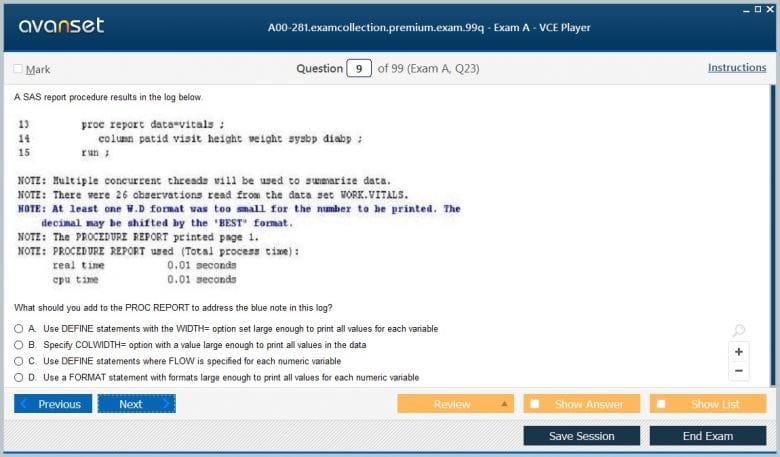
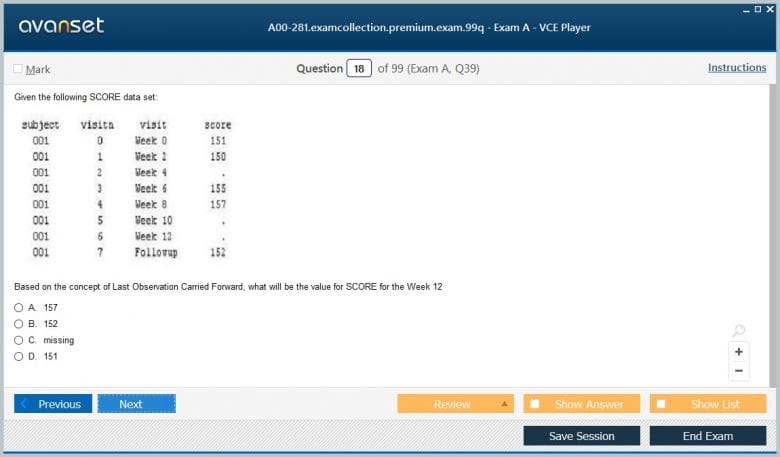
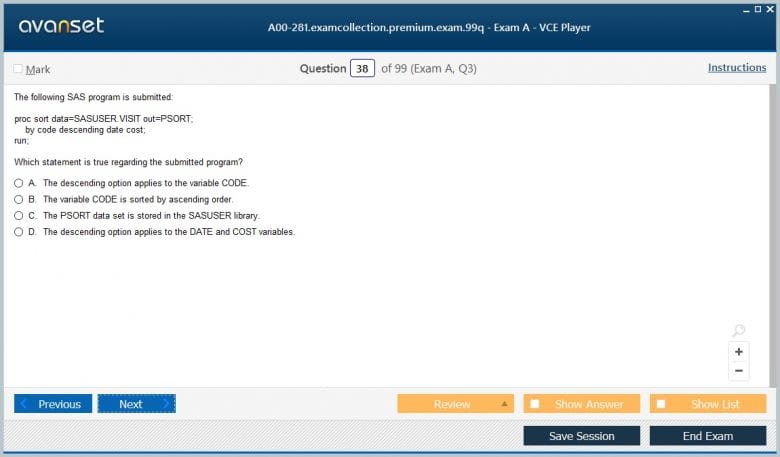
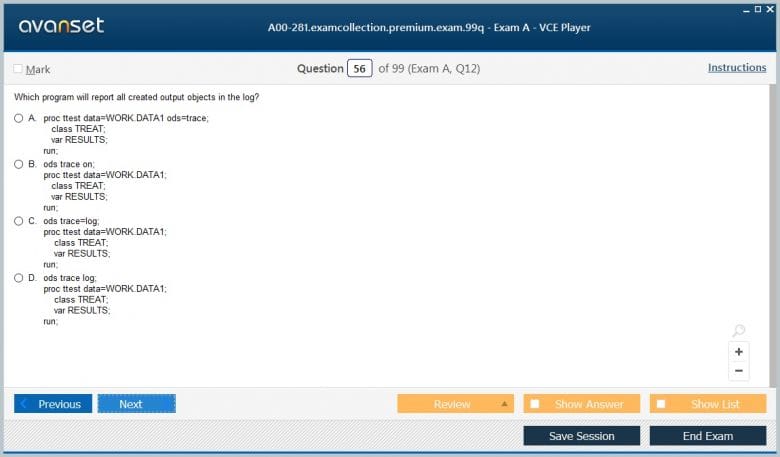
SAS Institute A00-281 Practice Test Questions in VCE Format
| File | Votes | Size | Date |
|---|---|---|---|
File SAS Institute.Train4sure.A00-281.v2026-09-18.by.Ben.55q.vce |
Votes 3 |
Size 1.1 MB |
Date Sep 18, 2026 |
SAS Institute A00-281 Practice Test Questions, Exam Dumps
SAS Institute A00-281 (SAS Clinical Trials Programming Using SAS 9 - Accelerated Version 9 Accelerated Version) exam dumps vce, practice test questions, study guide & video training course to study and pass quickly and easily. SAS Institute A00-281 SAS Clinical Trials Programming Using SAS 9 - Accelerated Version 9 Accelerated Version exam dumps & practice test questions and answers. You need avanset vce exam simulator in order to study the SAS Institute A00-281 certification exam dumps & SAS Institute A00-281 practice test questions in vce format.
A00-281 was the accelerated route to the SAS Certified Clinical Trials Programmer Using SAS 9 credential. It matters historically because it tested a very particular combination: practical SAS programming, clinical-trial data structures, regulated reporting habits, and the ability to turn raw study data into traceable analysis and presentation outputs. SAS no longer offers A00-281; the older A00-280/A00-281 route ended in 2023, while the current clinical-programming credential uses SAS 9.4 and the A00-282 exam.
That status distinction is important when reading older preparation material. The core programming ideas remain relevant across SAS certifications, but an A00-281 study plan should be treated as legacy exam preparation rather than a description of the current testing route. Candidates using the old code for historical study should separate durable clinical-programming skills from product-version details, exam logistics, and credential requirements that have changed.
The enduring subject is not ordinary data analysis. Clinical programming operates inside a controlled evidence chain. Every transformation should be explainable, every derivation reproducible, and every table, listing, or figure traceable back through analysis datasets to collected study data. That combination of programming and accountability is what makes the domain distinctive.
A programmer needs enough trial context to understand why the data exist. Protocol design defines populations, visits, endpoints, treatments, timing windows, safety assessments, and statistical objectives. Those decisions shape the data that appear in case report forms and external systems. A variable is rarely meaningful by itself; its interpretation depends on the subject, visit, treatment period, unit, collection method, and protocol rule that produced it.
Study scenarios therefore reward contextual reasoning. If a laboratory value is collected repeatedly, the programmer must distinguish the raw result from its standardized value, reference range, visit mapping, baseline flag, and analysis window. If a subject discontinues early, downstream datasets must represent what was observed without inventing what was not. Good preparation follows a few sample subjects end to end and explains how protocol events become analysis-ready records.
The DATA step is central because clinical datasets often require controlled row-by-row transformation: retaining values, creating flags, merging subject-level attributes, manipulating dates, parsing character data, applying formats, and deriving new variables under explicit conditions. Small syntax mistakes can create clinically meaningful errors, so candidates should understand execution order rather than relying on memorized code fragments.
Practice should include BY-group processing, FIRST. and LAST. logic, RETAIN, arrays, conditional output, SET and MERGE behavior, informats, formats, and missing-value handling. The key question is always what the program does to the Program Data Vector and what observation is written. When a result looks wrong, that execution model is more useful than trial-and-error editing.
Clinical programmers use more than DATA steps. PROC SQL can join tables, summarize records, create calculated columns, and express many transformations compactly. Procedures such as SORT, TRANSPOSE, FORMAT, FREQ, MEANS, REPORT, TABULATE, and statistical procedures support cleaning, reshaping, checking, summarizing, and presenting data. The exam-era skill was knowing which tool fits the problem and what side effects each tool introduces.
A useful comparison exercise is to solve the same task with a DATA step and PROC SQL. For example, derive one row per subject with treatment, first dose date, and latest disposition date. Compare duplicate handling, sort requirements, join behavior, and missing keys. That develops the judgment needed in regulated work, where a concise program is valuable only if its behavior is transparent and testable.
Regulated submissions rely on conventions that make data easier to exchange, review, and analyze. CDISC standards such as SDTM organize tabulation data, while ADaM supports analysis-ready structures with explicit derivations and traceability. A legacy A00-281 candidate did not need to become a standards architect, but needed to understand how standard structures influence programming decisions and reporting workflows.
Study by tracing a common endpoint. Begin with collected data, identify the SDTM representation, define the ADaM derivation, and then show how the analysis dataset feeds a table or figure. The exercise reveals where metadata, controlled terminology, analysis flags, population definitions, and timing rules belong. It also makes validation easier because each stage has a clear purpose.
Clinical reporting can involve dozens of outputs with similar structures across visits, parameters, treatment groups, or analysis populations. The SAS macro language can reduce repetition by generating consistent code from parameters and metadata. Useful skills include macro variables, parameterized macros, conditional macro logic, iteration, quoting, and understanding when resolution happens.
The risk is hiding complexity. A macro that saves ten lines but becomes impossible to validate is not an improvement. Good regulated code keeps interfaces explicit, limits side effects, records inputs, and produces predictable logs. Practice reviewing expanded code and symbol-table behavior so that a macro can be debugged as a program generator, not treated as magic syntax.
Clinical outputs may support regulatory review or medical interpretation, so independent checking is built into mature workflows. Validation can include double programming, targeted code review, input-output checks, record-count reconciliation, boundary tests, and comparison of expected statistics. The objective is not merely to find syntax errors; it is to detect incorrect assumptions, missed populations, wrong timing, and inconsistent derivations.
Create test cases deliberately. Include a subject with no post-baseline data, one with multiple records on the same date, one with an unscheduled visit, and one with a missing result. Predict the expected flags and summaries before running code. Edge cases expose weak logic earlier than a large clean dataset does and help distinguish a robust derivation from one that only works for typical records.
Reporting is not just formatting. A safety table might require treatment-emergent logic, subject-level denominators, event hierarchy, severity, relationship, and clear handling of multiple occurrences. An efficacy table may depend on baseline rules, change scores, estimands, visit windows, and analysis populations. The programmer must know which dataset variables encode those decisions and how the display communicates them.
A strong exercise is to reconstruct an output specification. Identify the denominator, grouping variables, statistic, precision, ordering, footnotes, and source dataset. Then write a validation checklist before coding. This trains the habit of treating presentation requirements as part of the statistical contract rather than as decorative choices made at the end.
Regulated programming requires a defensible path from source data to result. Programs should be version-controlled, logs reviewed, warnings resolved, datasets reproducible, and derivations documented well enough that another programmer can follow them. Naming conventions, metadata, controlled libraries, and predictable execution order reduce the chance that an old intermediate file or manual edit contaminates a result.
Think of every output as evidence with a lineage. If a reviewer asks why a value appears, the team should be able to identify the record, derivation, program, specification, and rule that produced it. That mindset is more durable than any one SAS syntax feature and remains relevant even as clinical platforms and certification exams evolve.
The most productive use of A00-281 material today is to identify which competencies survived the transition to the SAS 9.4 professional credential. Clinical process knowledge, data manipulation, statistical reporting, macros, standards awareness, validation, and traceability remain useful. Old registration instructions, prerequisite wording, and exact exam mechanics should not be assumed to apply to the current A00-282 route.
Build a two-column study map: one side for enduring clinical-programming competencies and the other for A00-281-specific historical details. Keep the first column as reusable professional knowledge and verify the second against current SAS documentation if you are pursuing certification now. That approach respects the value of the legacy exam without confusing it with the present credential.
Another useful exercise is to review SAS logs as if they were part of the deliverable. Notes about automatic character-to-numeric conversion, uninitialized variables, repeated BY values, truncation, or missing formats can point to defects that still produce an output. In clinical work, a program that runs without an ERROR message is not automatically correct. Build the habit of explaining every warning and unexpected note, then confirm that record counts and key variables behave as intended.
Date handling deserves special attention because clinical endpoints depend heavily on chronology. Partial dates, treatment start dates, visit dates, adverse-event onset, and laboratory collection times can affect baseline classification and treatment-emergent rules. Practice converting character dates safely, preserving imprecision where required, and avoiding derivations that create false certainty. A neat date value is not better data if the source only supported a month or year.
Program organization also affects reviewability. Separate setup, input preparation, derivations, summaries, and output creation so another programmer can inspect the logic without jumping through a monolithic script. Use meaningful dataset names and comments that explain business rules rather than restating syntax. In regulated programming, readability reduces validation cost and makes change impact easier to assess when a specification is revised late in the study.
Finally, keep the legacy status explicit in any preparation notes. A00-281 can still teach disciplined clinical SAS programming, but current candidates should use the official A00-282 content guide for exam scope and registration requirements. The historical credential remains a useful map of the profession; it is not the current destination.
Clinical programming also benefits from deliberately separating source correction from analysis derivation. If a source value appears inconsistent, a programmer should not silently overwrite it in an analysis dataset to make the result look reasonable. The discrepancy may require a data query, a documented imputation rule, or a derived variable that preserves the original value. Keeping raw, standardized, and derived information distinct protects traceability and prevents programming convenience from becoming undocumented data cleaning.
When practicing older A00-281 questions, explain not only which code works but why the alternatives fail. A wrong answer may misuse WHERE and IF timing, misunderstand BY-group processing, merge records incorrectly, or apply a procedure option at the wrong scope. That analysis turns multiple-choice practice into reusable programming knowledge and helps reveal gaps that memorizing answer letters would hide.
Go to testing centre with ease on our mind when you use SAS Institute A00-281 vce exam dumps, practice test questions and answers. SAS Institute A00-281 SAS Clinical Trials Programming Using SAS 9 - Accelerated Version 9 Accelerated Version certification practice test questions and answers, study guide, exam dumps and video training course in vce format to help you study with ease. Prepare with confidence and study using SAS Institute A00-281 exam dumps & practice test questions and answers vce from ExamCollection.
Purchase Individually
Site Search:

SPECIAL OFFER: GET 10% OFF

Pass your Exam with ExamCollection's PREMIUM files!
SPECIAL OFFER: GET 10% OFF
Use Discount Code:
MIN10OFF
A confirmation link was sent to your e-mail.
Please check your mailbox for a message from support@examcollection.com and follow the directions.

Download Free Demo of VCE Exam Simulator
Experience Avanset VCE Exam Simulator for yourself.
Simply submit your e-mail address below to get started with our interactive software demo of your free trial.