



Premium File
70 Q&A
$76.99$69.99
SAS Institute A00-260 Exam Questions & Answers, Accurate & Verified By IT Experts
Instant Download, Free Fast Updates, 99.6% Pass Rate
70 Questions & Answers
Last Update: Sep 06, 2026
$69.99
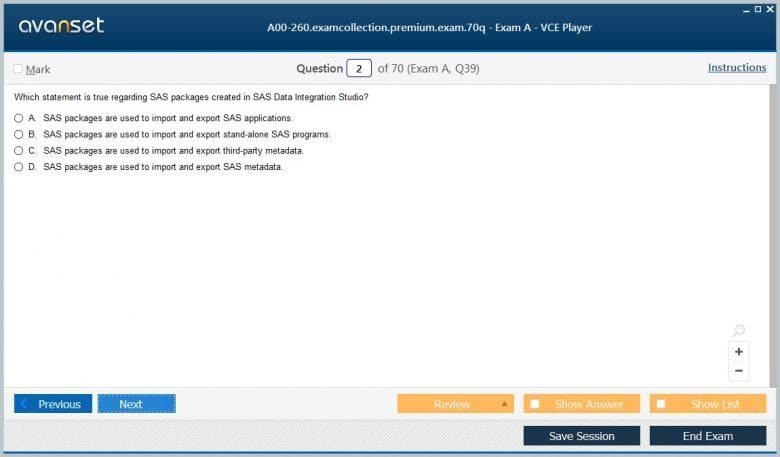
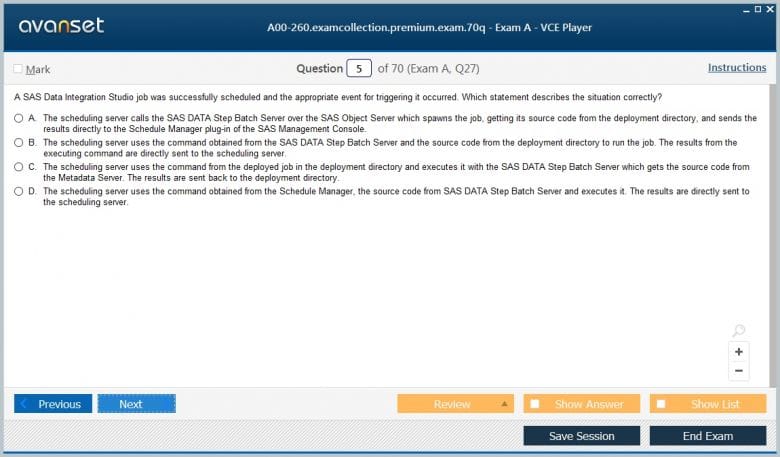
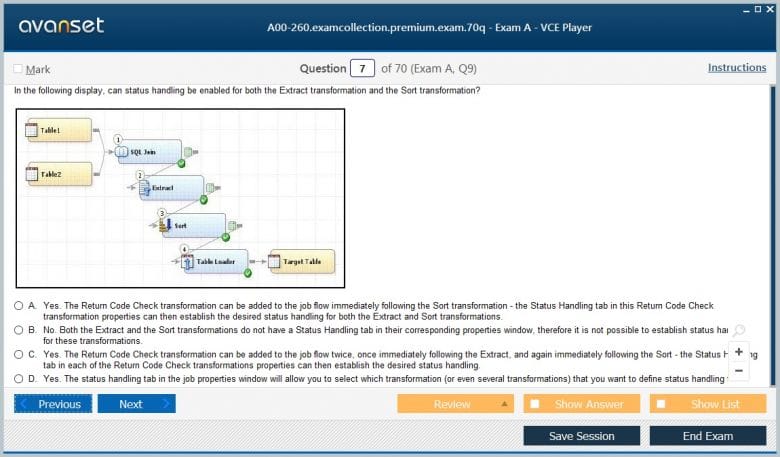
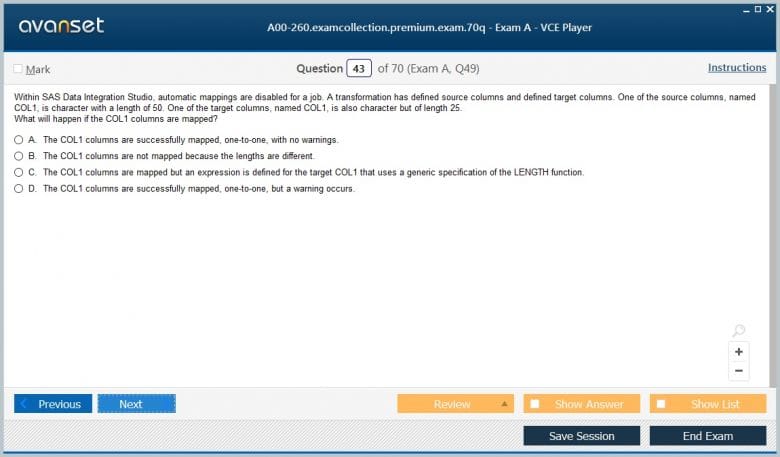
SAS Institute A00-260 Exam Screenshots
SAS Institute A00-260 Practice Test Questions in VCE Format
| File | Votes | Size | Date |
|---|---|---|---|
File SAS Institute.questionpaper.A00-260.v2026-08-05.by.harley.42q.vce |
Votes 1 |
Size 207.42 KB |
Date Aug 05, 2026 |
File SAS Institute.Test-king.A00-260.v2019-02-07.by.Alex.42q.vce |
Votes 2 |
Size 207.9 KB |
Date Feb 10, 2019 |
SAS Institute A00-260 Practice Test Questions, Exam Dumps
SAS Institute A00-260 (SAS Data Integration Development for SAS 9) exam dumps vce, practice test questions, study guide & video training course to study and pass quickly and easily. SAS Institute A00-260 SAS Data Integration Development for SAS 9 exam dumps & practice test questions and answers. You need avanset vce exam simulator in order to study the SAS Institute A00-260 certification exam dumps & SAS Institute A00-260 practice test questions in vce format.
A00-260 is the active SAS Data Integration Developer for SAS 9 exam. SAS currently lists the credential around creating metadata for source and target data, building jobs, working with transformations and table loading, defining generated transformations, deploying jobs, and using in-database processing.
Data integration development is the engineering layer between source systems and trustworthy analytical data. A developer must understand metadata, extraction patterns, transformation logic, keys, slowly changing dimensions, loading behavior, error handling, scheduling, deployment, performance, and reconciliation. The quality of analytics downstream depends on these decisions.
The work naturally intersects A00-250 platform administration because integration jobs depend on libraries, credentials, servers, permissions, and scheduling infrastructure. It also aligns with the broader principles in data integration: movement, transformation, quality, lineage, and recovery should be designed as one process.
Table definitions, column attributes, keys, formats, libraries, and source connections provide the contract between the physical data and the integration job. Incorrect metadata can cause truncation, type conversion, failed joins, or silent logic errors. Developers should validate metadata against the actual source rather than assuming imported definitions are perfect.
Profile critical columns after registration. Check types, lengths, null rates, distinct counts, and key uniqueness. If a source schema changes, determine whether the job should adapt automatically or fail for review. Silent schema drift is dangerous because it can make a successful job produce semantically different data.
Operational extracts, dimensional warehouses, analytical marts, and staging areas have different design needs. A target table should define grain, keys, history requirements, load frequency, retention, and consumers. Without a clear grain, joins and aggregations later become ambiguous.
Write the grain statement for a target before creating columns, such as one row per customer per month or one row per invoice line. Then identify natural keys, surrogate keys, and measures. This small design step prevents many integration defects that otherwise appear only when analysts discover duplicates or unexplained totals.
Data Integration Studio provides transformations for extraction, joins, lookups, sorting, filtering, expression handling, table loading, and many other tasks. The value is not drag-and-drop itself; it is creating a job whose logic can be reviewed, maintained, and regenerated consistently. Custom code should be used when it adds clear value.
Name steps according to their business purpose and document non-obvious rules. A transformation called “Filter” tells little; “Keep active policies for reporting month” reveals intent. Clear jobs reduce support time because another developer can trace why a record was included or excluded without reverse-engineering every expression.
Integration jobs frequently combine data from systems that use different keys or levels of detail. Many-to-many joins can multiply rows unexpectedly, and unmatched records can disappear when an inner join is used without intention. Developers should validate join cardinality before and after execution.
For each join, record expected key uniqueness and unmatched behavior. Compare input and output counts, duplicate keys, and reconciliation totals. If the job intentionally expands rows, document why. This makes cardinality an explicit design property rather than a surprise found by downstream analysts.
Dimensional models often need to track how descriptive attributes change over time. Type 1 updates overwrite history, while Type 2 patterns create new dimension versions with effective dates or current flags. The correct choice depends on reporting requirements and can vary by attribute.
Use a customer dimension example where address history must be preserved but a spelling correction should overwrite the existing value. Classify each attribute and define how source changes are detected. Then test multiple changes on the same business key to confirm the dimension creates the expected history without duplicate current rows.
A job can replace a table, append rows, update matching records, or use other loading patterns. Large targets may require bulk techniques, partition-aware strategies, or staging tables. The developer should decide how partial failure is handled so a job never leaves consumers with a mixture of old and incomplete new data.
Design a load with a staging phase, validation checks, and controlled publish step. If validation fails, the previous production table remains available. This pattern separates data processing from data release and makes recovery simpler than trying to undo thousands of partially committed changes.
A generated transformation can package recurring logic for reuse across jobs. Parameters and metadata interfaces should make the component flexible while preserving predictable output. Reuse becomes harmful when a component quietly assumes specific column names, formats, or source systems that are not documented.
Define the contract for a reusable transformation: required inputs, optional parameters, output columns, error conditions, and expected performance. Then test it with more than one source. A reusable component should reduce variation across projects, not move complexity into a black box.
When supported operations can execute in the source database, pushing work down can improve performance by filtering, joining, or aggregating data before it travels to SAS. The developer should understand which transformations are eligible and whether generated SQL preserves intended semantics.
Compare two job designs: one that extracts a large table before filtering and one that performs selective processing in the database. Measure network transfer and elapsed time. Then consider database workload and concurrency. Pushdown is an optimization choice that must respect the capacity of the source system.
A successful technical run does not prove the data is trustworthy. Jobs should validate key uniqueness, required fields, reference integrity, accepted ranges, record counts, and reconciliation totals where appropriate. Exceptions should be visible and owned rather than silently discarded.
Create an exception table that records rejected rows with reason codes and source identifiers. Report the number and percentage of exceptions for each run. This allows business owners to distinguish a small known quality issue from a sudden source-system change that threatens the reliability of the whole load.
Integration jobs rely on metadata, libraries, transformations, schedules, credentials, and sometimes external files or database objects. Moving only the job definition can produce a deployment that looks complete but fails at runtime. Promotion should account for environment-specific values without hard-coding them into business logic.
Maintain a deployment checklist that identifies objects, connection mappings, permissions, schedules, and validation queries. After promotion, run a controlled test and compare outputs with the source environment. Repeatable deployment is part of the application, not a separate administrative convenience.
Long-running integration flows should expose enough information to identify which source, transformation, or target failed. Jobs should also have a restart strategy: rerunning from the beginning may be safe for a replace load but dangerous for an append process without idempotency controls.
For each major job, document restart behavior and the restart stage from which recovery is safe. Include who owns the source data, job logic, platform, and target. This shortens outages because support teams know both what evidence to inspect and who can authorize corrective action.
SAS currently lists A00-260 as an active exam with 52 multiple-choice and short-answer questions and a published objective distribution across metadata, jobs, transformations, table loading, generated transformations, deployment, and in-database processing. The scope rewards end-to-end understanding.
Practice building a small warehouse flow from registered source through transformation, dimension or target loading, validation, deployment, and recovery. Explain the grain, key strategy, join cardinality, rejected records, and restart behavior. That gives each exam objective a place in a coherent integration system.
Incremental extraction strategy is critical for large sources. Timestamps, sequence keys, change-data indicators, or source-specific mechanisms can reduce the volume moved each run, but the developer must handle late-arriving updates, clock differences, and reprocessing. A watermark that advances too early can permanently skip records after a partial failure.
Late-arriving dimensions and facts also need explicit treatment. A transaction may arrive before the related dimension record is available, or a reference attribute may be corrected after the fact table was loaded. Define whether the pipeline uses inferred members, quarantines the row, or reprocesses later. The right choice depends on reporting urgency and reconciliation needs.
Lineage should be understandable at a business level. For an important measure, teams should be able to trace the target column through transformations to the source fields and rules that created it. This accelerates audits and incident response because a questionable number can be investigated without reading every job from scratch.
Scheduling should reflect dependencies rather than convenient clock times. A downstream job should start when its prerequisites are complete and validated, not simply because the clock reached 2:00 a.m. Where tooling permits, dependency-based orchestration reduces race conditions and makes the critical path visible when a source is delayed.
Performance testing should use representative production volumes. A job that completes quickly with a small development extract may fail its batch window when joins, sorts, or lookups operate over full history. Capture row counts and elapsed time by major step so growth trends reveal which part of the pipeline is approaching a limit.
Developers should also version integration logic and keep release notes for material rule changes. When a metric changes unexpectedly, teams need to know whether the source changed, the data-quality profile shifted, or a transformation was deliberately modified. Version discipline turns historical comparison into an explainable process.
Reconciliation between source and target should be designed at several levels: record counts, control totals, key populations, and business measures. Matching only the total number of rows can hide duplicate or missing records that offset one another. Layered checks make successful loads demonstrably correct rather than merely complete.
Go to testing centre with ease on our mind when you use SAS Institute A00-260 vce exam dumps, practice test questions and answers. SAS Institute A00-260 SAS Data Integration Development for SAS 9 certification practice test questions and answers, study guide, exam dumps and video training course in vce format to help you study with ease. Prepare with confidence and study using SAS Institute A00-260 exam dumps & practice test questions and answers vce from ExamCollection.
Purchase Individually
Site Search:

SPECIAL OFFER: GET 10% OFF

Pass your Exam with ExamCollection's PREMIUM files!
SPECIAL OFFER: GET 10% OFF
Use Discount Code:
MIN10OFF
A confirmation link was sent to your e-mail.
Please check your mailbox for a message from support@examcollection.com and follow the directions.

Download Free Demo of VCE Exam Simulator
Experience Avanset VCE Exam Simulator for yourself.
Simply submit your e-mail address below to get started with our interactive software demo of your free trial.