


Premium File
740 Q&A
$76.99$69.99
ACI 3I0-012 Exam Questions & Answers, Accurate & Verified By IT Experts
Instant Download, Free Fast Updates, 99.6% Pass Rate
740 Questions & Answers
Last Update: Sep 21, 2026
$69.99
ACI 3I0-012 Exam Screenshots
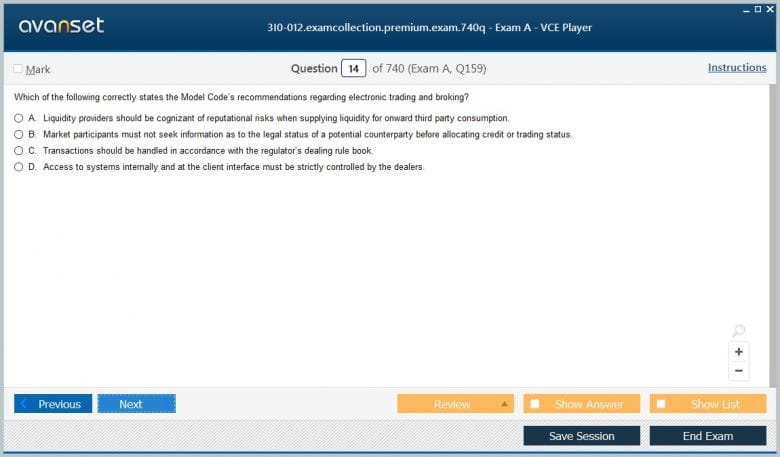
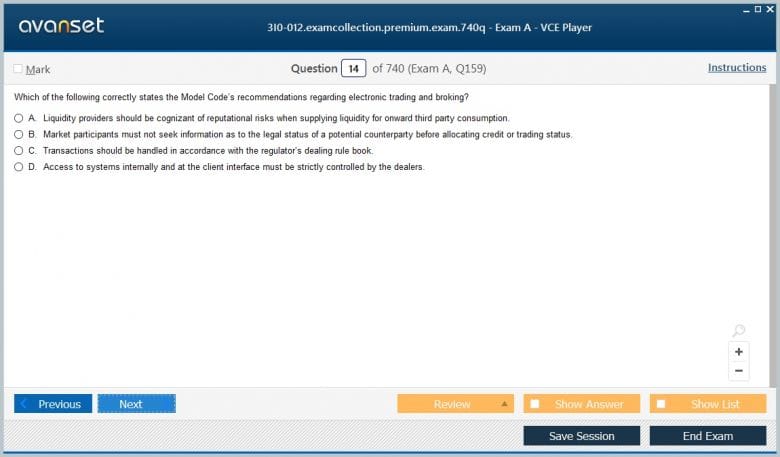
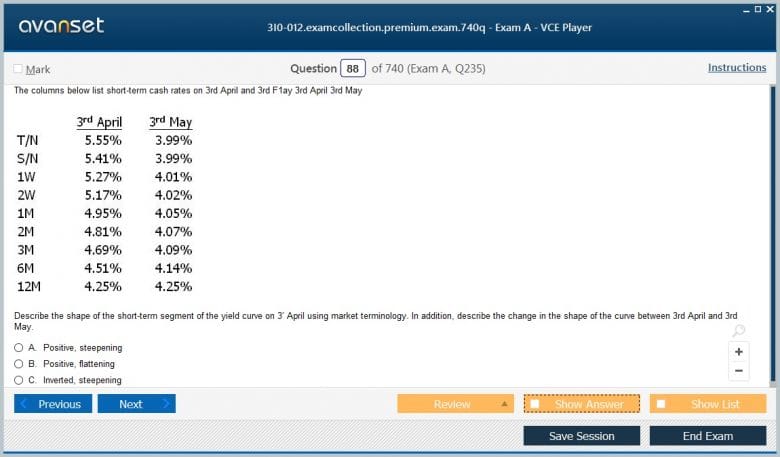
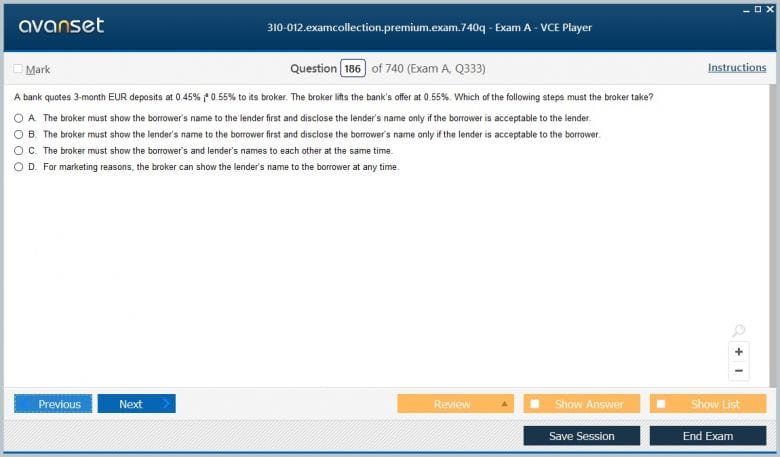
ACI 3I0-012 Practice Test Questions in VCE Format
| File | Votes | Size | Date |
|---|---|---|---|
File ACI.Test-king.3I0-012.v2026-09-13.by.Jasper.450q.vce |
Votes 2 |
Size 504.25 KB |
Date Sep 19, 2026 |
ACI 3I0-012 Practice Test Questions, Exam Dumps
ACI 3I0-012 (ACI Dealing Certificate) exam dumps vce, practice test questions, study guide & video training course to study and pass quickly and easily. ACI 3I0-012 ACI Dealing Certificate exam dumps & practice test questions and answers. You need avanset vce exam simulator in order to study the ACI 3I0-012 certification exam dumps & ACI 3I0-012 practice test questions in vce format.
Unlike some older codes that survive mainly in third-party catalogues, 3I0-012 is directly documented in a historical ACI Financial Markets Association syllabus as the Prometric code for the ACI Dealing Certificate. That makes its legacy status clear. The current ACI FMA program is the ACI Dealing Certificate New Version, registered as exam code 002-101, so candidates should not assume the 3I0-012 blueprint or administrative details remain current.
The old syllabus is still useful for understanding the lineage of the qualification. It covered foreign exchange, money markets, derivatives, market mathematics, and professional conduct for people entering dealing rooms and related control functions. The modern program preserves those foundations but reorganizes them into five current topic baskets and uses current codes, formula sheets, market references, and conduct expectations.
The older ACI syllabus explicitly labels 3I0-012 as the Prometric code for the Dealing Certificate. Current ACI web-shop listings instead use 002-101 for the Dealing Certificate New Version. Candidates should treat that as a program transition, not as two simultaneous current exam options.
This matters when evaluating preparation material. A product can accurately say it covers “ACI Dealing Certificate” while still target an obsolete syllabus. The credential family name alone is not enough. Check the current exam code, syllabus date, formula sheet, topic baskets, and registration channel.
The site also carries 3I0-008, another legacy dealing-certificate identifier. Its presence is useful for historical search traffic, but current candidates should consolidate their study around the live 002-101 framework rather than mix multiple old-code blueprints.
The current ACI Dealing Certificate New Version groups content into Financial Markets Environment, Foreign Exchange, Rates, FICC Derivatives, and Financial Markets Applications. This organization is broader than simply separating instruments into isolated chapters because it asks candidates to connect products with the market context in which they are traded.
A good study plan mirrors that structure. Begin with market participants, conduct, and conventions; then build product mechanics; then test the ability to apply those mechanics in realistic scenarios. That sequence makes formulas easier to remember because each formula solves a recognized market problem.
Candidates using 3I0-012-era notes should create a crosswalk. Mark which old topics still appear in the current five baskets, which terminology changed, and which references need replacement. Any topic that cannot be mapped confidently should be verified from current ACI material before it is studied deeply.
FX questions become difficult when the candidate loses track of which currency is being bought, sold, paid, or received. Before calculating, identify the base currency, terms currency, bid or offer side, amount, and settlement date. This simple discipline resolves many apparent complications.
Spot and forward transactions also depend on conventions. Forward points reflect the interest-rate relationship between currencies, while swaps combine legs with different value dates. Candidates should understand why the market quotes the transaction the way it does rather than memorize a list of additions and subtractions.
Cross rates are another good example. If two currency pairs share a common currency, the candidate must decide whether to multiply or divide quotes based on orientation. Writing the units beside each quote turns the problem into dimensional analysis and reduces errors.
Money-market calculations are often simple mathematically but unforgiving about conventions. A rate quoted on a particular basis may use a different day count from another instrument. A discount instrument quotes price differently from an interest-bearing deposit. These distinctions affect the numerical answer even when the economic intuition is similar.
Candidates should develop a habit of listing known values with units: principal, rate, days, year basis, price, redemption amount, or cash flow. Then identify the quantity the question asks for. This keeps a yield problem from being mistaken for an interest-accrual problem.
Current formula sheets are particularly important for legacy-code candidates. The goal is not to prove that an old formula was “wrong”; it is to use the conventions and notation that the live examination expects.
Futures, forwards, swaps, and options all modify exposure, but they do so in different ways. A forward creates a bilateral obligation, a futures contract is standardized and margined, a swap exchanges cash-flow patterns, and an option gives one party a right for which a premium is paid.
Option questions often become straightforward when the candidate separates intrinsic value from premium and identifies whether the position is long or short. The same market price produces opposite economic effects for a holder and a writer. A quick payoff sketch is often more reliable than mental arithmetic.
For swaps, focus on the cash flows exchanged and the risk being transformed. A candidate who can explain why a fixed-for-floating interest-rate swap changes rate exposure will be better prepared than one who knows only the product definition.
ACI positions its qualifications inside a professional market framework, including the FX Global Code and relevant industry codes. That means confidentiality, conflicts, fair dealing, accurate communication, and appropriate behavior are not optional “soft” topics beside the technical material.
Scenario questions may ask what a market professional should do when information is sensitive, a client instruction is unclear, a conflict exists, or a transaction raises conduct concerns. The strongest answer protects market integrity while following established procedure and escalating appropriately.
Candidates relying on old 3I0-012 notes should update conduct material carefully because codes and regulatory expectations can evolve even when the underlying ethical principle appears stable.
Operational errors can become conduct issues when they are concealed or left uncorrected. A professional who discovers an incorrect quote, booking, or client communication should follow the appropriate correction and escalation process rather than protect personal reputation by allowing the error to persist. This links ethics to the ordinary mechanics of market work.
Likewise, confidentiality is not limited to obvious inside information. Client intentions, order details, pricing discussions, positions, and commercially sensitive information can all require careful handling. Current ACI materials provide the relevant market-practice framing and should replace any obsolete examples in older notes.
A trade does not end when two parties agree a price. It must be captured accurately, confirmed, settled, valued, and monitored. Errors at any point can create financial, operational, legal, or reputational consequences. The current syllabus reflects this broader view of professional competence.
This makes the relationship with operations-focused preparation useful. Dealing and operations qualifications share product language, but the perspective changes. A dealer needs to understand execution and exposure; an operations professional needs to ensure the transaction is processed and settled correctly.
Candidates should therefore practice explaining a trade from several viewpoints. What does the client want? How is it priced? What risk does it create? Which details must be captured? What could cause settlement failure? This integrated reasoning is more durable than memorizing department-specific vocabulary.
The current 002-101 exam has 70 multiple-choice questions in two hours. ACI sets an overall pass level of 60 percent and also requires at least 50 percent in each topic basket. The design rewards balanced knowledge and penalizes candidates who abandon an entire topic.
Mock-exam review should therefore report two results: total score and basket score. If the overall result is 70 percent but one basket is below 50, the candidate has discovered a genuine readiness problem despite the apparently comfortable total.
Calculation errors should also be categorized. Was the problem a formula, unit, direction, convention, or arithmetic error? The remedy differs. A candidate who tracks error type improves faster than one who simply rereads every chapter after a missed question.
A weekly review can mirror the exam design by assigning one calculation set and one theory set to every basket. This prevents candidates from spending most of their time on the products they enjoy and then discovering late that conduct or applications is the area preventing a pass.
3I0-012 remains valuable because it documents the history of the ACI Dealing Certificate and can surface older practice material. It is not the current registration identity. Before scheduling or purchasing preparation resources, verify that the material targets ACI Dealing Certificate New Version 002-101.
Use historical questions to reinforce durable concepts only after the current five-basket map is clear. Update benchmark references, conduct material, formula conventions, and administrative details from ACI’s live resources. Do not let the larger size of an old question bank create false confidence about relevance.
The best transition strategy is selective rather than dismissive: keep the market reasoning that still applies, replace the obsolete exam architecture, and prepare for the qualification that ACI currently administers. A useful check is to rebuild one dealing scenario under the current 002-101 framework, identify the applicable market convention and risk, then compare the decision with any legacy 3I0-012 explanation. Differences reveal exactly where old material needs correction.
Go to testing centre with ease on our mind when you use ACI 3I0-012 vce exam dumps, practice test questions and answers. ACI 3I0-012 ACI Dealing Certificate certification practice test questions and answers, study guide, exam dumps and video training course in vce format to help you study with ease. Prepare with confidence and study using ACI 3I0-012 exam dumps & practice test questions and answers vce from ExamCollection.
Purchase Individually
Site Search:

SPECIAL OFFER: GET 10% OFF

Pass your Exam with ExamCollection's PREMIUM files!
SPECIAL OFFER: GET 10% OFF
Use Discount Code:
MIN10OFF
A confirmation link was sent to your e-mail.
Please check your mailbox for a message from support@examcollection.com and follow the directions.

Download Free Demo of VCE Exam Simulator
Experience Avanset VCE Exam Simulator for yourself.
Simply submit your e-mail address below to get started with our interactive software demo of your free trial.