



Premium File
70 Q&A
$76.99$69.99
Symantec 250-556 Exam Questions & Answers, Accurate & Verified By IT Experts
Instant Download, Free Fast Updates, 99.6% Pass Rate
70 Questions & Answers
Last Update: Sep 09, 2026
$69.99
Symantec 250-556 Exam Screenshots
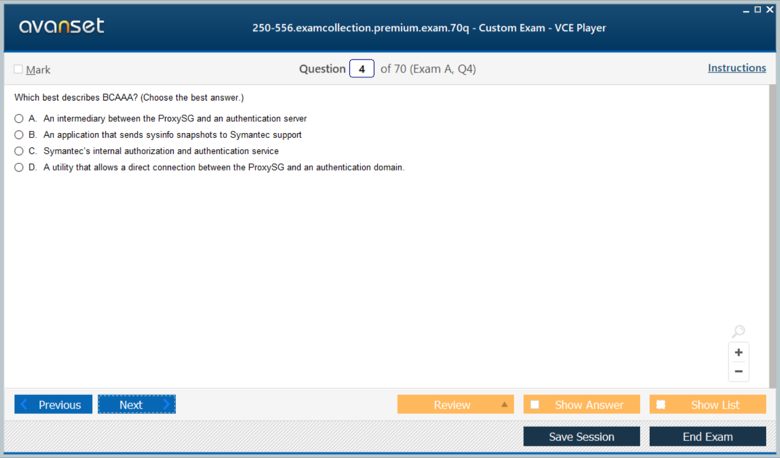
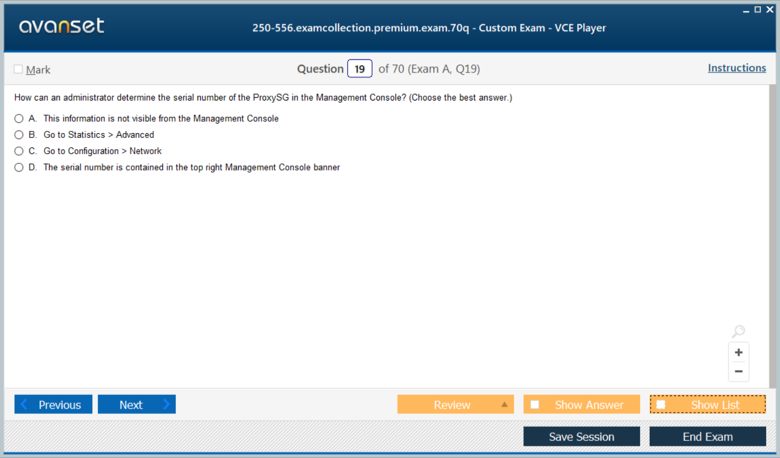
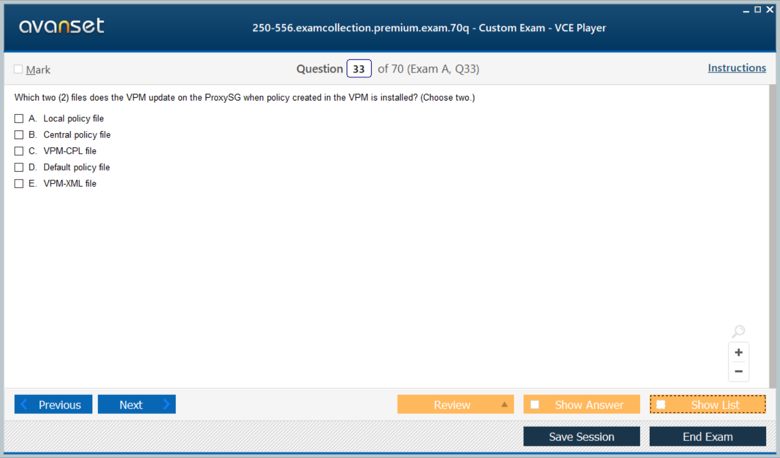
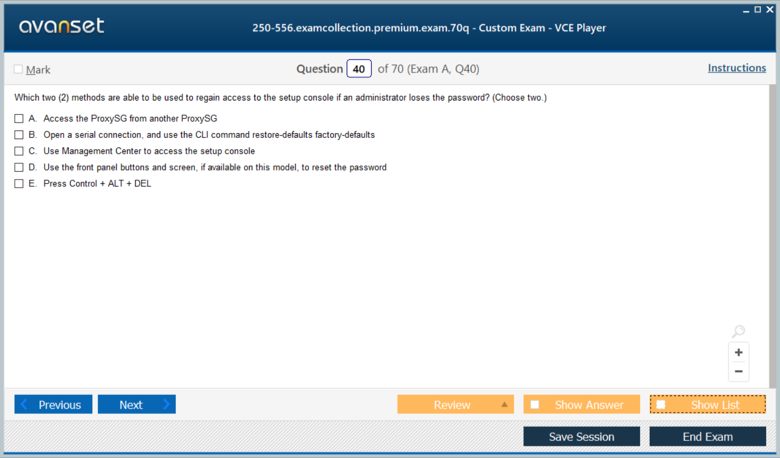
Symantec 250-556 Practice Test Questions in VCE Format
| File | Votes | Size | Date |
|---|---|---|---|
File Symantec.prep4sure.250-556.v2026-07-31.by.ezra.35q.vce |
Votes 2 |
Size 34.93 KB |
Date Jul 31, 2026 |
Symantec 250-556 Practice Test Questions, Exam Dumps
Symantec 250-556 (Administration of Symantec ProxySG 6.7) exam dumps vce, practice test questions, study guide & video training course to study and pass quickly and easily. Symantec 250-556 Administration of Symantec ProxySG 6.7 exam dumps & practice test questions and answers. You need avanset vce exam simulator in order to study the Symantec 250-556 certification exam dumps & Symantec 250-556 practice test questions in vce format.
250-556 covered administration of Symantec ProxySG 6.7, an older secure web gateway platform that is no longer listed in Broadcom’s current certification catalog. The product lineage continues through newer Edge SWG training and exams, but the 6.7 certification should be treated as historical. Its value comes from the network-security model it teaches: explicit and transparent proxying, authentication, policy evaluation, SSL inspection, content controls, logging, and the operational behavior of a gateway placed directly in users’ web path.
The exam sits naturally inside the Symantec security portfolio, where web gateways were one layer among endpoint, data, messaging, and cloud controls. A secure web gateway is particularly instructive because it has to combine network engineering with policy. If traffic cannot reach the gateway, authentication cannot work. If TLS inspection is misconfigured, content may become invisible. If policy is too broad, business traffic can break even when the appliance itself is healthy.
For modern study, it is useful to connect the older ProxySG vocabulary with broader network security architecture. The commands and interface labels may change, but the underlying questions remain current: how traffic is intercepted, how identity is established, where policy is enforced, what encrypted sessions reveal, and how operators prove what happened when access fails.
ProxySG could be deployed in more than one network pattern, and the choice determines what the appliance can see and how clients behave. Explicit proxying directs client applications to the gateway deliberately, while transparent approaches intercept traffic through network design. Inline, WCCP-based, and other patterns create different dependencies on routing, switching, failover, and client configuration. Administrators need to understand those dependencies before touching policy.
Troubleshooting therefore begins with path verification. A browser error may be caused by DNS, routing, interception, service configuration, authentication, upstream connectivity, or policy. Good administrators trace the session through those layers instead of changing several controls at once. This is one reason secure web gateway work is as much networking as security: the appliance can enforce only on traffic that arrives in the expected protocol and deployment mode.
A ProxySG system exposes services for different protocols and connection methods. Administrators must understand listener behavior, destination handling, port expectations, and whether the service is explicit or transparent. A service that is disabled, bound incorrectly, or associated with the wrong interception method can make a healthy appliance appear unavailable to users.
The configuration should also reflect actual traffic rather than a collection of defaults. Enabling unnecessary services expands complexity and can create confusing policy paths. The operating principle is to keep the listening surface deliberate, document why each service exists, and test connectivity before introducing higher-level controls. Once the gateway receives the session consistently, policy and authentication troubleshooting becomes much more deterministic.
Web security policies are more useful when the gateway knows which user or group generated a request. ProxySG environments commonly integrated with enterprise identity systems and could use multiple authentication mechanisms depending on client, browser, network placement, and directory design. Administrators should understand the difference between challenging a user, relying on transparent identity integration, and creating authentication realms that map users into policy conditions.
Identity failures often look like policy failures. A user may be unexpectedly denied because the gateway did not receive credentials, the realm could not contact its authentication source, group membership did not resolve, or a browser could not use the intended method. Broader authentication protocol concepts help here because the gateway is participating in an identity exchange, not merely checking a username field.
ProxySG policy could express who is making a request, where the traffic is going, what category or protocol is involved, whether content should be allowed, and which actions should occur. Visual Policy Manager simplified many common tasks, while Content Policy Language offered a more explicit way to express logic. The important skill is understanding evaluation order and conditions rather than assuming that the most recently added rule automatically wins.
Policy should be designed around observable intent. A rule named “block risky sites” is not enough; an operator should know which categories, users, exceptions, and time conditions make it true. This improves troubleshooting because a denied request can be traced to a specific condition instead of an opaque policy set. It also reduces the chance that overlapping rules create inconsistent behavior across user groups.
Encrypted web traffic is central to secure gateway design because content controls are limited when the gateway cannot inspect the application payload. SSL/TLS interception allows a proxy to establish separate encrypted sessions and inspect the traffic in between, but that requires certificate trust, careful exception handling, and a clear understanding of applications that use certificate pinning or sensitive protocols.
Inspection must be governed, not simply enabled everywhere. Organizations may exclude financial, health, or other privacy-sensitive categories, and technical exceptions may be necessary for services that fail under interception. Administrators should understand the certificate chain and failure symptoms before changing policy. The wider security principles behind TLS and certificate handling remain useful because secure web gateways depend on correct trust relationships.
A web gateway can use URL categories, reputation, threat intelligence, file controls, and other signals to decide whether traffic should continue. The operator must know the difference between a category decision and a malware or reputation decision. Blocking every unfamiliar destination can create large business-impact exceptions, while allowing broad uncategorized traffic can weaken the control point.
Policy quality improves when category controls are combined with identity and purpose. A developer group may legitimately need access to resources that would be unnecessary for another department. Administrators should monitor denied requests, refine exceptions, and keep the policy understandable. This is the same principle found in firewall design: access rules should reflect a defensible business requirement rather than accumulate as unexplained one-off exceptions.
ProxySG access logs show what the gateway did with requests, while centralized reporting can reveal broader patterns across users, categories, response codes, and bandwidth. Administrators need to know where logs are generated, how they are transferred, what fields matter, and how to distinguish a policy denial from a network or origin-server failure. Without that evidence, troubleshooting becomes guesswork.
Logging also supports security investigation. A suspicious download or credential-phishing event may need to be correlated with endpoint or identity data. The discipline of network-security logging applies directly: timestamps, source identity, destination, action, and context are valuable only when collection is reliable and analysts understand what the device actually records.
A secure web gateway is in the critical path, so capacity and resilience cannot be treated as afterthoughts. Administrators should watch connection counts, CPU and memory pressure, disk behavior, bandwidth, authentication latency, policy complexity, and upstream response time. A slow user experience may originate on the gateway, but it can also be caused by DNS, origin servers, certificate validation, or external networks.
High-availability planning should include what happens during device failure, link failure, or maintenance. The failover design must preserve traffic flow without creating a bypass that silently removes security controls. Testing under representative load is more useful than assuming that a redundant topology is resilient because two appliances exist. Operational confidence comes from observing actual failover behavior and documented recovery steps.
Broadcom’s current certification catalog no longer lists 250-556. Newer Edge SWG administration is represented by later exam generations, while 250-589 captures a more recent R2 stage in that product evolution. Current candidates should verify Broadcom’s latest Edge SWG administration code directly before registering, while using 250-556 for historical ProxySG 6.7 concepts.
The durable study path is to understand the secure gateway model first: traffic interception, proxy services, identity, policy, TLS visibility, content controls, logging, and fault isolation. Then compare the historical ProxySG 6.7 implementation with current vendor documentation. That avoids a common mistake in legacy certification content—treating an old interface as current—while preserving the genuinely transferable networking and security knowledge behind the exam.
Caching and object-handling behavior are another reason proxy troubleshooting can be counterintuitive. A response may be served from cache, fetched from the origin, revalidated, or altered by policy depending on configuration and object state. Administrators should understand enough HTTP behavior to determine whether a problem is caused by the origin site, the gateway, or a cached representation. This becomes especially important when users report that one browser or one device sees a different result from another.
DNS is equally foundational. The gateway may need to resolve destinations independently of the client, and failures can affect health checks, policy decisions, and upstream connections. Operators should know which resolver the appliance uses and how to test name resolution separately from HTTP or TLS. A secure gateway cannot enforce reliably if basic network services are unstable.
Finally, backup and restore of appliance configuration should be part of routine operations. Policy files, certificates, license state, and system settings may all be needed after hardware replacement or a failed change. A recovery procedure should be tested before an emergency so the team knows which settings are portable, which depend on the specific appliance, and which secrets require separate protection.
A final operational skill is learning how to separate a policy problem from a content problem. If the gateway allows a request but the application still fails, the administrator should compare HTTP status, object handling, TLS state, upstream reachability, and browser behavior before creating an exception. Reproducing the same transaction with a controlled test account can show whether identity or group policy is involved. That method keeps troubleshooting evidence-driven and prevents a temporary access problem from becoming a permanent reduction in web-security coverage.
Go to testing centre with ease on our mind when you use Symantec 250-556 vce exam dumps, practice test questions and answers. Symantec 250-556 Administration of Symantec ProxySG 6.7 certification practice test questions and answers, study guide, exam dumps and video training course in vce format to help you study with ease. Prepare with confidence and study using Symantec 250-556 exam dumps & practice test questions and answers vce from ExamCollection.
Purchase Individually
Top Symantec Certification Exams
Site Search:

SPECIAL OFFER: GET 10% OFF

Pass your Exam with ExamCollection's PREMIUM files!
SPECIAL OFFER: GET 10% OFF
Use Discount Code:
MIN10OFF
A confirmation link was sent to your e-mail.
Please check your mailbox for a message from support@examcollection.com and follow the directions.

Download Free Demo of VCE Exam Simulator
Experience Avanset VCE Exam Simulator for yourself.
Simply submit your e-mail address below to get started with our interactive software demo of your free trial.