



Premium File
479 Q&A
$76.99$69.99
Checkpoint CCSE R80 156-315.80 Exam Questions & Answers, Accurate & Verified By IT Experts
Instant Download, Free Fast Updates, 99.6% Pass Rate
479 Questions & Answers
Last Update: Sep 12, 2026
$69.99
Checkpoint CCSE R80 156-315.80 Exam Screenshots
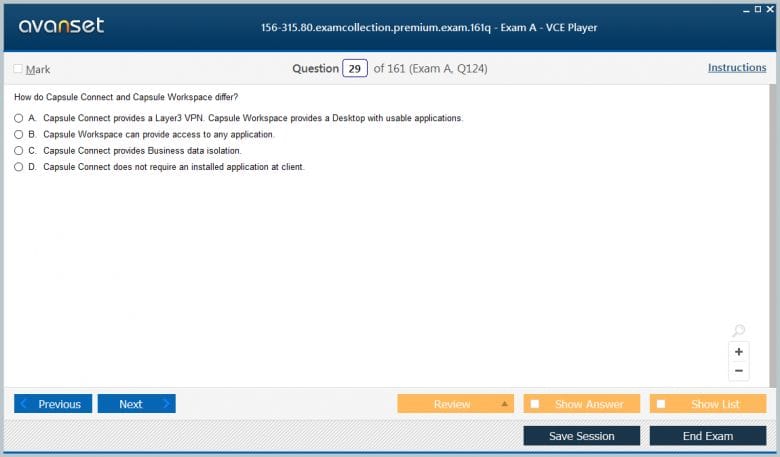
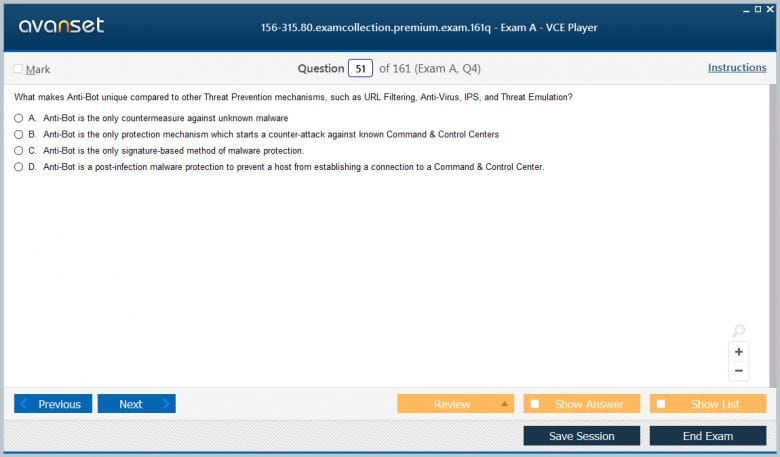
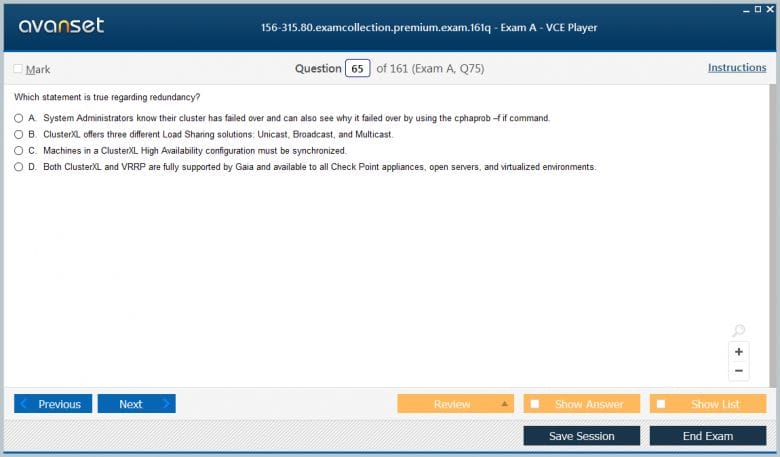
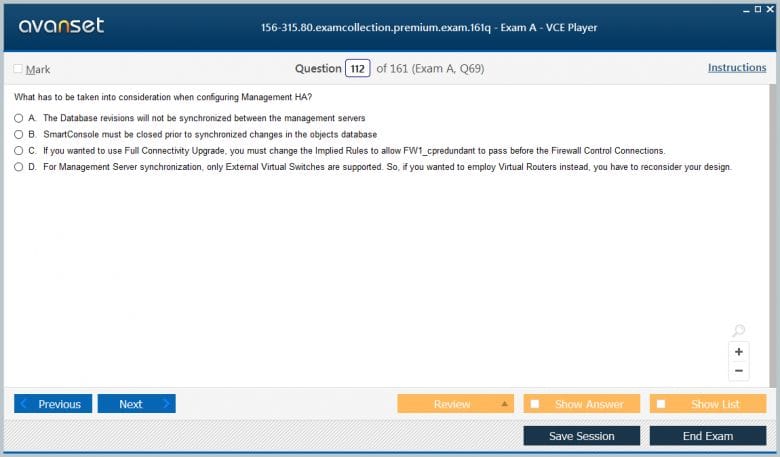
Checkpoint CCSE R80 156-315.80 Practice Test Questions in VCE Format
Checkpoint CCSE R80 156-315.80 Practice Test Questions, Exam Dumps
Checkpoint 156-315.80 (Check Point Certified Security Expert - R80) exam dumps vce, practice test questions, study guide & video training course to study and pass quickly and easily. Checkpoint 156-315.80 Check Point Certified Security Expert - R80 exam dumps & practice test questions and answers. You need avanset vce exam simulator in order to study the Checkpoint CCSE R80 156-315.80 certification exam dumps & Checkpoint CCSE R80 156-315.80 practice test questions in vce format.
Check Point 156-315.80 is the historical CCSE R80 exam. It belongs to the expert-level generation that followed CCSA R80 and focused on deeper management, gateway, VPN, clustering, troubleshooting, and operational tasks. Check Point’s current program has moved to CCSE R82 with exam 156-315.82, so the R80 code should be used as legacy technical context rather than a present-day scheduling target.
The value of R80 expert material is that many troubleshooting disciplines persist. An engineer still needs to understand packet flow, management communication, policy behavior, stateful clustering, VPN negotiation, logs, identity, upgrades, and failure isolation. What changes across releases are commands, interfaces, supported architectures, and feature behavior. Version labels therefore matter as much as the technical concept itself.
This page fits inside the broader Check Point certification ecosystem. Candidates maintaining R80-era systems can use the material to interpret older environments, while current certification candidates should use it to strengthen fundamentals before switching to R82-specific objectives.
CCSE-level troubleshooting requires more than knowing how to create a rule. Engineers need to understand how management services, databases, administrator access, policy compilation, gateway communication, and logging depend on one another. When policy installation fails, the root cause may be trust, connectivity, service health, or management state rather than the rule that was changed.
Develop a component map and use it during incidents. Identify which service or connection should carry the operation, then verify that path. This prevents broad restarts and rebuilds that destroy evidence. The same approach carries into current versions even though the specific processes and diagnostic tools may differ.
Secure Internal Communication is one of the trust mechanisms that connects management and gateways. When that trust fails, policy installation and management operations can break even though basic IP connectivity works. Expert troubleshooting should verify the trust state and underlying network path before reinitializing anything, because rebuilding trust can affect a working environment if done casually.
High availability protects service only when gateways agree on state and failover behaves as designed. Candidates should understand active and standby roles, synchronization, monitored interfaces, stateful connections, and the operational effect of maintenance. A cluster can appear healthy while application sessions still fail during a transition if state or routing assumptions are wrong.
Test failover deliberately in a lab. Record what traffic survives, which connections reset, how routes change, and what the management system reports. Treat high availability as a capability that must be validated, not as a box checked because two gateways exist.
Routing around the cluster is part of failover behavior. Upstream and downstream devices need to send traffic to the active member correctly, and return paths must remain compatible with stateful inspection. A cluster test that considers only member status can miss an external routing dependency that fails during a real outage. Include neighboring network behavior in the test plan.
A site-to-site VPN can fail during peer authentication, proposal negotiation, traffic-domain matching, routing, NAT, or ordinary firewall enforcement. Expert troubleshooting separates those stages. Confirm that the peers can communicate, inspect the negotiation state, verify encryption domains, and then observe protected traffic on both sides.
Cryptographic concepts help interpret the evidence. ExamCollection’s VPN security mechanisms provides broader context for tunnel establishment and protected traffic. Product expertise then adds the Check Point-specific objects, logs, and diagnostic state needed to identify where the exchange diverges from the design.
Remote-access VPN adds another dimension because client software, user authentication, endpoint posture, address assignment, and gateway policy can all influence the session. Expert analysis should separate whether the client established a secure channel from whether the authenticated user can reach the intended resource. Combining those questions can lead to unnecessary changes in the tunnel configuration.
An expert should be able to connect a packet to rule order, objects, services, NAT, identity, application context, and installed policy. When the observed result differs from the expected result, verify each assumption rather than immediately creating a bypass rule. Policy problems often become obvious once the actual object membership or translated address is compared with the design.
Logs are valuable, but they should be read alongside topology and packet evidence. An accepted connection can still fail because of routing, return traffic, application behavior, or a later security layer. The expert task is to narrow the fault domain until one change can be tested safely.
Kernel-level or low-level debugging should be used with a narrow question and a collection plan. Expert tools can generate large amounts of data and affect performance if used carelessly. Define the traffic, time window, gateway, and expected evidence before enabling deeper diagnostics. Stop collection as soon as the question is answered and preserve the output with the incident record.
Identity Awareness depends on acquisition sources, mappings, policy references, and gateway enforcement. Logging depends on event generation, transport, storage, indexing, and search. A failure in either chain can mislead an administrator. Candidates should learn to test each stage rather than assuming that a missing username or missing log proves the traffic never occurred.
Build a timeline with management changes, policy installations, gateway events, and user activity. This is especially useful during intermittent problems because it reveals whether the system state changed shortly before the symptom. Accurate time and consistent naming become practical troubleshooting controls rather than administrative details.
Log retention and indexing strategy affect how far back an investigator can reconstruct an event. Expert administrators should understand storage pressure, retention policy, log forwarding, and the operational cost of verbose logging. The goal is enough evidence to investigate security and availability events without overwhelming the management environment or losing the events that matter most.
Expert administrators are often responsible for version changes. A safe upgrade begins with compatibility checks, backups, configuration inventory, capacity review, maintenance planning, and a clear rollback decision point. The engineer should know which components must be upgraded together and which can operate temporarily in a mixed state.
Validation after an upgrade must cover more than successful login. Install policy, test critical traffic, verify VPNs, confirm cluster state, inspect logging, and compare key operational metrics with the pre-change baseline. A technically completed upgrade that silently breaks one business path is not a successful change.
Upgrade evidence should be retained after the maintenance window. Record versions, packages, migration logs, backups, policy-install results, cluster state, and validation tests. If a delayed problem appears days later, this record helps determine what changed. Good documentation also makes the next upgrade faster because the team has an accurate picture of dependencies and previous failure points.
High CPU, dropped traffic, delayed policy operations, or slow logging can have different causes. Candidates should collect system health, traffic volume, process information, interface statistics, and relevant logs before concluding that the firewall is overloaded. Performance analysis is strongest when it compares abnormal behavior with a known baseline.
Avoid changing multiple tunables during diagnosis. One change at a time preserves cause and effect. If the issue disappears after a restart, continue investigating why the state developed rather than treating the restart as the permanent fix. Expert operations aim to make the failure understandable and preventable.
Capacity planning should use trends, not one dramatic snapshot. Review growth in connections, throughput, logging, enabled inspection features, and peak resource use. An environment that is healthy at average load can fail during a seasonal peak or incident. Expert operations connect monitoring history with architecture decisions before the gateway reaches an emergency threshold.
The older CCSE R80 certification context explains where 156-315.80 fit in the program. Current candidates should instead prepare for 156-315.82 and the CCSE R82 objectives. Check Point’s current catalog should control exam-specific facts such as scope and scheduling.
For an experienced R80 engineer, the best transition method is comparative. Take each familiar task—policy troubleshooting, cluster failover, VPN diagnosis, logging, upgrades—and rebuild it in R82 using current documentation. This preserves hard-earned troubleshooting instincts while preventing obsolete commands or architecture assumptions from becoming current answers.
A current expert candidate should also revisit the administrator-level R82 foundation rather than jumping directly into advanced topics. Expert troubleshooting assumes that object behavior, policy installation, identity, NAT, logging, and gateway operations are already familiar. Weak fundamentals make advanced tools look more complicated because the candidate cannot tell whether the problem is ordinary administration or a genuinely expert-level failure.
Technology certifications age fastest at the interface and version-detail level, while good troubleshooting method lasts much longer. Define the symptom, establish a baseline, identify the responsible subsystem, collect evidence, test one hypothesis, and validate the result. Those habits are as relevant to R82 as they were to R80.
When reading 156-315.80 material, label every command, screenshot, and feature by version. Keep the architecture and reasoning that still apply, then replace outdated details with current references. That is the safest way to turn a legacy CCSE exam page into useful professional knowledge without presenting a retired generation as the live certification path.
Legacy labs are most valuable when paired with a current one. Reproduce a familiar R80 troubleshooting case, then solve the equivalent problem in R82 and compare the evidence available in each generation. This highlights which skills are genuinely transferable and which depend on a particular release. The result is a more durable expert mental model than either environment alone can provide.
Go to testing centre with ease on our mind when you use Checkpoint CCSE R80 156-315.80 vce exam dumps, practice test questions and answers. Checkpoint 156-315.80 Check Point Certified Security Expert - R80 certification practice test questions and answers, study guide, exam dumps and video training course in vce format to help you study with ease. Prepare with confidence and study using Checkpoint CCSE R80 156-315.80 exam dumps & practice test questions and answers vce from ExamCollection.
Purchase Individually
Top Checkpoint Certifications



Top Checkpoint Certification Exams
Site Search:

SPECIAL OFFER: GET 10% OFF

Pass your Exam with ExamCollection's PREMIUM files!
SPECIAL OFFER: GET 10% OFF
Use Discount Code:
MIN10OFF
A confirmation link was sent to your e-mail.
Please check your mailbox for a message from support@examcollection.com and follow the directions.

Download Free Demo of VCE Exam Simulator
Experience Avanset VCE Exam Simulator for yourself.
Simply submit your e-mail address below to get started with our interactive software demo of your free trial.
Great!, i Recommended Dump 90% more True !! i pass 967 / 1000
@belle22, as I have already found out, the dumps for 156-315.80 exam are just the best materials for prep! i used them after learning topics from books and found some concepts i haven’t grasped well… so i knew what i need to study and now my exam results are great! I recommend these exam dumps!
hello guys, i’m seeking preparation materials for this exam. are these 156-315.80 exam dumps good enough?
@Abel87, don’t worry, these Checkpoint 156-315.80 practice questions and answers are still valid. i can confirm that they are the most helpful materials I used during my preparation. i used them and then didn’t face any strange tasks on the main exam… these vce files will help you too, good luck☺
who knows whether these are the latest questions and answers for 156-315.80 exam? are they still helpful or i need to search for anything else?
@Luis_E, yes, these free 156-315.80 braindumps are still valid. they helped me pass my exam with ease. with the knowledge i gained from them, i was able to find my way through all the exam questions and achieved a very high score! thy will surely help you pass as well, simply study hard and dedicate enough time for your preparation!
can someone please comment on the vce files for Checkpoint 156-315.80 exam… are they still valid?
Hi all,
Is this validated or not, thanks
Is the dumps still valid?
Hey guy,
Do you know this dump is valid? Thanks