



Premium File
70 Q&A
$76.99$69.99
RSA 050-6201-ARCHERASC01 Exam Questions & Answers, Accurate & Verified By IT Experts
Instant Download, Free Fast Updates, 99.6% Pass Rate
70 Questions & Answers
Last Update: Oct 27, 2026
$69.99
RSA 050-6201-ARCHERASC01 Exam Screenshots
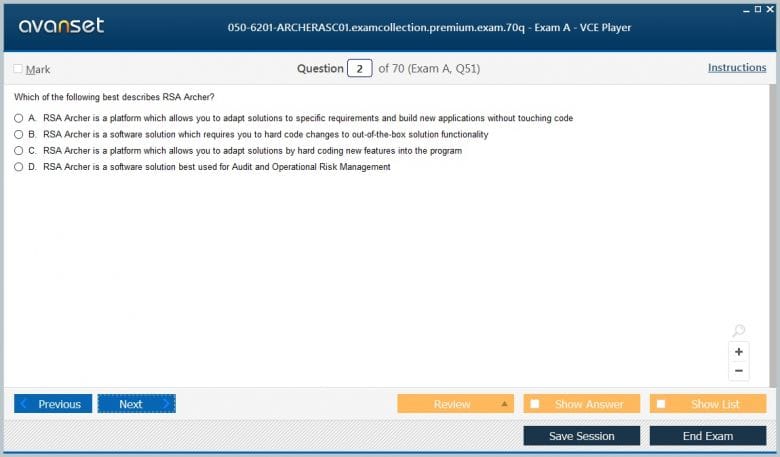
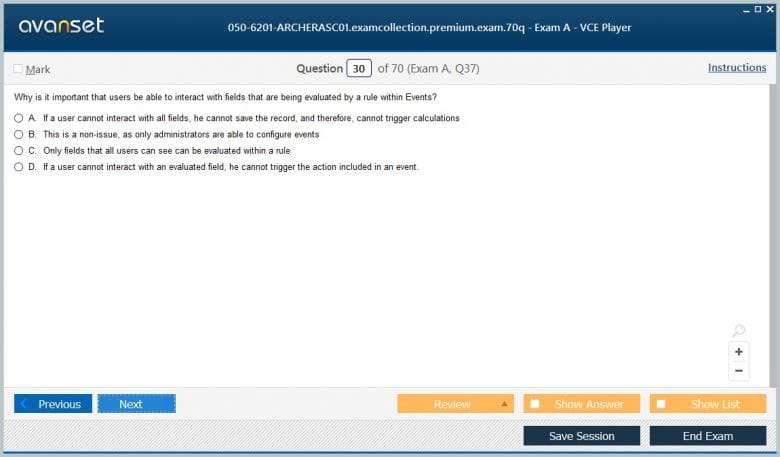
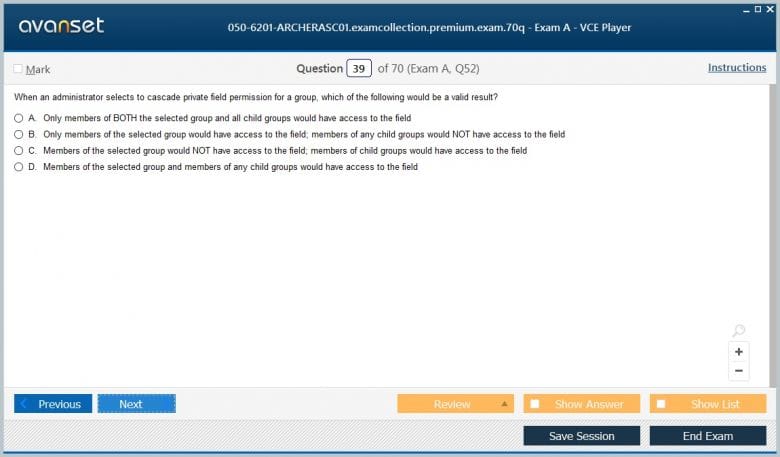
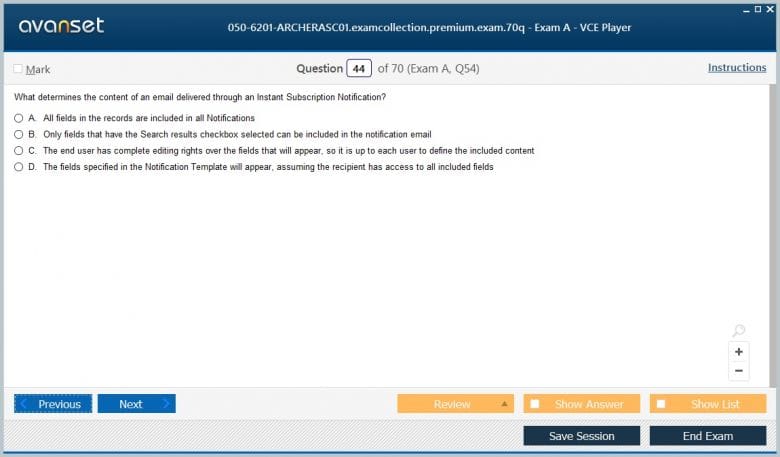
RSA 050-6201-ARCHERASC01 Practice Test Questions in VCE Format
| File | Votes | Size | Date |
|---|---|---|---|
File RSA.certkiller.050-6201-ARCHERASC01.v2026-10-12.by.hunter.36q.vce |
Votes 1 |
Size 45.88 KB |
Date Oct 12, 2026 |
File RSA.Testking.050-6201-ARCHERASC01.v2019-03-09.by.Hugo.30q.vce |
Votes 4 |
Size 36.83 KB |
Date Mar 12, 2019 |
RSA 050-6201-ARCHERASC01 Practice Test Questions, Exam Dumps
RSA 050-6201-ARCHERASC01 (RSA Archer Associate Exam) exam dumps vce, practice test questions, study guide & video training course to study and pass quickly and easily. RSA 050-6201-ARCHERASC01 RSA Archer Associate Exam exam dumps & practice test questions and answers. You need avanset vce exam simulator in order to study the RSA 050-6201-ARCHERASC01 certification exam dumps & RSA 050-6201-ARCHERASC01 practice test questions in vce format.
The 050-6201-ARCHERASC01 RSA Archer Associate exam belongs to the older RSA-era Archer certification program. Historical exam guides describe a 70-question, 85-minute, closed-book Pearson VUE exam with a 70 percent passing score. That format should not be confused with Archer’s current certification program, which has been redesigned and delivered directly through Archer Academy since 2021.
Archer now uses three platform certification levels: Archer Certified Associate, Archer Certified Administrator – Specialist, and Archer Certified Administrator – Expert. Archer’s current program overview says the modern Administrator – Specialist level is roughly equivalent to the former Associate exam. This makes 050-6201-ARCHERASC01 a useful legacy code, but not the current way to describe or schedule the modern Archer Associate credential.
The old exam remains valuable as a map of foundational Archer administration. Within the RSA certifications, it sits beside older administrator credentials such as 050-v5x-CAARCHER01. The technical themes—applications, records, access, dashboards, reporting, notifications, and workflow—still help explain how a governance, risk, and compliance platform is operated.
Archer is used to turn risk, compliance, audit, third-party, policy, and other governance processes into structured data and workflows. Instead of managing those processes through disconnected spreadsheets and email, organizations can define applications with fields, records, relationships, permissions, notifications, and reports that reflect the way work is supposed to move.
GRC software tools are easiest to understand when every configuration decision is tied to a governance outcome: what information must be captured, who owns it, who may see it, what action follows, and how the organization proves the process occurred. Archer administration translates that governance model into concrete platform configuration.
An administrator can create many fields quickly, but a useful application needs a coherent model. Text, numeric, date, list, user/group, calculated, attachment, relationship, and other field types each carry different behavior. Naming, required status, default values, help text, and relationships influence both data quality and the user experience.
Poor design creates long-term maintenance problems. Duplicate fields, ambiguous labels, uncontrolled free text, and weak relationships make reporting difficult. Before adding a field, decide what business question it answers, who supplies the value, whether the value should be constrained, and how it will be used in workflow or reporting.
Governance platforms contain sensitive information, so access cannot be an afterthought. Archer administrators need to understand how users, groups, roles, record permissions, and application privileges combine. A user may need to create records in one application, review only assigned items in another, and see aggregate reporting without receiving access to every underlying record.
Permission troubleshooting should be systematic. Confirm the user’s group memberships, role assignments, application privileges, record-level permissions, and any field-level restrictions before changing security. Broadly granting access to solve one complaint can expose unrelated risk or audit data. Least privilege is easier to maintain when permissions are based on stable business roles rather than individual exceptions.
A governance system becomes useful when users can see what requires attention. Workspaces and dashboards organize reports, charts, metrics, and navigation around a role or process. A risk owner may need overdue assessments and high residual risks; an audit manager may need issue status; an executive may need trends and exposure by business unit.
Dashboard design should start from decisions, not from available widgets. Each element should answer a question and lead the user toward the underlying records when action is required. Too many charts can obscure priorities, while a small set of well-defined metrics can make the platform part of daily operations rather than a repository visited only before audits.
Archer reporting can summarize, group, filter, and calculate information across governance records. Administrators should understand the difference between a report that is technically correct and one that is meaningful. A risk count without a date boundary, ownership filter, status definition, or denominator may produce a visually attractive but misleading metric.
Validate reports against known records. Check inclusion and exclusion logic, null values, permissions, and the timing of data updates. When a report is used for management or regulatory evidence, document the definition of each metric so that the same number means the same thing across reporting periods.
Governance workflows depend on people completing reviews, approvals, assessments, and remediation. Notifications can prompt those actions, but excessive email trains users to ignore the platform. Administrators should trigger messages when they change behavior: assignment, approaching due date, overdue status, approval request, escalation, or significant state change.
Good notifications contain context and a clear next action. The recipient should know which record is affected, why the message was sent, what is expected, and when it is due. Communication rules should also respect ownership so that a change in assignment does not continue sending reminders to the wrong person.
Historical Archer Associate objectives included data-driven events and workflow concepts. The practical idea is to react to record state. A field value, status, score, date, or relationship can trigger an action such as updating another field, sending a notification, assigning work, or moving the record into the next stage.
Automation needs guardrails. Rules should avoid loops, hidden side effects, and conditions that are difficult to reproduce. Administrators should test both the trigger and the cases in which the trigger should not fire. A workflow that works only for the expected path can create stranded records when users enter data in an unanticipated order.
Archer’s 2026 program documentation explains that exams are now delivered through Archer Academy, are open book, use 70 questions in 90 minutes, and cost 100 training credits or $100 by credit card. Current certifications expire after two years. Those facts describe the modern program and should not be retroactively attached to the 050-6201-ARCHERASC01 Pearson VUE exam.
The distinction is particularly important because Archer changed the meaning of “Associate.” The modern Level 1 Associate is aimed at business users and other professionals with hands-on platform experience, while the modern Administrator – Specialist is described as roughly equivalent to the former Associate exam. Readers searching the old code need this translation to avoid choosing the wrong present-day level.
For legacy 050-6201-ARCHERASC01 study, organize preparation around navigation, solution concepts, applications and records, access roles and groups, workspaces, dashboards, reports, notifications, data-driven events, and workflow. Build sample scenarios such as an issue-management process or third-party assessment and explain how data, permissions, reporting, and automation support the process end to end.
For a current certification attempt, use Archer Academy’s present exam-preparation guidance instead of assuming the old RSA blueprint still applies. The old code can inform foundational study, but the modern level structure, exam delivery, resources, and feature set are controlled by Archer’s current program.
The lasting skill is translating governance requirements into a maintainable platform. Administrators should know not only where a configuration option sits but why the organization needs it, how users will interact with it, how permissions protect it, and how reporting proves the process works. That reasoning survives certification redesigns and product ownership changes.
Data import and integration deserve the same modeling discipline as manual records. External feeds can create or update large numbers of records quickly, which magnifies mapping mistakes. Administrators should define keys, required fields, update behavior, error handling, and ownership before enabling recurring imports. A successful file transfer is not enough if it creates duplicates or bypasses workflow expectations.
Calculated values and scoring can make risk information easier to prioritize, but formulas should be transparent. Users need to know what drives a score, how missing values are handled, and whether a threshold triggers downstream action. Hidden or overly complex calculations undermine trust, especially when the result influences executive reporting, audit findings, or remediation priorities.
Application changes should be promoted with controlled testing. A field rename, permission change, workflow edit, or report filter can affect many records and users. Maintain a representative test set, validate permissions from multiple roles, and confirm existing data behaves as expected before production release. GRC platforms are often treated as configuration rather than software, but their change impact can be just as significant.
Archiving and retention should reflect governance requirements rather than convenience. Some records must remain accessible for audit or regulatory periods; others may contain personal or sensitive data that should not be retained indefinitely. Administrators need to understand the organization’s policy and design the application lifecycle accordingly. Keeping everything forever is not a neutral decision.
Current Archer candidates should also use the open-book format intelligently. Open book does not mean there is enough time to research every question from scratch. Familiarity with the platform and with the structure of Archer Help makes reference material useful for confirmation rather than discovery. The strongest preparation combines hands-on practice with knowing where authoritative documentation lives.
Administrator maturity also means resisting unnecessary customization. Archer can be configured deeply, but every bespoke field, rule, report, and exception creates future maintenance. Before implementing a special case, ask whether the requirement can be met with an existing pattern or shared component. Consistency improves user learning, reporting, security review, and upgrade testing. A GRC platform should encode the organization’s governance model clearly, not reproduce every historical spreadsheet exception inside a more powerful system.
Hands-on practice should include troubleshooting permissions from a normal user account rather than only from an administrator session. A configuration can look correct to the builder while the intended reviewer cannot see a record or complete a workflow step. Testing through realistic personas exposes access and usability problems before they become production support issues.
Go to testing centre with ease on our mind when you use RSA 050-6201-ARCHERASC01 vce exam dumps, practice test questions and answers. RSA 050-6201-ARCHERASC01 RSA Archer Associate Exam certification practice test questions and answers, study guide, exam dumps and video training course in vce format to help you study with ease. Prepare with confidence and study using RSA 050-6201-ARCHERASC01 exam dumps & practice test questions and answers vce from ExamCollection.
Purchase Individually
Site Search:

SPECIAL OFFER: GET 10% OFF

Pass your Exam with ExamCollection's PREMIUM files!
SPECIAL OFFER: GET 10% OFF
Use Discount Code:
MIN10OFF
A confirmation link was sent to your e-mail.
Please check your mailbox for a message from support@examcollection.com and follow the directions.

Download Free Demo of VCE Exam Simulator
Experience Avanset VCE Exam Simulator for yourself.
Simply submit your e-mail address below to get started with our interactive software demo of your free trial.