



Premium File
1826 Q&A
$76.99$69.99
AHIMA RHIA Exam Questions & Answers, Accurate & Verified By IT Experts
Instant Download, Free Fast Updates, 99.6% Pass Rate
1826 Questions & Answers
Last Update: Sep 03, 2026
$69.99
AHIMA RHIA Exam Screenshots
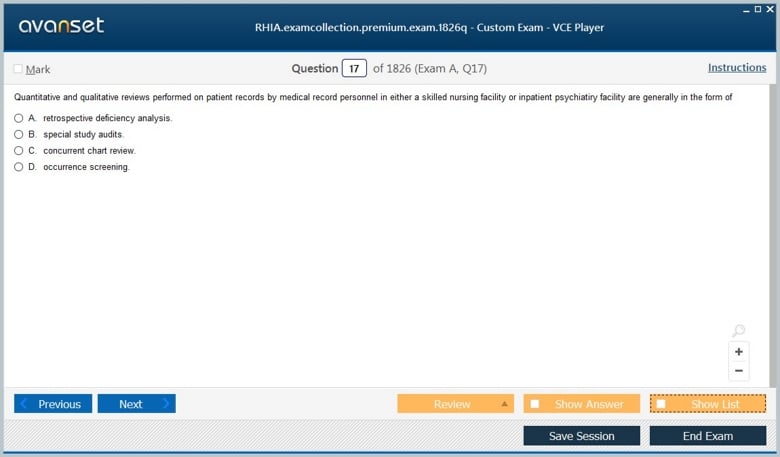
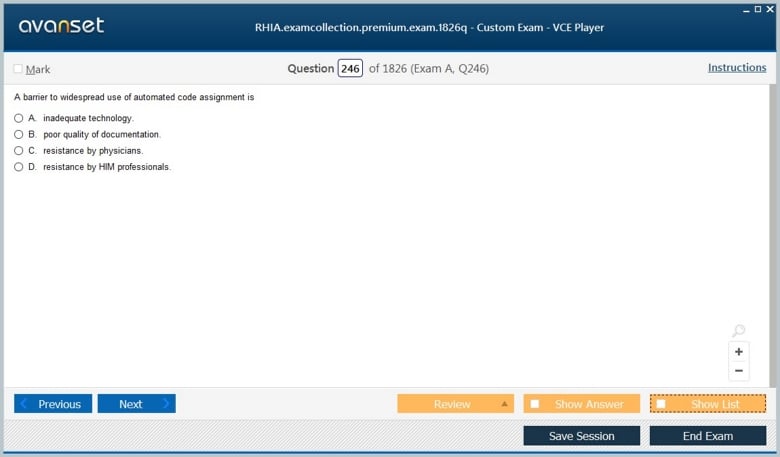
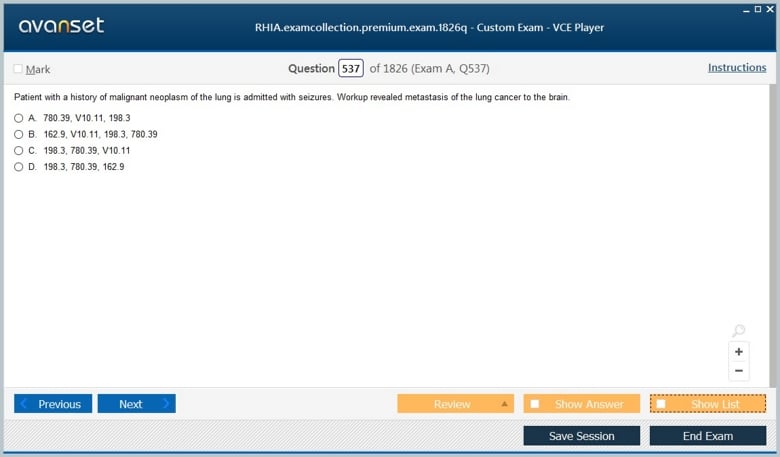
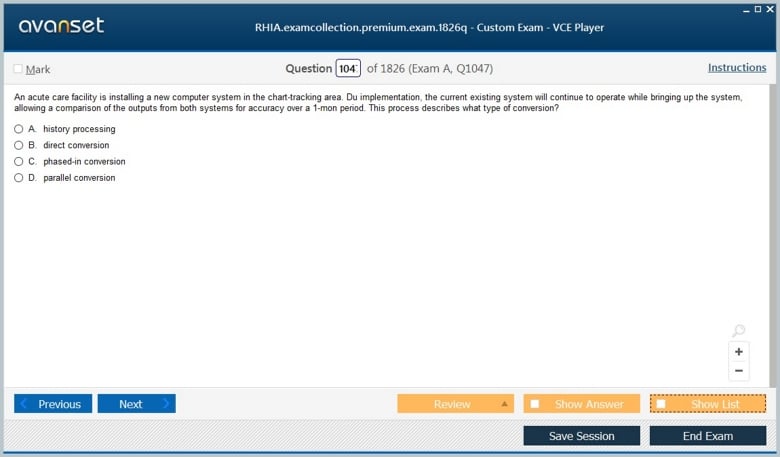
AHIMA RHIA Practice Test Questions in VCE Format
| File | Votes | Size | Date |
|---|---|---|---|
File AHIMA.selftesttraining.RHIA.v2026-02-26.by.niamh.1096q.vce |
Votes 1 |
Size 4.03 MB |
Date Feb 26, 2026 |
File AHIMA.Pass4sures.RHIA.v2019-02-12.by.Tony.760q.vce |
Votes 3 |
Size 2.03 MB |
Date Feb 15, 2019 |
AHIMA RHIA Practice Test Questions, Exam Dumps
AHIMA RHIA (Registered Health Information Administrator) exam dumps vce, practice test questions, study guide & video training course to study and pass quickly and easily. AHIMA RHIA Registered Health Information Administrator exam dumps & practice test questions and answers. You need avanset vce exam simulator in order to study the AHIMA RHIA certification exam dumps & AHIMA RHIA practice test questions in vce format.
The Registered Health Information Administrator credential is designed for professionals who manage health information as an enterprise asset rather than as a single coding or records task. RHIA candidates are expected to understand governance, privacy, access and disclosure, data quality, analytics, informatics, revenue-cycle relationships, leadership, and the systems that make health information usable across clinical and business operations. The breadth is the point: the credential tests whether a professional can connect information policy to operational reality.
AHIMA currently lists the RHIA examination at 150 total questions, including 130 scored items and 20 pretest items, with three hours and thirty minutes of testing time and a scaled passing score of 300. The active blueprint is organized around Data and Information Governance; Compliance with Access, Use, and Disclosure of Health Information; Data Analytics and Informatics; Revenue Cycle Management; and Management and Leadership. Eligibility is tied to qualifying CAHIIM-accredited health information management education pathways, so candidates should verify their academic route before registering.
The wider AHIMA certifications provide career context. RHIA also overlaps with CDIP when documentation quality, coding integrity, and data use intersect, but RHIA is deliberately broader. A useful study plan therefore avoids turning the exam into either a coding test or a privacy test; both are important, but they sit inside a larger information-governance role.
Data governance establishes accountability for definitions, quality, access, retention, ownership, and appropriate use. In health care that work spans clinical documentation, registries, billing data, master data, patient identity, research, reporting, and many other uses. RHIA candidates should understand how policies, standards, stewardship roles, committees, and escalation paths combine to turn broad governance principles into repeatable organizational behavior.
Exam scenarios can make governance look like a technology problem when the deeper issue is accountability. Duplicate patient identities, inconsistent data definitions, or uncontrolled spreadsheet reporting may require technical correction, but durable improvement also needs a named owner, common definitions, monitoring, and a process for resolving exceptions. The RHIA perspective asks how the organization keeps the corrected state from degrading again.
Health information professionals routinely balance access against protection. A request may come from a treating provider, patient, payer, attorney, researcher, public-health authority, or internal employee, and the correct response depends on the purpose and applicable authority. Candidates need to distinguish access rights, permitted uses and disclosures, authorization requirements, restrictions, accounting obligations, and organizational safeguards without reducing every scenario to “HIPAA allows it” or “HIPAA forbids it.”
The minimum-necessary principle is especially useful because it forces a practical question: what information does this person or process actually need for the permitted purpose? Exceptions matter, but the reasoning habit helps candidates analyze disclosure scenarios systematically. Strong preparation also includes breach response, role-based access, sanction policies, and documentation of disclosure decisions so that privacy is implemented operationally rather than treated as a legal abstraction.
Accuracy, completeness, consistency, timeliness, validity, accessibility, and uniqueness are common data-quality dimensions, but their importance varies by use case. A slightly delayed demographic update may affect outreach; an incorrect allergy can threaten patient safety; a mismatched diagnosis code can distort reimbursement or quality reporting. RHIA work therefore connects data-quality controls to the consequence of failure.
Candidates should practice selecting the right corrective mechanism. Some errors are resolved through validation rules, others through master-data governance, workflow redesign, staff education, reconciliation, or source-system correction. A dashboard that reports bad data more quickly does not solve the source defect. The exam rewards professionals who can recognize both the information symptom and the process that produces it.
RHIA professionals increasingly work with descriptive, diagnostic, predictive, and operational analytics. They may define measures, validate data sources, interpret trends, or help leaders understand limitations in a dataset. The key skill is not advanced statistical programming; it is knowing whether a measure is valid for its stated purpose and whether the underlying information supports the conclusion being drawn.
For study, take a hospital metric such as length of stay, denial rate, readmission, coding turnaround, or chart completion and trace it from source data to definition, calculation, visualization, and decision. Ask what could bias the measure and what denominator is appropriate. This makes analytics concrete and reinforces why governance, quality, and informatics belong in the same RHIA blueprint.
Health information rarely stays in one application. Data moves through electronic health records, interfaces, billing systems, registries, patient portals, analytics platforms, and external exchanges. RHIA candidates should understand the governance consequences of interoperability: patient matching, standardized vocabularies, metadata, data provenance, interface errors, access controls, and change management all affect whether exchanged information remains trustworthy.
The practical question is often where a defect originates. If a report contains missing values, the source may be incomplete documentation, an interface mapping, a transformation rule, or a reporting filter. Health information administrators do not need to be interface developers to investigate effectively, but they do need enough systems literacy to ask the right questions and coordinate clinical, technical, and operational teams.
RHIA candidates need to understand how registration, documentation, coding, charge capture, claim submission, payment, denial management, and follow-up interact. Errors early in the cycle can appear later as rejected claims, delayed payment, inaccurate reporting, or compliance risk. The health information function often sits at the point where clinical facts are translated into administrative and financial representations.
Preparation should focus on causes rather than memorizing department names. A denial may stem from missing authorization, coding, insufficient documentation, medical-necessity policy, payer edits, or incorrect patient information. The RHIA role is often to help determine which process failed, what data proves the cause, and what control can prevent recurrence while preserving compliant reimbursement.
Health information leaders manage people, budgets, vendors, projects, priorities, and organizational change. They also influence clinicians, finance teams, compliance staff, IT, executives, and external partners who may not report to them. Effective leadership therefore depends on translating information risks into terms each stakeholder can act on and on designing workflows that are realistic enough to sustain.
Exam scenarios may test staffing, conflict resolution, performance management, change implementation, or project prioritization. The best answer usually reflects both the technical requirement and the human system around it. A correct policy that staff cannot interpret or an efficient workflow that violates privacy is not a successful management outcome.
A strong RHIA practice case begins with an organizational problem rather than a domain label. Consider a new data-sharing initiative, a rise in denials, a privacy incident, an unreliable dashboard, or a patient-identity problem. Identify the governance owner, relevant access rules, data-quality risks, analytics implications, revenue-cycle effects, and leadership actions. The exercise reveals where memorized definitions fail to support integrated reasoning.
Missed questions should be classified by decision error. Did you choose a technology solution before defining governance? Confuse a permitted disclosure with unrestricted access? Accept a metric without validating its denominator? Treat a revenue problem as purely coding-related? Those patterns are more valuable than the individual answer because they predict what will happen on a new scenario.
AHIMA uses a two-year recertification cycle, reflecting how quickly health information practice evolves. Privacy expectations, interoperability rules, analytics capabilities, payment models, artificial intelligence, data governance, and organizational technology continue to change. Credential maintenance is most useful when continuing education follows those changes instead of merely accumulating hours near the end of a cycle.
The RHIA credential is strongest as a framework for professional judgment. It signals that the holder can manage information across technical, regulatory, financial, and leadership boundaries. Candidates who study with that integrated purpose are better prepared not only for the exam but also for the real work of keeping health information accurate, available, protected, and useful.
Preparation also benefits from reviewing information governance as an enterprise service rather than an HIM-department possession. Patient identity, access control, data definitions, retention, release of information, analytics, and revenue-cycle data all cross organizational boundaries. The RHIA professional often succeeds by creating common rules and then coordinating the people who own different parts of the workflow. This perspective helps with scenarios where no single department can solve the problem alone.
Candidates should pay attention to evidence of control effectiveness. A policy may exist, yet audit results, incident trends, access logs, data-quality reports, or turnaround metrics may show that it is not working. The correct management response is to investigate the gap between policy and practice, identify root cause, and select a corrective action that can be measured. This prevents governance from becoming a paperwork exercise.
Finally, use the current AHIMA blueprint to balance study time. The largest domain is not automatically the one an individual candidate needs most practice in, but the weighting prevents a study plan from overinvesting in familiar areas while neglecting analytics, leadership, access and disclosure, or revenue-cycle concepts. A candidate should be able to move between all five domains because real health-information problems rarely stay inside one category.
Go to testing centre with ease on our mind when you use AHIMA RHIA vce exam dumps, practice test questions and answers. AHIMA RHIA Registered Health Information Administrator certification practice test questions and answers, study guide, exam dumps and video training course in vce format to help you study with ease. Prepare with confidence and study using AHIMA RHIA exam dumps & practice test questions and answers vce from ExamCollection.
Purchase Individually
Top AHIMA Certification Exams
Site Search:

SPECIAL OFFER: GET 10% OFF

Pass your Exam with ExamCollection's PREMIUM files!
SPECIAL OFFER: GET 10% OFF
Use Discount Code:
MIN10OFF
A confirmation link was sent to your e-mail.
Please check your mailbox for a message from support@examcollection.com and follow the directions.

Download Free Demo of VCE Exam Simulator
Experience Avanset VCE Exam Simulator for yourself.
Simply submit your e-mail address below to get started with our interactive software demo of your free trial.