



Premium File
198 Q&A
$76.99$69.99
DMI PDDM Exam Questions & Answers, Accurate & Verified By IT Experts
Instant Download, Free Fast Updates, 99.6% Pass Rate

PDDM Premium File: 198 Questions & Answers
Last Update: Oct 24, 2026
PDDM PDF Study Guide: 445 Pages
$74.99
DMI PDDM Exam Screenshots
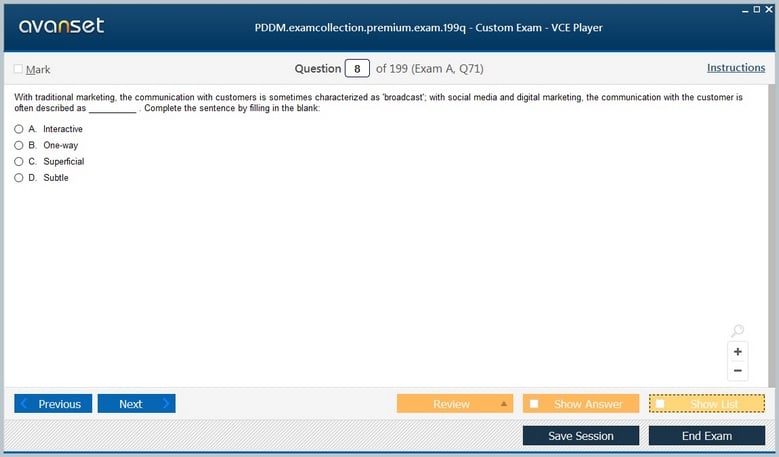
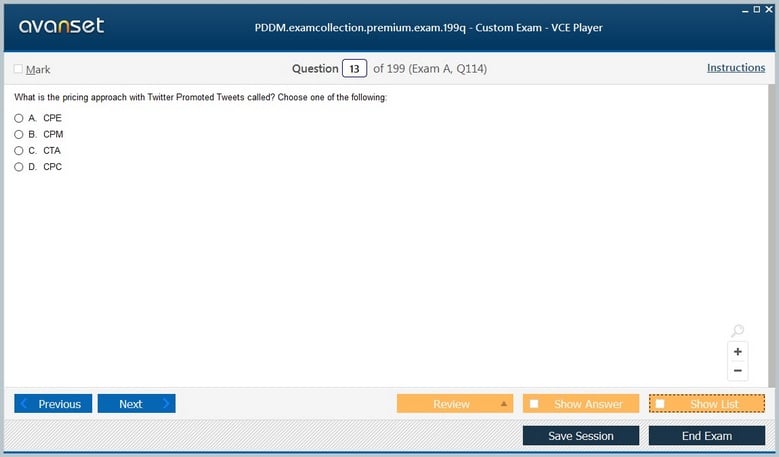
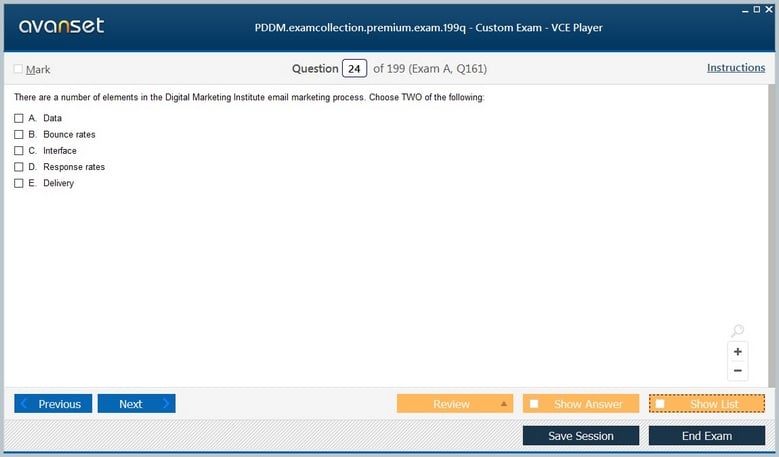
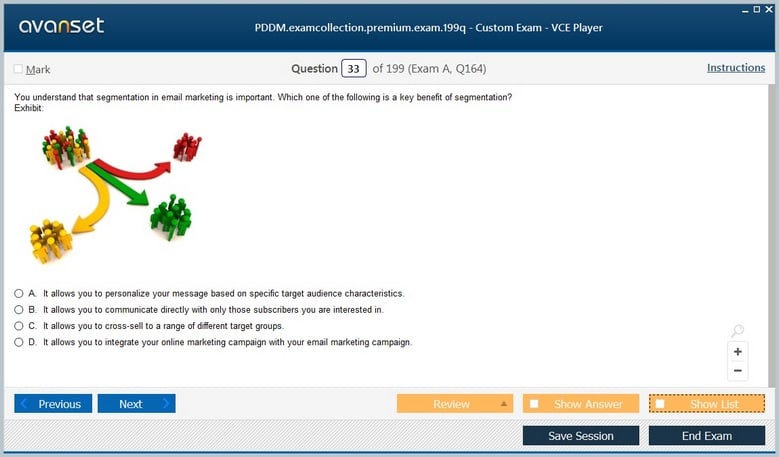
DMI PDDM Practice Test Questions in VCE Format
| File | Votes | Size | Date |
|---|---|---|---|
File DMI.test4prep.PDDM.v2026-07-26.by.ellie.109q.vce |
Votes 1 |
Size 2.68 MB |
Date Jul 27, 2026 |
File DMI.Test-inside.PDDM.v2019-03-19.by.Eric.108q.vce |
Votes 2 |
Size 2.29 MB |
Date Mar 21, 2019 |
DMI PDDM Practice Test Questions, Exam Dumps
DMI PDDM (Professional Diploma in Digital Marketing) exam dumps vce, practice test questions, study guide & video training course to study and pass quickly and easily. DMI PDDM Professional Diploma in Digital Marketing exam dumps & practice test questions and answers. You need avanset vce exam simulator in order to study the DMI PDDM certification exam dumps & DMI PDDM practice test questions in vce format.
DMI PDDM Professional Diploma in Digital Marketing is an older exam/catalog identifier associated with the Digital Marketing Institute’s professional-level marketing program. DMI still markets a Professional Diploma in Digital Marketing, but its current DMI Pro path awards the Certified Digital Marketing Professional credential, commonly shown as CDMP. Current public DMI pages do not present PDDM as the active certification code, so the useful way to study the historical PDDM identifier is to separate the historical identifier from the modern curriculum and credential name.
The subject itself has become broader, not narrower. A modern digital marketer is expected to understand strategy, audience research, content, search, paid media, social platforms, email, analytics, conversion, automation, and increasingly AI-assisted workflows. The professional skill is not mastery of one advertising interface. It is the ability to coordinate channels around measurable business goals.
The broader Digital Marketing Institute certifications give the historical PDDM material its natural context. A candidate looking at PDDM today should prepare for current DMI Pro concepts and verify current assessment details directly with DMI rather than assuming an archived code defines the present exam experience.
Digital marketing plans often fail because they start with channels instead of objectives. “We need more social media” is not a strategy. The marketer first needs to define the outcome—revenue, qualified leads, retention, subscriptions, brand reach, product adoption, or another measurable result—and then identify the audience behavior that can influence it.
Objectives should connect to metrics that can actually guide decisions. Traffic can be useful, but traffic without intent may not improve the business. Conversion rate, cost per acquisition, lifetime value, lead quality, repeat purchase, assisted conversions, and incrementality can reveal whether marketing activity changes behavior rather than merely generating activity.
A good strategy also states assumptions. Which audience has the problem? What value proposition should resonate? Which channels can reach them efficiently? What evidence would show the hypothesis is wrong? That discipline keeps digital marketing from becoming a sequence of disconnected campaigns.
Segmentation helps marketers distinguish groups with different needs, behaviors, value, and barriers. Demographics can be useful, but behavioral and intent signals often provide more actionable insight. Search behavior, site engagement, purchase history, content consumption, and lifecycle stage can change both message and media choice.
Personas are useful when they summarize evidence rather than stereotypes. A good persona describes goals, constraints, common objections, information sources, decision criteria, and the journey from awareness to purchase or advocacy. It should guide creative and content decisions, not become decorative documentation.
The most important habit is to keep research connected to testing. Audience beliefs should be validated through campaign data, interviews, analytics, experiments, and sales feedback. Digital channels produce rapid signals, but those signals only become useful when the marketer knows what question the data is supposed to answer.
Content marketing creates useful material for people at different stages of a decision. Search marketing helps that material become discoverable when users express intent. The connection matters: keyword research can reveal questions and demand, while strong content can satisfy that demand and build authority over time.
Search optimization includes technical accessibility, page structure, relevance, site structure, performance, and the quality of the answer provided. It is not simply repeating a keyword. The page should match search intent, make the information easy to understand, and give users a credible next step.
The experience described in hands-on digital marketing training is relevant here because professional development becomes valuable when theory is connected to real campaign work, analytics, and practical platform decisions.
Paid search, display, video, and paid social can create rapid reach, but they expose weak strategy quickly. Bidding, targeting, creative, landing-page quality, and conversion tracking all affect efficiency. A marketer should know what a conversion is worth before deciding what a click is worth.
Campaign structure should reflect intent and measurement needs. Highly specific groups can improve relevance but become difficult to manage at scale. Broad targeting can give algorithms room to learn but may waste budget when conversion signals are weak. The right structure depends on data volume, creative variety, audience size, and business risk.
Attribution deserves caution. Platforms often claim credit using different models, and last-click reporting can hide earlier influence. Marketers should compare platform reporting with analytics, controlled tests, and business results rather than assuming one dashboard provides the complete causal story.
Social platforms combine organic publishing, community management, paid distribution, creator relationships, customer service, and social listening. The strategy should reflect why the audience uses each platform. Content that works in a professional network may feel out of place in a short-form entertainment feed.
Consistency matters, but consistency should not mean repetition. A content system can reuse a core idea across formats while adapting tone, length, visual treatment, and call to action. Instagram marketing fundamentals illustrate how profile design, engagement, and platform-native content all contribute to performance.
Community signals can also inform product and campaign decisions. Questions, complaints, comments, and sharing behavior reveal what the audience understands, values, and resists. Marketers who treat social only as distribution miss a valuable source of qualitative insight.
Email remains powerful because it can connect communication to known customer relationships. Segmentation, trigger logic, frequency, consent, deliverability, and message relevance all influence results. A large list is not automatically an asset if recipients do not expect or value the communication.
Automation can support onboarding, abandoned-cart recovery, lead nurturing, renewal, reactivation, and service communication. The strongest workflows use behavior and lifecycle stage to decide what happens next. marketing automation is most effective when it reduces irrelevant messaging rather than simply increasing message volume.
Measurement should extend beyond open rates. Revenue, qualified actions, unsubscribe rate, complaint rate, progression through the funnel, and incremental lift provide a more complete view of whether automation is helping the customer relationship.
Digital marketing becomes much easier to improve when campaigns are treated as testable hypotheses rather than collections of activity. A team should be able to state what audience it is trying to influence, what behavior it expects to change, which message or offer should create that change, and which measurement would count as meaningful evidence. That discipline prevents vanity metrics from becoming the main definition of success.
The journey should also be measured across stages. Reach and impressions describe exposure, but they do not explain whether the right people engaged. Clicks and sessions show response, but they do not prove commercial value. Leads, qualified opportunities, transactions, repeat purchases, retention, and lifetime value reveal progressively more about whether marketing is creating useful demand. The right metric depends on the decision being made.
Attribution deserves particular caution. Last-click reporting is easy to understand but can over-credit the final interaction and ignore awareness or consideration activity that happened earlier. Multi-touch models can add nuance, yet they also depend on identity resolution, tracking quality, consent, and platform visibility. A good marketer therefore treats attribution as a model with assumptions rather than as a perfect record of causality.
Experiment design helps separate correlation from improvement. A landing-page test, email subject test, audience test, or bidding change should alter one important variable where possible and define the success metric before results are reviewed. Sample size, seasonality, campaign overlap, and short measurement windows can all produce misleading conclusions. The goal is not statistical theater; it is enough rigor to avoid making expensive decisions from noise.
Finally, reporting should connect observations to action. A dashboard that shows declining conversion but does not prompt investigation of traffic quality, offer relevance, page friction, or technical errors is incomplete. Useful analysis explains what changed, why that change matters commercially, what evidence supports the interpretation, and what the team will test next. That decision-oriented mindset remains central even as specific advertising and analytics platforms change.
Data quality deserves its own attention because dashboards can be precise and still be wrong. Duplicate tags, broken campaign parameters, consent changes, bot traffic, payment-domain transitions, and cross-device behavior can distort metrics. Marketers should therefore validate important events against real user journeys and business systems rather than assuming the analytics interface is automatically authoritative.
That habit also improves collaboration with technical teams. When marketers can describe the event, user action, expected value, and business purpose clearly, developers and analysts can instrument it more reliably. Measurement then becomes shared infrastructure for decision making instead of a reporting layer added after campaigns launch.
Digital analytics should answer business questions: where valuable users come from, what they do, where journeys break, which campaigns add value, and which experiments change outcomes. Clean event definitions and consistent naming are essential because poor measurement can make sophisticated analysis meaningless.
Dashboards are useful when they surface decisions, not when they maximize the number of charts. A professional marketer should be able to move from a KPI change to a hypothesis, segment the data, test possible explanations, and recommend an action. That requires statistical humility as well as platform fluency.
DMI’s modern program also reflects the growing role of AI. AI can accelerate research, drafting, segmentation ideas, and analysis, but marketers still need governance, brand judgment, source validation, and measurement. The PDDM code is historical; the professional capability it represented has become more data-driven and more integrated.
Go to testing centre with ease on our mind when you use DMI PDDM vce exam dumps, practice test questions and answers. DMI PDDM Professional Diploma in Digital Marketing certification practice test questions and answers, study guide, exam dumps and video training course in vce format to help you study with ease. Prepare with confidence and study using DMI PDDM exam dumps & practice test questions and answers vce from ExamCollection.
Purchase Individually

Site Search:

SPECIAL OFFER: GET 10% OFF

Pass your Exam with ExamCollection's PREMIUM files!
SPECIAL OFFER: GET 10% OFF
Use Discount Code:
MIN10OFF
A confirmation link was sent to your e-mail.
Please check your mailbox for a message from support@examcollection.com and follow the directions.

Download Free Demo of VCE Exam Simulator
Experience Avanset VCE Exam Simulator for yourself.
Simply submit your e-mail address below to get started with our interactive software demo of your free trial.