



Premium File
170 Q&A
$76.99$69.99
Guidance Software GD0-100 Exam Questions & Answers, Accurate & Verified By IT Experts
Instant Download, Free Fast Updates, 99.6% Pass Rate
170 Questions & Answers
Last Update: Sep 27, 2026
$69.99
Guidance Software GD0-100 Exam Screenshots
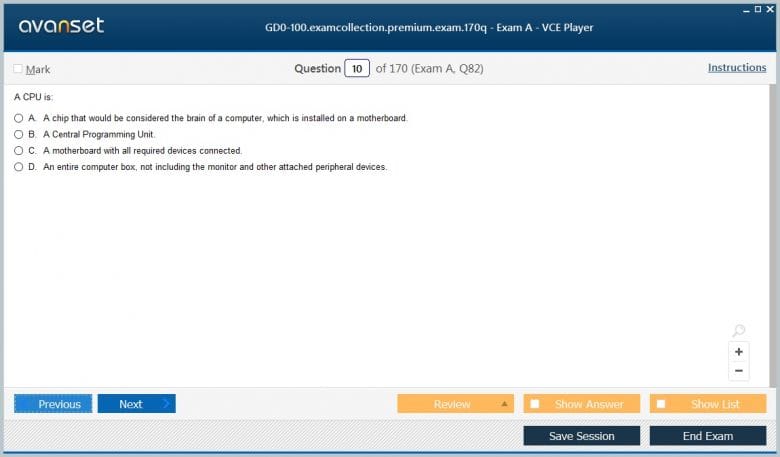
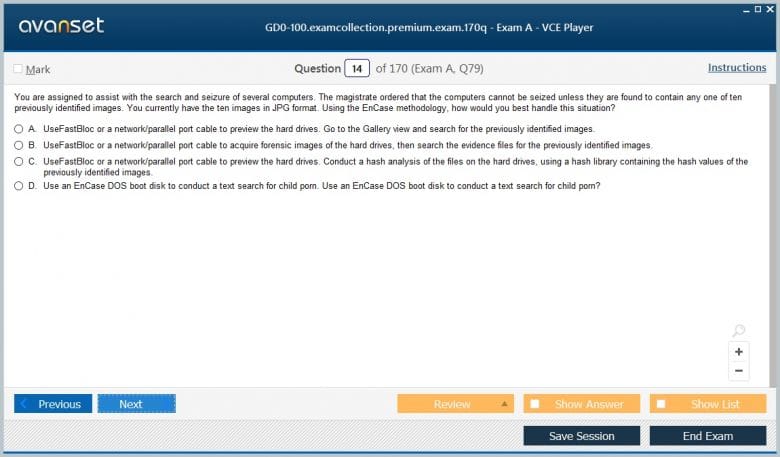
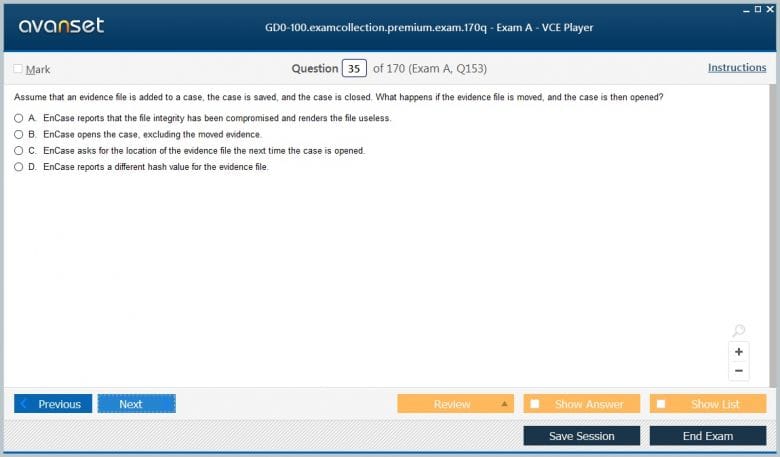
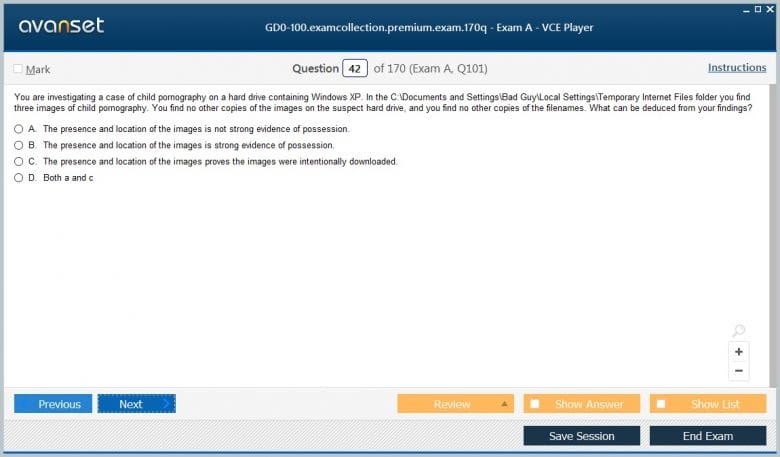
Guidance Software GD0-100 Practice Test Questions in VCE Format
| File | Votes | Size | Date |
|---|---|---|---|
File Guidance Software.practicetest.GD0-100.v2026-07-16.by.lucas.77q.vce |
Votes 1 |
Size 72.44 KB |
Date Jul 16, 2026 |
Guidance Software GD0-100 Practice Test Questions, Exam Dumps
Guidance Software GD0-100 (Certification For ENCE North America) exam dumps vce, practice test questions, study guide & video training course to study and pass quickly and easily. Guidance Software GD0-100 Certification For ENCE North America exam dumps & practice test questions and answers. You need avanset vce exam simulator in order to study the Guidance Software GD0-100 certification exam dumps & Guidance Software GD0-100 practice test questions in vce format.
GD0-100 is a legacy Guidance Software exam code associated with the EnCase Certified Examiner (EnCE) credential in North America. The code still appears in older preparation material, but the current certification is administered under OpenText, which acquired and evolved the EnCase business. OpenText continues to offer EnCE in 2026, yet its current certification process is described as a two-phase program rather than a publicly promoted GD0-100 booking code. Candidates should therefore separate the historical exam identifier from the live EnCE requirements.
OpenText’s current EnCE program requires either 64 hours of authorized computer-forensics training or 12 months of work experience in computer forensics before application. After approval, candidates take a written Phase I exam and, if successful, a practical Phase II examination. This current process is more authoritative for new candidates than an old GD0-100 question count. The Guidance Software exams page is useful as historical vendor context, while preparation should emphasize enduring forensic methodology and modern OpenText EnCase practice.
The current EnCE program is not simply a software-navigation test. OpenText describes it as validation that an examiner has mastered computer-investigation methodology and the use of EnCase during complex examinations. That distinction matters because reliable forensics depends on evidence handling, acquisition, validation, analysis, interpretation, documentation, and reporting. A practitioner who can click through a tool without understanding evidence integrity is not performing defensible forensic work.
Preparation should therefore combine procedural discipline with technical skill. Candidates need to understand how to preserve source evidence, create working copies, validate acquisitions, document actions, distinguish facts from interpretations, and explain findings so another examiner can reproduce the reasoning. The product assists the investigation; it does not replace examiner judgment.
Chain of custody supports the history of evidence handling. Records should identify the item, who collected or transferred it, when custody changed, where it was stored, and which procedures were performed. The exact documentation process depends on organizational and legal requirements, but the purpose is consistent: demonstrate that the evidence examined can be connected to the item originally collected.
OpenText currently requires approved training or practical experience before the EnCE application can proceed. After application approval, the current testing fee is $500 and Phase I is delivered through Certiverse. Candidates have two hours for the written phase and need an 80 percent passing score. Those who pass receive an electronic license for Phase II, an 18-question practical examination with a 60-day completion window and an 85 percent passing score.
This structure means a 2026 candidate should not assume that historical GD0-100 logistics—such as old third-party question totals, delivery vendors, or region labels—still describe the live program. The EnCE process now uses OpenText’s current application and Certiverse-based Phase I workflow, followed by the timed practical phase. Candidates should still verify the latest application, payment, retest, and renewal rules directly with OpenText before scheduling preparation time or purchasing training.
Examiners should understand when to create a forensic image, how to document source media, how write blocking reduces the risk of modification, and how cryptographic hashes help verify that acquired data remains unchanged. The forensic disk-imaging process illustrates the broader principles even when a different tool is used: acquire deliberately, record the method, validate the result, and preserve the original whenever possible.
Acquisition choices depend on the case. A dead-box disk image provides a stable view of storage but may miss volatile memory and live network state. A live collection can capture ephemeral evidence while also changing the system. Examiners should be able to justify the acquisition order based on volatility, legal authority, business impact, and investigative objectives.
Acquisition planning should also consider encryption and locked devices. Shutting a system down may protect disk state while making encrypted data inaccessible if keys were only present in memory. Leaving it running preserves volatile state but can allow background activity to change evidence. Examiners must weigh those consequences under the authority and procedures of the case rather than applying one acquisition rule to every system.
Forensic tools can parse partitions, file systems, metadata, deleted entries, registry structures, browser history, link files, logs, and many other artifacts. The examiner’s task is to understand what an artifact proves and what it does not. A timestamp may reflect creation, modification, access, metadata change, synchronization, extraction, or another event depending on the file system and application.
Timelines become powerful when multiple independent artifacts corroborate one another. A file event, user login, USB insertion, browser download, and execution trace may together support a stronger conclusion than any single artifact. Candidates should practice building explanations from multiple sources and recording uncertainty when timestamps or metadata can have several causes.
Deleted data requires careful language. A deleted directory entry or recoverable file fragment does not automatically establish when deletion occurred or who performed it. File-system behavior, application history, journaling, and surrounding artifacts may provide additional context. Reports should distinguish recovered content from proven user actions and avoid converting a technical possibility into a categorical conclusion.
Volatile memory may contain running processes, network connections, injected code, decrypted content, credentials, command history, or malware artifacts that never reach persistent storage. The RAM-forensics workflow reinforces why order of volatility matters. If a system can be examined live within legal and operational constraints, memory acquisition may preserve evidence that disappears at shutdown.
Memory evidence also requires careful interpretation. Process names can be spoofed, network connections can be short-lived, and recovered strings may be remnants rather than active values. Analysts should correlate volatile findings with disk artifacts, logs, endpoint telemetry, and case context. A strong forensic conclusion usually rests on multiple consistent observations rather than one dramatic string found in memory.
USB artifacts may help show that a storage device was connected, when it appeared, which account was active, and what identifiers the operating system recorded. The USB forensic analysis process can be useful in insider-threat, data-loss, or policy investigations. Examiners should avoid overclaiming: device connection alone does not prove that a particular file was copied.
User-activity reconstruction often combines registry data, shortcut files, recent documents, shell artifacts, browser history, application logs, and file-system metadata. The value comes from correlation. If several artifacts support the same sequence and the examiner can explain alternative interpretations, the timeline becomes more defensible.
Keyword searching can locate relevant names, terms, identifiers, or fragments across allocated and unallocated space, but hits need context. A string may occur in a deleted file, cache, slack space, binary structure, or unrelated document. Recovery and carving can reconstruct files from data patterns, yet the absence of original metadata may limit what can be claimed about source path, timestamps, or ownership.
The broader computer-forensics toolkit is useful because no single technique answers every question. Examiners should validate tool results, understand parser limitations, and preserve notes showing how a relevant artifact was located. When a finding is important, reproducing it with another method or manually verifying the underlying structure can strengthen confidence.
Hash sets and known-file filtering can reduce noise by identifying common operating-system or application files, but investigators should understand the source and purpose of the set. A known-good match can help deprioritize a file; it does not mean the entire system is clean. Conversely, an unknown hash is not evidence of malware. Context determines investigative value.
A forensic report should state the authority and scope of the examination, evidence received, acquisition and validation methods, relevant findings, limitations, and conclusions supported by the evidence. Technical detail should be sufficient for another qualified examiner to understand the work without burying decision-makers in every artifact examined. Screenshots can support a report, but the reasoning and underlying evidence matter more than presentation.
The digital-forensics professional context explains why credibility depends on repeatable process. Current EnCE candidates should practice complete cases: acquire evidence, validate it, analyze artifacts, build a timeline, preserve notes, and write a concise report. That workflow prepares for both the written knowledge phase and the practical demands that distinguish the modern EnCE program from a legacy GD0-100 label.
Current OpenText materials state that EnCE certification is valid for three years. Renewal currently costs $250 when the process begins before expiration; once the credential has expired, OpenText requires the holder to restart the EnCE process from Phase I and the full $500 certification price applies. That reinforces the difference between a living certification program and an old exam code. New candidates should prepare for the current written-plus-practical structure, while historical GD0-100 materials can be used only when their technical content still aligns with present EnCase methodology and tooling.
Practical preparation should include peer review. Have another examiner reproduce a key finding from your notes without verbal guidance. If they cannot locate the artifact, understand the acquisition source, or follow the reasoning, the documentation is not yet strong enough. This exercise improves both examination discipline and report clarity before a real case or practical certification assessment.
Forensics also intersects with incident response, but the priorities can differ. Responders may need to contain a threat quickly, while examiners may prioritize preserving evidence and documenting state. The digital forensics and incident-response relationship is useful preparation because practitioners must know when speed, preservation, or business continuity should dominate and who has authority to make that decision.
Evidence storage and case closure deserve attention too. Working copies, exported artifacts, notes, reports, and temporary analysis files should be retained or disposed of according to case policy and legal requirements. Sensitive evidence should not linger on analyst workstations simply because the investigation ended. A disciplined closeout preserves what must remain, documents disposition, and reduces the risk that forensic data creates a new privacy or security problem.
Go to testing centre with ease on our mind when you use Guidance Software GD0-100 vce exam dumps, practice test questions and answers. Guidance Software GD0-100 Certification For ENCE North America certification practice test questions and answers, study guide, exam dumps and video training course in vce format to help you study with ease. Prepare with confidence and study using Guidance Software GD0-100 exam dumps & practice test questions and answers vce from ExamCollection.
Purchase Individually
Site Search:

SPECIAL OFFER: GET 10% OFF

Pass your Exam with ExamCollection's PREMIUM files!
SPECIAL OFFER: GET 10% OFF
Use Discount Code:
MIN10OFF
A confirmation link was sent to your e-mail.
Please check your mailbox for a message from support@examcollection.com and follow the directions.

Download Free Demo of VCE Exam Simulator
Experience Avanset VCE Exam Simulator for yourself.
Simply submit your e-mail address below to get started with our interactive software demo of your free trial.