



Premium File
200 Q&A
$76.99$69.99
EMC E20-375 Exam Questions & Answers, Accurate & Verified By IT Experts
Instant Download, Free Fast Updates, 99.6% Pass Rate
200 Questions & Answers
Last Update: Sep 06, 2026
$69.99
EMC E20-375 Exam Screenshots
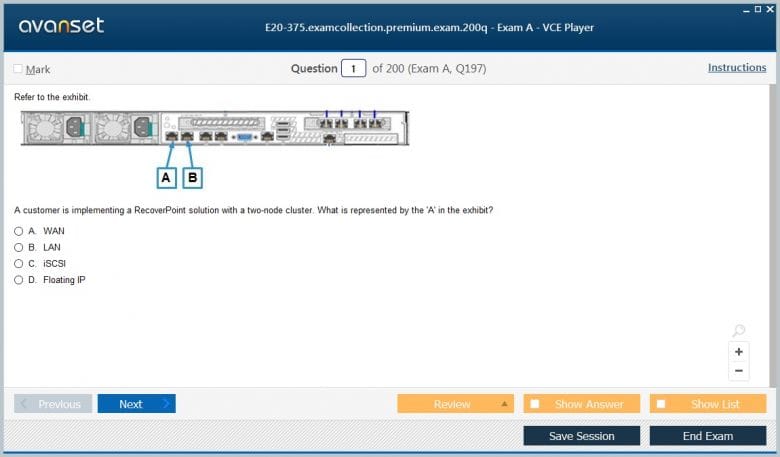
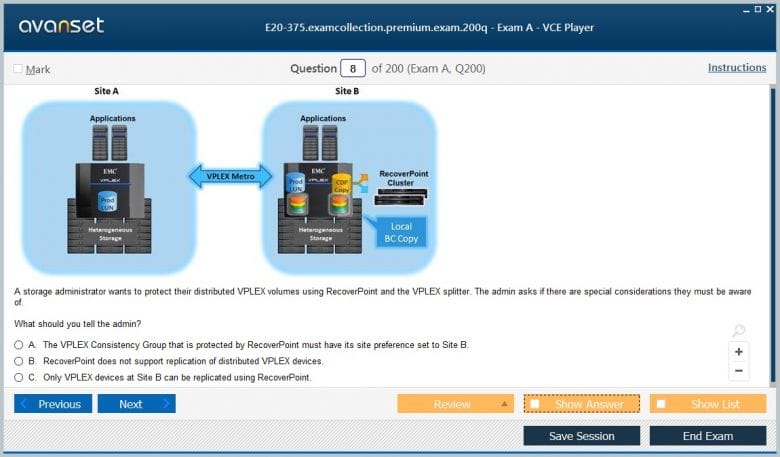
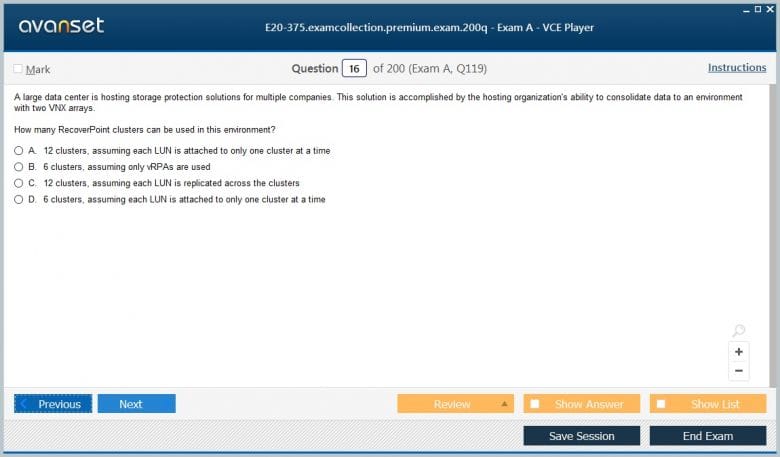
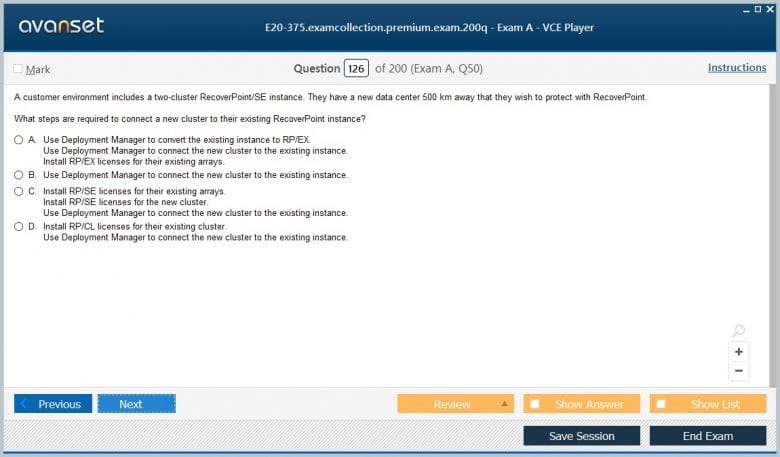
EMC E20-375 Practice Test Questions in VCE Format
| File | Votes | Size | Date |
|---|---|---|---|
File EMC.Train4sure.E20-375.v2026-07-18.by.Anthony.122q.vce |
Votes 3 |
Size 126.68 KB |
Date Jul 21, 2026 |
File EMC.selftestengine.E20-375.v2015-03-19.by.Cruz.200q.vce |
Votes 6 |
Size 356.61 KB |
Date Mar 19, 2015 |
EMC E20-375 Practice Test Questions, Exam Dumps
EMC E20-375 (RecoverPoint Specialist for Implementation Engineers) exam dumps vce, practice test questions, study guide & video training course to study and pass quickly and easily. EMC E20-375 RecoverPoint Specialist for Implementation Engineers exam dumps & practice test questions and answers. You need avanset vce exam simulator in order to study the EMC E20-375 certification exam dumps & EMC E20-375 practice test questions in vce format.
E20-375 was Dell EMC’s RecoverPoint Specialist Exam for Implementation Engineers. Dell’s exam description listed a 90-minute assessment of roughly 60 questions with a 63% passing score. The blueprint focused on deploying physical and virtual RecoverPoint appliances, configuring storage arrays and write splitting, connecting clusters, expanding environments, managing consistency groups, and troubleshooting the resulting replication system.
The exam is no longer current. Dell retired E20-375 on February 2, 2024 and migrated the role to the Dell RecoverPoint Deploy achievement, D-RP-DY-A-24. That makes the old exam a historical guide to implementation skills rather than a booking target. The wider EMC certifications preserve the older lineage, while current candidates should verify the active Dell assessment path before planning study.
RecoverPoint protects application data by capturing writes and transferring them through RecoverPoint appliances to protected copies. The exact integration method depends on the storage environment, but the core concept is consistent: intercept the writes that matter, preserve write order, move data to the copy, and maintain journal information that allows the environment to return to useful points in time.
Implementation engineers need this data-flow model before touching installation tools. If a replication problem appears later, the model helps isolate whether writes are being split correctly, whether appliances are communicating, whether journals are healthy, or whether the remote copy is unable to receive or apply data. Understanding the flow turns troubleshooting from guesswork into a sequence of verifiable stages.
A RecoverPoint deployment should begin with recovery requirements rather than appliance counts. Recovery point objective influences how much data loss the business is willing to tolerate. Recovery time objective influences how quickly a protected workload must be made usable. Change rate, available bandwidth, latency, retention expectations, journal sizing, storage capacity, and the number of protected consistency groups all shape the technical design.
Those requirements need to be collected before installation because replication cannot overcome impossible network or capacity assumptions after the fact. An application with a high write rate and a narrow WAN link may need different retention or topology choices. A workload with strict consistency requirements may need applications grouped and tested together. Broader disaster-recovery planning principles reinforce the same lesson: recovery architecture should be driven by business objectives and tested behavior, not by the mere presence of a replication product.
The E20-375 blueprint included both physical and virtual RecoverPoint Appliances. Physical appliances depend on rack, power, network, SAN, and array connectivity. Virtual appliances depend on the virtualization environment, compute resources, virtual networking, and supported storage integration. Both require management configuration and reliable communication with peer appliances or clusters.
The implementation engineer should document addresses, ports, cluster identity, supported software levels, and connectivity before deployment. Installation should be followed by health validation rather than immediate production onboarding. Confirm that appliances see the expected arrays, networks, and peer components, and resolve warnings before creating protection relationships. A clean initial state makes later troubleshooting much easier.
RecoverPoint relies on a splitter or supported array integration to capture writes. The historical blueprint expected implementation knowledge across arrays such as VNX, VMAX, Unity, XtremIO, and VPLEX. Each platform can have different preparation, licensing, zoning, host, or integration requirements, which means the engineer must follow product-specific procedures instead of assuming a universal configuration.
This is a critical dependency. If the splitter is missing, unhealthy, or configured for the wrong volumes, replication can fail even when the appliances themselves appear healthy. Implementation validation should therefore trace a protected write end to end: confirm that the production volume is correctly integrated, the write is captured, the appliance receives it, and the copy advances as expected. That evidence is stronger than relying on a single dashboard status.
RecoverPoint clusters have to communicate reliably locally and remotely. Deployment Manager historically helped with installation and cluster connection tasks, while the implementation blueprint also covered EX and CL deployment patterns and cluster expansion. The engineer needs to understand which networks carry management, replication, and storage traffic and how a failure in each path presents operationally.
Do not scale the deployment while foundational connectivity remains uncertain. Protect a small test workload, observe replication behavior, and exercise basic recovery functions first. Once the cluster behaves predictably, expand protection in controlled stages. This approach limits the number of variables introduced at once and provides a working reference configuration when a later onboarding task fails.
Cluster expansion should be treated as a capacity and resiliency change, not simply an appliance-count increase. The engineer needs to verify software compatibility, resource balance, network reachability, repository and journal dependencies, and the effect on existing consistency groups. Expansion work is safer when pre-change health is documented, because a warning that existed before the change should not be mistaken for a new fault introduced by the additional RPA.
A consistency group defines a set of volumes protected together under common replication behavior. The grouping should follow application write dependencies, not arbitrary storage ownership. If a database and its logs must remain crash-consistent together, the protection design needs to preserve that relationship. Distributed consistency groups extend the idea when applications span a wider set of resources.
Implementation engineers should work with application owners to identify which volumes belong together, what recovery points matter, and how failover will be validated. A technically healthy replication session is not enough if the recovered application cannot start or data sets are out of sync. Test recoveries are therefore part of implementation quality, not an optional task left entirely to operations.
RecoverPoint provides snapshots, bookmarks, image access, failover, failback, and other recovery workflows depending on the environment. These capabilities are valuable because replication alone does not tell an administrator which copy or point in time is safe to use after corruption. Journals provide historical points, but the recovery process still needs application-aware validation.
A good implementation includes documented test procedures. Create a controlled change, verify that it reaches the copy, identify a prior point in the journal, test access to that image, and confirm the application can be validated without damaging the production path. More general backup and recovery planning illustrates the same operational principle: a protection design is only credible when restoration has been exercised.
Recovery testing should include both technical and ownership decisions. Someone must know who is authorized to expose a copy, who validates application consistency, when a test image can be discarded, and how production protection is restored after the exercise. These controls prevent a recovery test from becoming a new source of risk. They also help distinguish a platform-level success—such as making an image accessible—from a business-level success in which the application and its dependent services actually function.
A useful rehearsal should test more than whether a copy can be exposed. Teams should verify application startup order, host access, name or address dependencies, write authority, validation checks, and the decision point for returning to normal protection. The exercise should end with replication healthy again and documentation updated, because a recovery test that leaves the protection topology ambiguous creates a new operational risk.
The E20-375 blueprint included system-analysis and troubleshooting tasks because replication failures cross infrastructure boundaries. A problem may come from appliance health, storage-array integration, WAN quality, splitter state, journal capacity, cluster communication, or host behavior. The engineer should correlate events rather than fixating on whichever interface first displayed an alarm.
Use logs, alerts, CLI output, deployment diagnostics, array status, and network evidence to determine the failing stage of the data path. When a workaround or software change is support-directed, document that boundary rather than normalizing an undocumented modification. Troubleshooting should result not only in a restored service but also in a clearer explanation of why the fault occurred and how recurrence will be detected.
Replication lag deserves careful interpretation. A rising lag value can be caused by a temporary burst of writes, sustained bandwidth limitation, appliance pressure, copy-side performance, or another bottleneck. The useful question is not simply whether lag exists but whether the system is converging after the burst and whether the observed behavior still meets the required RPO. Trend data and known workload windows make that distinction much easier than a single point-in-time alarm.
Implementation documentation is part of that evidence. Capture appliance placement, network paths, protected-volume relationships, consistency-group intent, journal sizing assumptions, and tested recovery procedures. When a later incident crosses storage, virtualization, and network teams, a verified topology shortens the time spent debating how the environment was supposed to work.
E20-375 concentrated on building and integrating RecoverPoint. The related E20-575 systems-administrator exam focused more heavily on day-two management, consistency-group administration, recovery operations, monitoring, and analysis. Implementation engineers still needed operational knowledge because they had to prove the deployed solution was usable; administrators inherited that solution and kept it healthy.
Dell’s migration to the RecoverPoint Deploy achievement preserves that role distinction in a newer framework. The best way to study the historical E20-375 material is to follow the deployment lifecycle from requirements through verification: map recovery objectives, prepare infrastructure, install and connect appliances, configure write capture, create application-aware protection, run a recovery test, and leave behind a documented baseline that operations teams can trust.
Go to testing centre with ease on our mind when you use EMC E20-375 vce exam dumps, practice test questions and answers. EMC E20-375 RecoverPoint Specialist for Implementation Engineers certification practice test questions and answers, study guide, exam dumps and video training course in vce format to help you study with ease. Prepare with confidence and study using EMC E20-375 exam dumps & practice test questions and answers vce from ExamCollection.
Purchase Individually
Site Search:

SPECIAL OFFER: GET 10% OFF

Pass your Exam with ExamCollection's PREMIUM files!
SPECIAL OFFER: GET 10% OFF
Use Discount Code:
MIN10OFF
A confirmation link was sent to your e-mail.
Please check your mailbox for a message from support@examcollection.com and follow the directions.

Download Free Demo of VCE Exam Simulator
Experience Avanset VCE Exam Simulator for yourself.
Simply submit your e-mail address below to get started with our interactive software demo of your free trial.