



Premium File
147 Q&A
$76.99$69.99
Dell DES-1721 Exam Questions & Answers, Accurate & Verified By IT Experts
Instant Download, Free Fast Updates, 99.6% Pass Rate
147 Questions & Answers
Last Update: Nov 01, 2026
$69.99
Dell DES-1721 Exam Screenshots
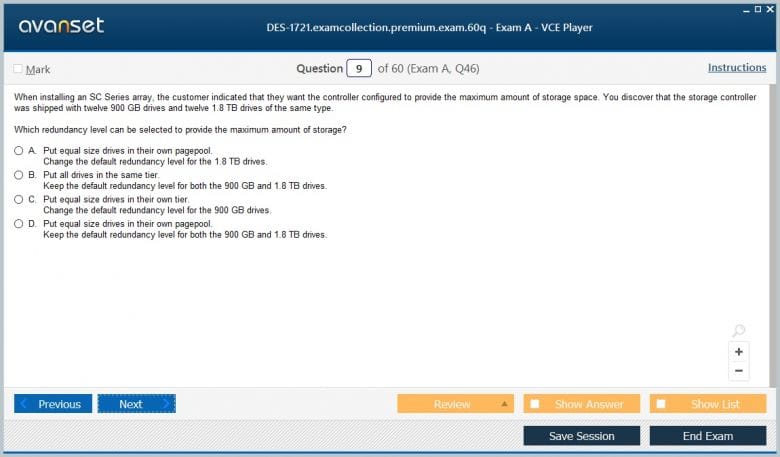
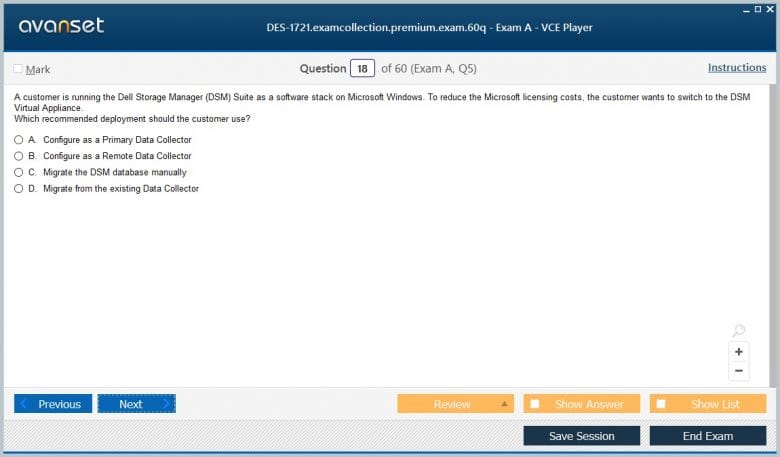
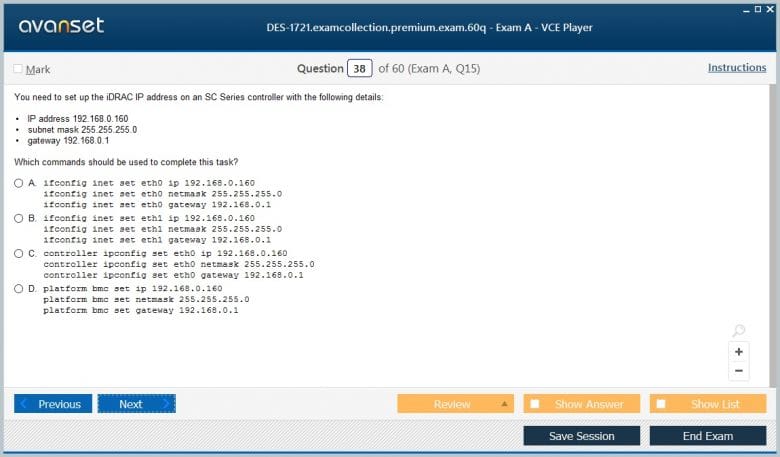
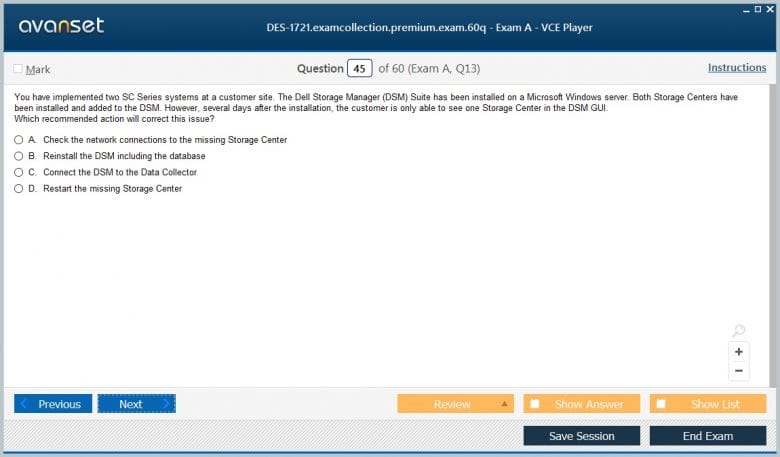
Dell DES-1721 Practice Test Questions in VCE Format
| File | Votes | Size | Date |
|---|---|---|---|
File Dell.onlinetest.DES-1721.v2026-07-24.by.wangmin.61q.vce |
Votes 2 |
Size 4.03 MB |
Date Jul 24, 2026 |
File EMC.Test-king.DES-1721.v2019-03-18.by.Gardner.34q.vce |
Votes 4 |
Size 1.55 MB |
Date Mar 21, 2019 |
Dell DES-1721 Practice Test Questions, Exam Dumps
Dell DES-1721 (Specialist - Implementation Engineer, SC Series Exam) exam dumps vce, practice test questions, study guide & video training course to study and pass quickly and easily. Dell DES-1721 Specialist - Implementation Engineer, SC Series Exam exam dumps & practice test questions and answers. You need avanset vce exam simulator in order to study the Dell DES-1721 certification exam dumps & Dell DES-1721 practice test questions in vce format.
Dell DES-1721 Specialist – Implementation Engineer, SC Series belongs to an earlier generation of Dell storage certification. Dell’s certification-transformation record shows the exam retired on February 2, 2024 and lists no direct replacement. That status matters because candidates should not confuse an archived SC Series implementation target with a current Dell booking option. At the same time, the underlying engineering work remains useful for understanding how enterprise storage moves from rack-and-cable planning to a stable, supportable service.
The blueprint centered on Dell EMC SC Series systems such as the SCv3000 family, SC5020, SC7020, and SC9000. Those arrays brought together controllers, enclosures, front-end Fibre Channel or iSCSI connectivity, SAS back-end cabling, fault domains, virtual ports, storage profiles, volumes, replication, and day-two validation. The details are product-specific, but the implementation discipline is not. Modern storage platforms still reward the same habits: verify the design, preserve redundancy, document dependencies, validate paths, and prove that the system can fail gracefully.
A useful way to approach the retired code is therefore historical rather than nostalgic. The SC Series material shows why storage implementation is a systems problem, not just a menu-driven configuration task. Broader Dell certifications now emphasize newer platforms and solution-oriented skills, but DES-1721 remains a compact case study in enterprise storage fundamentals.
A storage engineer needs to know what the controllers own, how cache and I/O are protected, how disk enclosures attach, and where redundancy exists. In an SC Series deployment, that means understanding controller pairs, front-end ports, back-end SAS connectivity, enclosure placement, disk tiers, and the software layer that presents storage to hosts. None of those components can be treated in isolation because an implementation decision at one layer changes the failure behavior of the whole array.
Candidates preparing from the old blueprint should pay attention to the difference between capacity and availability. Adding disks increases raw capacity, but availability depends on enclosure layout, redundancy, fault domains, and how the system protects data across failures. The same distinction appears in modern storage design, where usable capacity is only one part of the requirement. Performance consistency, rebuild exposure, controller failure, and maintenance windows are equally important.
The broader principles in data-storage security reinforce the point: storage is both an availability service and a security boundary. Access, encryption, logging, and operational control belong in the design from the start rather than being added after volumes are online.
The SC Series blueprint placed real weight on front-end and back-end cabling because physical topology determines which failures are survivable. Fibre Channel zoning, iSCSI network paths, controller ports, SAS chains, and switch redundancy all have to agree with the design. A link can be technically up while still being wrong for the required multipath or fault-isolation model.
Fault domains are especially important because they convert a collection of ports into a resilience model. An engineer should be able to explain which interfaces participate in a fault domain, why hosts need independent paths, and what a controller or fabric failure should look like from the application perspective. The goal is not simply “two connections.” The goal is independent failure paths that the host multipathing layer can use predictably.
This is where basic networking-device fundamentals become storage knowledge. Switches, VLANs, routing boundaries, and physical links influence iSCSI behavior, while Fibre Channel fabrics introduce their own zoning and path considerations. Storage implementation engineers have to reason across those boundaries rather than treating the network as somebody else’s problem.
Deployment begins by confirming management addressing, system identity, licensing, time services, DNS where applicable, controller state, and the intended connectivity to hosts. Defaults are convenient for a lab but dangerous in production because they often ignore naming standards, security policy, monitoring integration, and established network segmentation.
A strong engineer distinguishes discovery from acceptance. Discovering the array in a management tool does not prove that the configuration is ready. Management access, controller health, disk status, enclosure visibility, front-end port state, and support connectivity should all be checked before creating production volumes. Early validation reduces the chance that a host-side symptom later masks an infrastructure problem.
Documentation should be created while the system is being built. Record management addresses, controller and enclosure identifiers, fabric or switch ports, fault-domain mappings, firmware level, host connections, and any deviation from the approved design. That information becomes essential during expansion, incident response, and component replacement.
One of the more interesting SC Series concepts was the ability to express storage behavior through profiles and automated tiering rather than through a simple “fast disk versus slow disk” choice. That encourages candidates to think in terms of workload intent: latency sensitivity, access pattern, retention, snapshot activity, and cost all influence where data should live and how aggressively it should move.
The broader lesson is that storage policy should be explicit. When a volume is created, the engineer should know why its placement and protection settings match the workload. If the answer is merely “that is the default,” the design has not really been translated into operations. Modern policy-driven storage continues this idea with more automation, but the need to connect technical settings to service objectives has not changed.
Performance troubleshooting also improves when the policy is understood. Queue depth, path balance, cache behavior, media tier, snapshot load, and replication can all affect latency. A good troubleshooting sequence starts with the expected behavior, gathers evidence from each layer, and avoids changing multiple controls at once.
Provisioning a volume is only half the job. The host must discover the correct paths, use the appropriate multipathing policy, recognize the device consistently, and format or consume it according to the platform design. Fibre Channel and iSCSI each have their own operational dependencies, but both require path validation under normal and degraded conditions.
Testing should therefore include more than a successful mount. Verify path count, preferred or active paths where relevant, failover behavior, recovery after a path returns, and application visibility. If the environment depends on redundant switches or controller ports, deliberately proving that redundancy works is more valuable than assuming it does.
A similar mindset appears in business-continuity and disaster-recovery planning: resilience exists only when dependencies have been identified and recovery behavior has been tested. Storage-path redundancy is one local example of that larger principle.
SC Series replication concepts force the engineer to ask what data must be protected, where a replica lives, how frequently it is updated, and what recovery process is expected during an outage. These questions are broader than any one storage product. They map directly to recovery point objectives, recovery time objectives, bandwidth planning, consistency, and operational ownership.
Replication is not the same as backup. A replicated mistake, deletion, or corruption can reach the secondary system quickly. Organizations still need independent recovery copies and a clear retention model. The distinction is central to data-protection strategy, even when the implementation technology is completely different.
For exam-style scenarios, look for the business requirement before selecting a technical feature. A solution optimized for low recovery time may consume more bandwidth and infrastructure, while a solution optimized for retention may accept a slower restore. The right answer follows the service objective.
A storage implementation is not complete when volumes appear to the host. The more meaningful finish line is a controlled commissioning exercise that proves the design behaves as expected during normal operation and under failure. For an SC Series environment, that means validating controller reachability, front-end paths, multipathing, host mappings, storage profiles, alerting, and replication relationships before application owners are asked to trust the platform.
Path testing is especially important because redundancy that exists only on a diagram is not operational redundancy. Administrators should be able to take one expected path or component out of service and observe that I/O continues through the remaining path without application-visible disruption. If failover produces long pauses, inconsistent device discovery, or manual intervention, the problem belongs in commissioning rather than in a future incident.
Performance baselines are another part of acceptance. A team does not need a synthetic benchmark that chases the largest possible number; it needs measurements that represent the workload classes the array will actually host. Latency, throughput, queue behavior, cache effectiveness, and capacity consumption should be observed under representative load so that later troubleshooting has a trustworthy “healthy” comparison point.
Capacity validation also needs more thought than checking free terabytes. Thin provisioning, snapshots, replication, and data movement can change the relationship between logical allocation and physical consumption. Operations teams should understand the warning thresholds and growth assumptions that were built into the design, because an array can be technically available while running too close to a capacity boundary for safe recovery or maintenance.
Finally, commissioning should produce a small but useful operational record: what was connected, which host and volume naming conventions were used, which policies were selected, what failover was tested, and where monitoring is expected to raise alarms. That record turns the implementation from a one-time engineering activity into an environment that another administrator can support confidently months later.
After handoff, the array needs health monitoring, capacity forecasting, performance review, alert ownership, firmware planning, and change control. Configuration drift can quietly weaken resilience: a new host may be connected through only one fabric, a volume may receive the wrong policy, or a maintenance change may leave a path disabled.
Operational discipline is therefore part of implementation quality. The installer should leave behind enough evidence for another engineer to understand the intended state and recognize drift. That includes diagrams, port mappings, host mappings, protection settings, monitoring expectations, and support information.
DES-1721 is retired, but its most useful lesson is durable: storage availability is engineered through many small, coordinated decisions. Current Dell platforms have changed the interfaces and product names; the habit of validating architecture, connectivity, protection, and operations remains exactly the kind of thinking a storage professional still needs.
Go to testing centre with ease on our mind when you use Dell DES-1721 vce exam dumps, practice test questions and answers. Dell DES-1721 Specialist - Implementation Engineer, SC Series Exam certification practice test questions and answers, study guide, exam dumps and video training course in vce format to help you study with ease. Prepare with confidence and study using Dell DES-1721 exam dumps & practice test questions and answers vce from ExamCollection.
Purchase Individually
Top Dell Certifications
Top Dell Certification Exams
Site Search:

SPECIAL OFFER: GET 10% OFF

Pass your Exam with ExamCollection's PREMIUM files!
SPECIAL OFFER: GET 10% OFF
Use Discount Code:
MIN10OFF
A confirmation link was sent to your e-mail.
Please check your mailbox for a message from support@examcollection.com and follow the directions.

Download Free Demo of VCE Exam Simulator
Experience Avanset VCE Exam Simulator for yourself.
Simply submit your e-mail address below to get started with our interactive software demo of your free trial.
Guys is this dump valid?
Any updates from this exam?
Please share if anyone has updates.