



Premium File
98 Q&A
$76.99$69.99
Dell DES-1241 Exam Questions & Answers, Accurate & Verified By IT Experts
Instant Download, Free Fast Updates, 99.6% Pass Rate
98 Questions & Answers
Last Update: Oct 26, 2026
$69.99
Dell DES-1241 Exam Screenshots
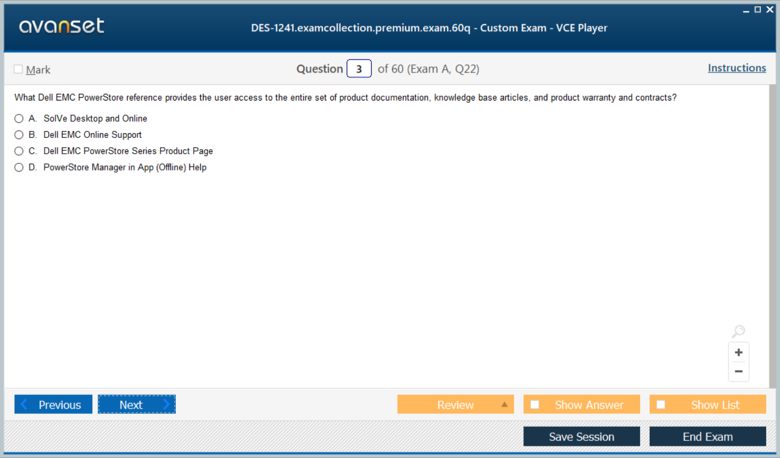
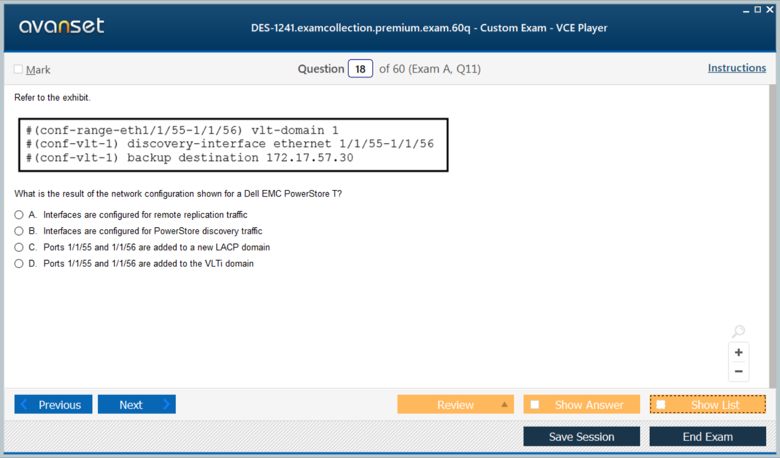
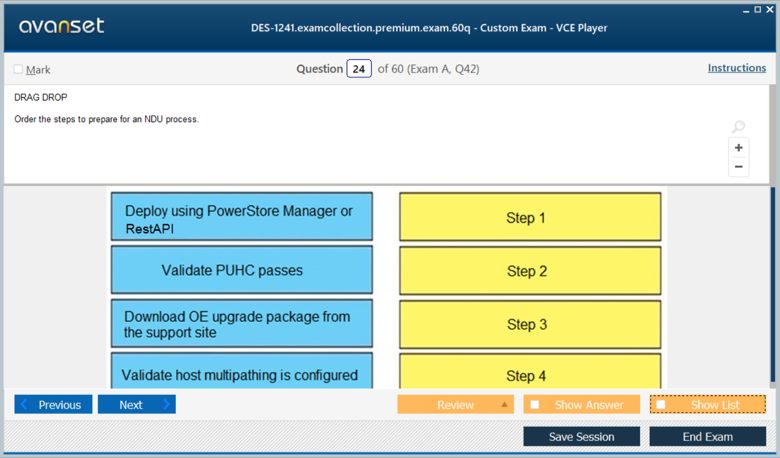
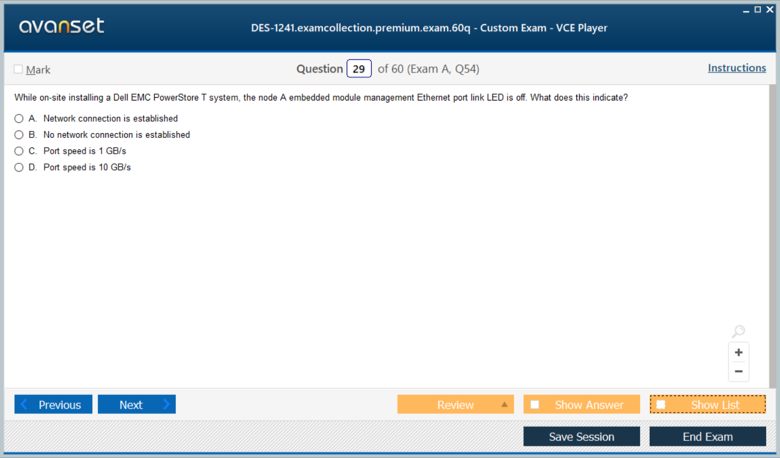
Dell DES-1241 Practice Test Questions in VCE Format
| File | Votes | Size | Date |
|---|---|---|---|
File Dell.passcertification.DES-1241.v2026-08-25.by.martha.56q.vce |
Votes 1 |
Size 1.84 MB |
Date Aug 25, 2026 |
File Dell.selftesttraining.DES-1241.v2021-11-04.by.maximilian.44q.vce |
Votes 1 |
Size 2.07 MB |
Date Nov 04, 2021 |
File Dell.passguide.DES-1241.v2020-10-21.by.evie.25q.vce |
Votes 2 |
Size 513.8 KB |
Date Oct 21, 2020 |
Dell DES-1241 Practice Test Questions, Exam Dumps
Dell DES-1241 (Specialist - Platform Engineer, PowerStore) exam dumps vce, practice test questions, study guide & video training course to study and pass quickly and easily. Dell DES-1241 Specialist - Platform Engineer, PowerStore exam dumps & practice test questions and answers. You need avanset vce exam simulator in order to study the Dell DES-1241 certification exam dumps & Dell DES-1241 practice test questions in vce format.
Dell DES-1241 Specialist - Platform Engineer, PowerStore covered installation, cabling, implementation, maintenance, upgrades, and troubleshooting for early PowerStore platforms. Dell retired the exam on February 2, 2024 and migrated the role to Dell PowerStore Maintenance D-PST-MN-A-24 on February 3, 2024. Dell now uses D-PST-MN-A-01 for the current PowerStore Maintenance track, so DES-1241 is best read as historical platform-engineering context.
Related PowerStore work includes D-PST-DS-00 PowerStore Design, D-PST-DY-23 PowerStore Deploy, and the broader Dell PowerStore Deploy 2023 certification. Those materials cover adjacent design and deployment responsibilities, while DES-1241 maps most directly to maintenance and platform engineering.
The enduring lesson is operational: storage engineering is not finished when an appliance is powered on. Within Dell storage certifications, PowerStore work spans site readiness, cabling, network configuration, storage services, host access, maintenance, upgrades, and fault isolation.
Platform engineers need rack space, power, cooling, network ports, IP addresses, switch configuration, management access, and cabling plans. Installation delays are often caused by environmental dependencies rather than by the storage array itself.
Verify that the delivered appliance matches the bill of materials and that the site can support both current and planned expansion. Capacity, ports, rack units, and power should be treated as lifecycle resources rather than one-time installation details.
Document switch ports, cable labels, management addresses, and physical placement because those records make later maintenance and troubleshooting substantially faster.
Front-end, back-end, management, and power connections each serve different purposes. Candidates should understand which ports connect hosts, switches, expansion components, and management networks and what redundancy is expected.
A cable installed in the wrong port or on the wrong switch can create a subtle single point of failure. Physical validation should therefore include path diversity rather than only link-up status.
Strong Ethernet fundamentals help when reasoning about switch configuration, link speed, redundancy, and the difference between management and data traffic.
PowerStore implementation includes cluster initialization, network configuration, storage provisioning, host connectivity, file or block services, and integration with management tools. The engineer should understand the purpose of each setting rather than follow a wizard mechanically.
Naming, DNS, NTP, addressing, identity, and certificates are infrastructure dependencies that can affect management and supportability. Validate them early so later application problems are not caused by a basic control-plane issue.
The deployment process should end with evidence: healthy components, correct network state, accessible storage, valid host paths, working data services, and documented configuration.
Block storage design includes host identifiers, volumes, performance, multipathing, and data protection. File services add NAS servers, shares or exports, protocol configuration, identity, and file-level access control. Candidates should recognize which settings belong to each service model.
General block and file storage distinctions provide useful context because the same workload patterns appear across enterprise arrays and cloud platforms.
Provisioning should also preserve headroom. Allocating all available capacity to current requests leaves no margin for snapshots, growth, protection, or unexpected application demand.
Platform engineers should understand hardware indicators, service ports, management alerts, diagnostic collections, and the correct sequence for replacing or servicing components. A fault message is a starting point, not proof that the named component is the root cause.
Troubleshooting should correlate hardware health, network state, host symptoms, capacity, and recent changes. Multiple alarms can be consequences of one underlying failure.
Before invasive maintenance, confirm protection state, support guidance, replacement procedure, and rollback or recovery options. Enterprise storage maintenance should be deliberate because the blast radius can be large.
Upgrades can change firmware, operating software, management behavior, and compatibility. Engineers should review prerequisites, health, capacity, support matrices, backups, maintenance windows, and post-upgrade validation before starting.
The surrounding environment matters too. Hosts, multipathing, VMware integration, backup software, monitoring, and automation may depend on particular versions or APIs.
A successful upgrade includes validation of storage access, replication, snapshots, alerts, performance, and administrative functions after the change—not merely a completed progress bar.
Hardware redundancy protects against component failure, while snapshots, replication, and backup protect against other events. Engineers should understand which copies exist, what can delete them, and how quickly an application can be recovered.
The ideas in storage-redundancy design help distinguish local component resilience from geographic or logical recovery.
Independent backup protection remains important because corruption, ransomware, or administrative mistakes can survive perfectly healthy hardware.
For legacy study, build a deployment runbook from site readiness through acceptance. Include rack and cable plans, management networking, initial configuration, host access, file/block services, protection, monitoring, maintenance, and upgrade procedures.
Then compare the workflow with current PowerStore Design and Deploy material. Identify which concepts remain unchanged and which moved into separate role-based certifications after the 2024 program transformation.
DES-1241 is retired, but its operational discipline remains relevant: install carefully, validate every dependency, document the environment, and treat maintenance as part of the service lifecycle.
Hardware maintenance should also consider redundancy state before a part is removed. If the system is already degraded, a normally safe maintenance action can increase risk. Engineers should confirm health, protection, and support guidance, then verify the system returns to full redundancy after the replacement.
Host integration is another common source of operational problems. Multipath configuration, supported operating systems, initiator registration, network or Fibre Channel zoning, and host-side rescans all influence whether new storage is actually usable. Platform engineers should validate paths from the host perspective rather than stopping at array-side presentation.
File services introduce identity and protocol dependencies that deserve their own checks. DNS, directory services, network interfaces, SMB or NFS configuration, and permissions can create failures even when the underlying storage pool is healthy. Troubleshooting should isolate file-service control-plane issues from capacity or hardware problems.
Capacity forecasting should include snapshots, thin provisioning, data reduction, and planned workload growth. Thin provisioning can make early utilization look comfortable while committed capacity grows quickly. Alerts and operating thresholds should be set so expansion occurs before the array reaches a state where maintenance or protection becomes difficult.
A useful final lab is to document a PowerStore appliance from rack installation through its first upgrade. Include physical connections, network configuration, host onboarding, storage provisioning, snapshots, backup, monitoring, fault handling, and change validation. The legacy DES-1241 exam becomes much easier to understand when those tasks are treated as one lifecycle.
PowerStore implementation also depends on secure administrative access. Role-based permissions, directory integration, certificates, secure service access, and audit records should be configured with the same care as storage pools and host connections. Storage platforms contain business-critical data, so management-plane security is a core availability concern as well as a confidentiality concern.
Troubleshooting benefits from a strict distinction between symptom and root cause. A host-path alert may originate in a switch, a failed cable, an initiator configuration, or the array. A capacity warning may result from snapshot retention or unexpected data reduction rather than simply from new production data. Engineers should gather enough evidence to choose the correct layer before replacing hardware or changing configuration.
PowerStore file and block services can also have different change windows and owners. A single appliance may support virtualization, databases, and file shares at once. Maintenance planning should therefore identify every dependent workload and verify that protection exists for each service type before disruptive work.
For current learning, compare the retired platform-engineer scope with the newer role-based PowerStore paths. The names and codes changed, but the same lifecycle remains visible: design the platform, deploy it, operate it, maintain it, and recover it. Understanding that lifecycle prevents candidates from treating certifications as isolated exams.
PowerStore administrators should also plan for alert ownership. Capacity, hardware, network, replication, and service warnings need routing to teams that can act on them, with escalation thresholds that distinguish informational events from incidents. Monitoring that generates alerts without ownership creates noise rather than resilience.
Performance baselining should happen soon after deployment while the environment is healthy. Record normal latency, throughput, path utilization, capacity growth, and host behavior for representative workloads. Later troubleshooting is far easier when teams can compare a problem against known-good behavior instead of relying on memory.
Decommissioning belongs in the platform lifecycle as well. Retired hosts, test volumes, old snapshots, unused NAS exports, and stale access mappings should be removed in a controlled way after retention and recovery requirements are satisfied. Cleaning up obsolete objects improves security and keeps capacity and configuration understandable.
Operational runbooks should include service-access procedures and evidence collection. When a fault occurs, engineers need to know how to reach the appliance safely, gather logs, identify the affected component, and escalate without disrupting healthy nodes or workloads. Preparing that process in advance reduces risky improvisation during incidents.
A documented escalation path also helps separate routine administrator work from hardware faults that require Dell support.
Go to testing centre with ease on our mind when you use Dell DES-1241 vce exam dumps, practice test questions and answers. Dell DES-1241 Specialist - Platform Engineer, PowerStore certification practice test questions and answers, study guide, exam dumps and video training course in vce format to help you study with ease. Prepare with confidence and study using Dell DES-1241 exam dumps & practice test questions and answers vce from ExamCollection.
Purchase Individually
Top Dell Certifications
Top Dell Certification Exams
Site Search:

SPECIAL OFFER: GET 10% OFF

Pass your Exam with ExamCollection's PREMIUM files!
SPECIAL OFFER: GET 10% OFF
Use Discount Code:
MIN10OFF
A confirmation link was sent to your e-mail.
Please check your mailbox for a message from support@examcollection.com and follow the directions.

Download Free Demo of VCE Exam Simulator
Experience Avanset VCE Exam Simulator for yourself.
Simply submit your e-mail address below to get started with our interactive software demo of your free trial.