



Premium File
35 Q&A
$76.99$69.99
AHLEI AHLEI-CHA Exam Questions & Answers, Accurate & Verified By IT Experts
Instant Download, Free Fast Updates, 99.6% Pass Rate
35 Questions & Answers
Last Update: Oct 21, 2026
$69.99
AHLEI AHLEI-CHA Exam Screenshots
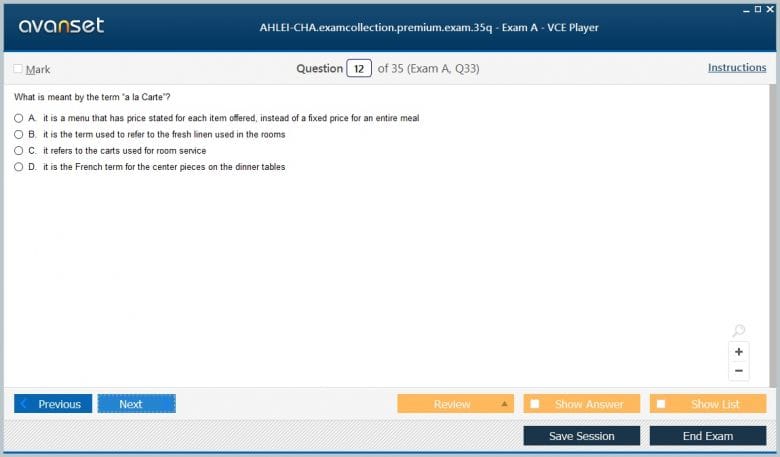
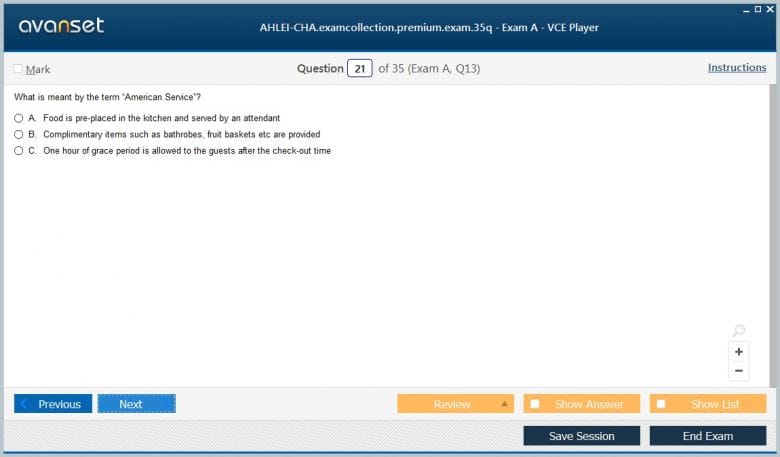
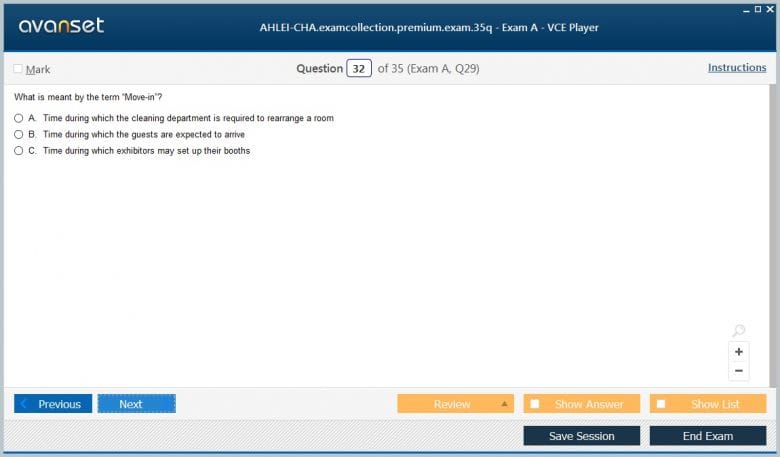
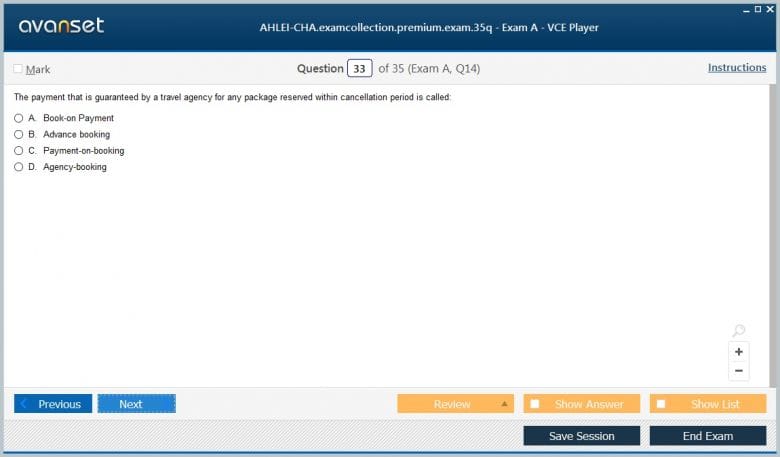
AHLEI AHLEI-CHA Practice Test Questions in VCE Format
| File | Votes | Size | Date |
|---|---|---|---|
File AHLEI.Pass4sures.AHLEI-CHA.v2026-10-11.by.Ben.20q.vce |
Votes 2 |
Size 18.46 KB |
Date Oct 13, 2026 |
AHLEI AHLEI-CHA Practice Test Questions, Exam Dumps
AHLEI AHLEI-CHA (Certified Hotel Administrator) exam dumps vce, practice test questions, study guide & video training course to study and pass quickly and easily. AHLEI AHLEI-CHA Certified Hotel Administrator exam dumps & practice test questions and answers. You need avanset vce exam simulator in order to study the AHLEI AHLEI-CHA certification exam dumps & AHLEI AHLEI-CHA practice test questions in vce format.
The Certified Hotel Administrator credential from the American Hotel & Lodging Educational Institute is designed for experienced hospitality leaders who are responsible for the performance of an entire lodging operation. The CHA therefore reaches beyond one department. It tests a general manager’s ability to connect finance, food and beverage, human resources, leadership, marketing and sales, revenue management, and rooms operations into a coherent business.
AHLEI currently presents a revised CHA examination with 200 multiple-choice questions, a four-hour testing window, and a 70 percent passing requirement. The assessment is proctored, and AHLEI permits two retake purchases within one year of application approval. Eligibility is also role- and experience-based, reflecting that the credential is intended for professionals who already carry significant property or multi-property responsibility rather than people seeking an entry-level hospitality qualification.
The broader AHLEI certifications provide organizational context, but CHA should be studied as a leadership credential in its own right. Strong preparation uses hotel operating scenarios that force tradeoffs among guest experience, labor, revenue, risk, asset condition, and owner expectations rather than reducing the exam to memorized hospitality definitions.
Hotel leaders need to understand revenue, expenses, departmental profitability, cash implications, budgets, forecasts, capital priorities, and the meaning of performance variance. They do not need to become accountants, but they must be able to read the story behind the numbers and decide which operating action is appropriate. A favorable revenue result can still conceal weak margins if labor, distribution, or other costs rise faster.
Candidates should practice tracing a variance to its driver. Lower rooms revenue may come from occupancy, average rate, mix, group displacement, distribution cost, or market change. A food-and-beverage variance may reflect volume, menu mix, food cost, labor, waste, or pricing. The exam rewards managers who use financial information to diagnose operations rather than simply report the result.
Hotels sell perishable inventory: an unsold room night cannot be stored for later. Revenue management therefore uses demand forecasts, pricing, restrictions, channel strategy, segmentation, and inventory controls to improve the value of available capacity. The best decision is not always the highest room rate or the highest occupancy; it depends on the total revenue and strategic value of the business accepted.
Scenario practice should include group versus transient demand, high-demand compression nights, weak periods, channel cost, length-of-stay patterns, and displacement analysis. General managers should also understand how revenue decisions affect operations. A sudden occupancy push can create housekeeping, front-desk, parking, breakfast, or maintenance pressure that must be planned rather than discovered after check-in begins.
Front office, reservations, housekeeping, maintenance coordination, guest services, and security all affect the rooms product. Problems often appear at handoffs: a room is physically clean but not released in the system, an out-of-order room is sold, a maintenance issue is not communicated, or a guest preference disappears between reservation and arrival. The general manager needs systems that make those transitions reliable.
Candidates should think in terms of service recovery as well as prevention. When a failure reaches the guest, the response should recognize impact, resolve the immediate problem, empower appropriate staff, and capture the root cause. A generous recovery without process correction can create repeated cost and dissatisfaction.
Food-and-beverage operations involve menu strategy, purchasing, inventory, production, service standards, labor, sanitation, waste, and profitability. Even hotels where rooms generate most revenue can experience reputational or financial damage from poorly controlled outlets, banquets, or breakfast operations. Managers need enough operational knowledge to recognize when a problem is caused by demand forecasting, procurement, portioning, staffing, or service design.
Exam preparation should connect controls to purpose. Inventory procedures help prevent loss and support accurate purchasing; sanitation protects guests and the operation; standardized recipes support consistency and cost control; banquet planning coordinates sales promises with production capacity. The goal is not to memorize every kitchen detail but to manage the department as part of the property’s total performance.
Hotels depend on people working across shifts, departments, languages, and customer-facing situations. Recruitment, onboarding, scheduling, training, performance management, recognition, discipline, and retention therefore have direct operational consequences. Chronic vacancies or poor scheduling can appear to guests as slow service, inconsistent housekeeping, or unresolved maintenance even when the underlying issue is workforce planning.
Candidates should distinguish a performance problem from a system problem. An employee may need coaching, but repeated failure across several employees can indicate unclear standards, insufficient training, bad staffing levels, or a broken workflow. Effective managers investigate the pattern before assuming individual blame.
Hotel departments can optimize themselves while harming the whole property. Sales may want to accept business that operations cannot service efficiently; revenue management may restrict inventory that a strategic account expects; engineering may need downtime during a high-demand period; finance may pressure labor that affects guest satisfaction. The general manager’s role is to resolve these conflicts using property-wide objectives.
Leadership also involves communication during uncertainty. Managers should explain the decision, establish accountability, and give teams enough information to act. A culture where departments hide bad news until it becomes visible to guests is operationally fragile. CHA preparation should therefore include scenarios about delegation, conflict, ethics, and change—not only technical hotel functions.
Marketing creates demand and brand expectations, while sales converts opportunities into contracted business. Both functions rely on accurate knowledge of rooms, meeting space, food and beverage capability, service levels, seasonality, and operational constraints. Overselling features or accepting poorly structured group business may win revenue initially but create service failures and financial leakage later.
General managers should understand segmentation, account value, digital reputation, brand positioning, and sales productivity while maintaining operational realism. A campaign should be evaluated not only by bookings but also by contribution, guest fit, channel cost, and the property’s ability to deliver the promised experience.
Hotels face safety, security, emergency, legal, reputational, technology, and physical-asset risks. A manager who focuses only on monthly profit can defer maintenance or controls until a failure becomes much more expensive. Preventive maintenance, life-safety systems, insurance, incident procedures, access controls, and capital planning all protect the continuity of the business.
The CHA perspective is managerial rather than engineering-specific. Candidates should know how to recognize a risk, assign ownership, fund an appropriate response, and verify completion. The same approach applies to cyber incidents, guest-safety events, weather disruption, utility failure, and other situations that require coordinated leadership.
A strong final review uses a property scenario containing several simultaneous problems: occupancy is rising, labor is tight, a large group is arriving, guest scores have fallen, an outlet is missing budget, and an asset issue needs capital. Work through the financial, rooms, food-and-beverage, HR, revenue, sales, and leadership implications rather than answering each issue independently.
That integrated exercise reflects why CHA is a senior-level credential. The general manager is judged by the combined performance of the property, not by excellence in one department. Candidates who can balance guest experience, employee capability, revenue, cost, risk, and long-term asset health are preparing for the credential in the same way they would prepare to lead the hotel itself.
Guest-experience data should also be interpreted with care. Survey scores, online reviews, complaints, repeat business, service-recovery logs, and loyalty behavior can identify patterns, but no single source tells the whole story. A manager should segment feedback by department, time, guest type, and recurring issue before investing in a solution. The objective is to distinguish a systemic process weakness from an isolated event.
Brand standards add another layer of accountability for properties operating under a flag. The general manager may need to balance owner economics, brand requirements, local market realities, and guest expectations. A standard can create cost, but noncompliance can create penalties, inconsistent experience, or reputational damage. Candidates should think in terms of the business rationale behind the standard and the process for resolving legitimate conflicts.
CHA preparation is strongest when the candidate can explain why a decision works for the entire property. A staffing cut, pricing move, maintenance deferral, or sales commitment may improve one metric while harming another. Senior hotel leadership requires recognizing those interactions early, quantifying the tradeoff, and choosing the action that protects sustainable performance rather than optimizing one department in isolation.
The general manager should also understand owner relations and asset strategy. Operating teams may focus on this month’s guest experience, while ownership evaluates long-term return, brand position, debt obligations, renovation cycles, and asset value. Capital requests are more persuasive when they explain both operational risk and financial consequence. CHA scenarios can therefore require the manager to translate daily operating evidence into a recommendation that makes sense to owners and other senior stakeholders.
Go to testing centre with ease on our mind when you use AHLEI AHLEI-CHA vce exam dumps, practice test questions and answers. AHLEI AHLEI-CHA Certified Hotel Administrator certification practice test questions and answers, study guide, exam dumps and video training course in vce format to help you study with ease. Prepare with confidence and study using AHLEI AHLEI-CHA exam dumps & practice test questions and answers vce from ExamCollection.
Purchase Individually
Site Search:

SPECIAL OFFER: GET 10% OFF

Pass your Exam with ExamCollection's PREMIUM files!
SPECIAL OFFER: GET 10% OFF
Use Discount Code:
MIN10OFF
A confirmation link was sent to your e-mail.
Please check your mailbox for a message from support@examcollection.com and follow the directions.

Download Free Demo of VCE Exam Simulator
Experience Avanset VCE Exam Simulator for yourself.
Simply submit your e-mail address below to get started with our interactive software demo of your free trial.