



Premium File
72 Q&A
$76.99$69.99
Alibaba ACA-Cloud1 Exam Questions & Answers, Accurate & Verified By IT Experts
Instant Download, Free Fast Updates, 99.6% Pass Rate
72 Questions & Answers
Last Update: Sep 18, 2026
$69.99
Alibaba ACA-Cloud1 Exam Screenshots
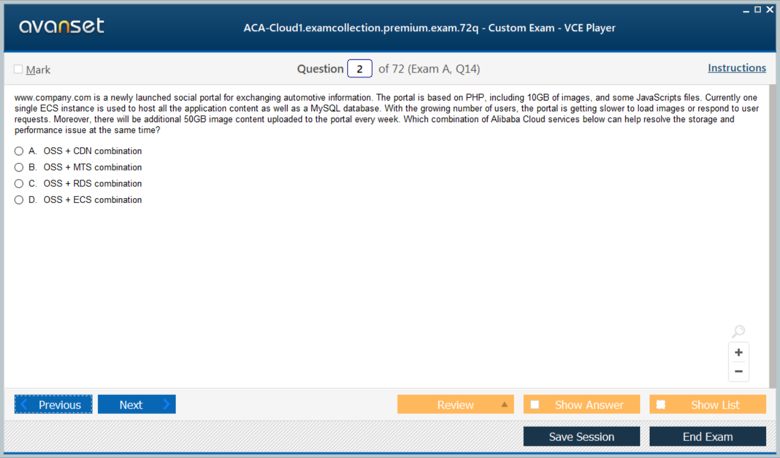
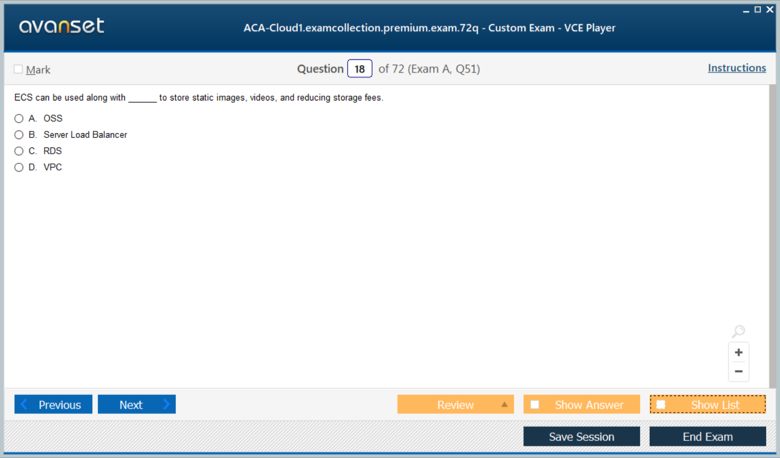
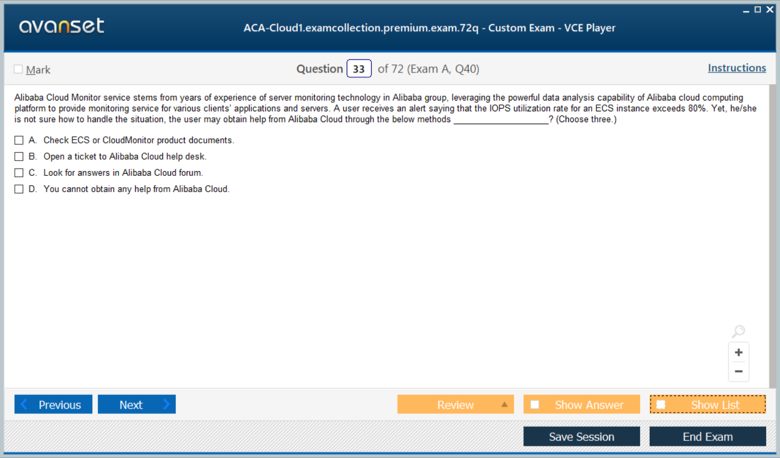
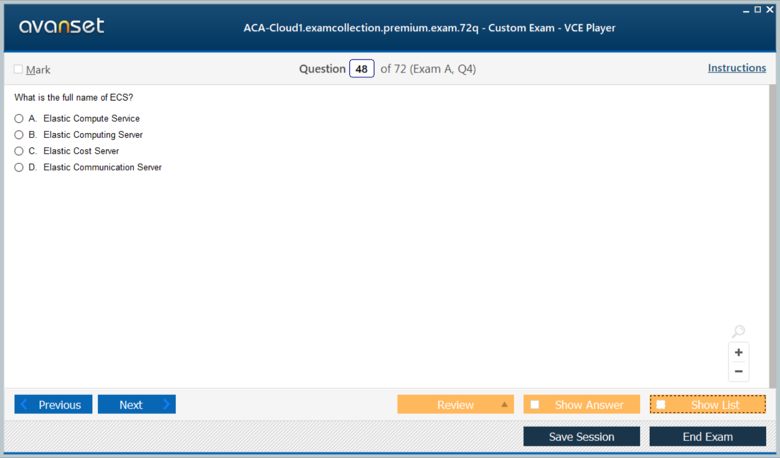
Alibaba ACA-Cloud1 Practice Test Questions in VCE Format
| File | Votes | Size | Date |
|---|---|---|---|
File Alibaba.selftestengine.ACA-Cloud1.v2026-09-20.by.wangmin.40q.vce |
Votes 1 |
Size 56.29 KB |
Date Sep 19, 2026 |
File Alibaba.selftesttraining.ACA-Cloud1.v2020-03-30.by.reggie.22q.vce |
Votes 2 |
Size 29.18 KB |
Date Mar 30, 2020 |
Alibaba ACA-Cloud1 Practice Test Questions, Exam Dumps
Alibaba ACA-Cloud1 (ACA Cloud Computing Certification Exam) exam dumps vce, practice test questions, study guide & video training course to study and pass quickly and easily. Alibaba ACA-Cloud1 ACA Cloud Computing Certification Exam exam dumps & practice test questions and answers. You need avanset vce exam simulator in order to study the Alibaba ACA-Cloud1 certification exam dumps & Alibaba ACA-Cloud1 practice test questions in vce format.
ACA-Cloud1 represents Alibaba Cloud’s former ACA Cloud Computing Associate path. Alibaba Cloud formally retired ACA Cloud Computing in 2025 and replaced it with the role-based Alibaba Cloud Certified Associate: Cloud Engineer certification. The current exam code is CEA-C01, so candidates finding the legacy page should not prepare from old ACA objectives as though they were still the booking target.
The transition preserves many fundamentals while changing the frame. A cloud engineer still needs compute, networking, storage, database, elasticity, security, and monitoring knowledge, but the current credential emphasizes operating cloud resources as a job role. Alibaba Cloud lists CEA-C01 as live with 50 questions, a 90-minute duration, and a passing score of 70 out of 100.
Use Alibaba Cloud certifications for the wider program, then move to the current CEA-C01 Cloud Engineer exam. The older ACP-Cloud1 page belongs to the retired professional-level route and now points conceptually toward Cloud Architect rather than Associate-level operations.
Alibaba Cloud’s refresh moved from older ACA and ACP product-centered names toward role-oriented certifications. ACA Cloud Computing reached end of life in March 2025, with a transition period afterward, while Cloud Engineer (Associate) became the current entry technical role. That means historical materials are useful only when their service concepts still match current documentation.
The new role definition matters because exam preparation should follow tasks a cloud engineer performs: create and manage resources, configure connectivity, protect accounts, monitor services, and troubleshoot normal operational problems. Memorizing an old service list without that operational context is no longer enough.
Elastic Compute Service covers instance families, images, disks, network attachment, security groups, regions, zones, and lifecycle operations. Candidates should understand how a workload’s CPU, memory, storage, availability, and cost needs influence the choice of instance and deployment pattern.
Cloud engineering also requires lifecycle thinking. Images support repeatable builds, disks need protection, and a single instance does not become highly available merely because it runs in the cloud. Resilience comes from architecture, health checks, replacement, and recoverable data.
Region and zone selection should be tied to latency, availability, service support, data requirements, and cost. A workload deployed close to users may improve response time, but every additional region increases operational complexity. Engineers should know which services are regional, which resources are zonal, and how dependencies behave if one zone is unavailable. Location is an architectural decision even at associate level.
Virtual Private Cloud provides the logical network boundary for Alibaba Cloud resources. Engineers need to understand CIDR selection, vSwitch placement, routes, security groups, Internet access, NAT, and how workloads communicate privately. Drawing packet paths is often more effective than memorizing configuration screens.
Address design should allow growth and avoid conflicts with connected networks. Security groups should permit only required traffic, while routing determines whether packets can reach a destination at all. When troubleshooting connectivity, separate name resolution, routes, security policy, and application listening behavior.
Cloud disks support instance-oriented block storage, while Object Storage Service is designed for object data such as media, backups, archives, and static assets. The right choice depends on access semantics, latency, sharing, durability, lifecycle, and cost. Treating every storage need as a disk problem leads to poor cloud design.
Engineers should also understand backup and restore behavior. Redundancy within a service does not replace a recovery plan. Data can be lost through deletion, corruption, or application error even when infrastructure remains healthy.
Service quotas and API throttling become more visible when automation is introduced. A script that creates or changes many resources can fail partway, leaving a partially configured environment. Engineers should design retries carefully, verify the final state, and avoid assuming that one successful API response proves the entire deployment succeeded. Idempotent automation and post-deployment checks make routine operations safer.
ApsaraDB RDS handles many database infrastructure tasks, yet the customer still decides connectivity, credentials, backup policy, sizing, monitoring, and appropriate availability options. A managed service is a division of responsibility, not an absence of responsibility.
Candidates should connect database health to application architecture. Scaling compute does not solve a database bottleneck, and opening database access broadly for convenience creates security risk. Current cloud-engineer scenarios reward understanding how services interact.
Operational security also includes logs and anomaly review. Identity activity, network exposure, unusual resource creation, and unexpected configuration changes should be observable. Engineers are not expected to run a full security operations center, but they should understand how cloud logs support accountability and why disabling logging to save cost creates blind spots during incidents.
Server Load Balancer can distribute requests across healthy backends, while Auto Scaling can adjust capacity according to policy. Horizontal scaling works best when application instances are replaceable and state is stored appropriately. Sticky local state or long startup time can make scaling behavior unpredictable.
Health checks deserve attention because they determine whether traffic reaches a backend. A server that is running but cannot serve the application should not remain in rotation. Engineers should test failure and recovery rather than assume the default settings express the application’s true health.
Hands-on preparation should also include quota and dependency awareness. Cloud deployments can fail even when the architecture is correct if a region lacks capacity for the chosen instance type, an account limit is reached, or a dependent service is unavailable. Engineers should know how to identify service limits, choose alternatives, and avoid designs that assume every resource request will always succeed. Operational readiness includes planning for platform constraints as well as software defects.
Resource Access Management provides identity and permission controls for users and roles. Least privilege, strong authentication, protected root or primary credentials, and regular review reduce the chance that one compromised account can control the environment.
Network controls address a different layer. Security groups and network architecture limit traffic paths, while identity policy limits management actions. Strong cloud security uses both. Candidates should be able to explain which layer would stop a specific unwanted action.
Change management becomes important once resources are shared by a team. Tags or labels, naming standards, ownership, maintenance windows, and documented change history make environments easier to operate and control cost. A technically correct resource with no clear owner can become a security and financial liability. Candidates should think beyond creation and ask how the resource will be reviewed, patched, scaled, and eventually removed.
CloudMonitor and service logs help teams detect resource pressure, availability problems, and unusual behavior. Useful monitoring connects a signal to an owner and response. An alarm that nobody interprets does not improve reliability.
Practice troubleshooting in sequence: define the symptom, identify the affected scope, inspect recent changes, review metrics and logs, test dependencies, apply the smallest safe correction, and verify recovery. This is the operational discipline the current Cloud Engineer role expects.
Cost troubleshooting can be treated like performance troubleshooting. Start with the unexpected signal, identify which resource or traffic pattern changed, compare it with recent deployments, and verify the business reason for the increase. Oversized instances, unattached storage, unnecessary public data transfer, and overly conservative scaling can all create waste. Basic cloud engineering therefore includes the ability to recognize when architecture and consumption no longer match demand.
Most foundational ACA topics remain useful: ECS, VPC, OSS, RDS, load balancing, Auto Scaling, security, and monitoring. The efficient transition is to map each legacy topic to the current CEA-C01 outline, identify gaps, and update version-sensitive knowledge from Alibaba Cloud’s live documentation.
Finish with end-to-end labs rather than isolated service drills. Build a small application with private networking, safe Internet exposure, object storage, a managed database, monitoring, and recovery steps. The legacy page explains where the learning path came from; CEA-C01 defines where current candidates should aim.
Finally, engineers should distinguish platform availability from application availability. Alibaba Cloud can keep an ECS instance or RDS service running while the application is unusable because of bad configuration, dependency failure, or an unhealthy release. Synthetic checks, application metrics, and user-path validation complement infrastructure health. That distinction is essential when designing alarms and when explaining whether a recovery action actually restored the service customers depend on.
A final useful distinction is between availability and durability. Multiple zones can keep an application reachable while poor backup practice still exposes data to deletion or corruption. Durable object storage can preserve data while the application remains unavailable because its network or compute layer failed. Candidates should be able to identify which architectural feature protects which failure mode, because cloud reliability comes from combining several controls rather than expecting one service characteristic to solve every risk.
Go to testing centre with ease on our mind when you use Alibaba ACA-Cloud1 vce exam dumps, practice test questions and answers. Alibaba ACA-Cloud1 ACA Cloud Computing Certification Exam certification practice test questions and answers, study guide, exam dumps and video training course in vce format to help you study with ease. Prepare with confidence and study using Alibaba ACA-Cloud1 exam dumps & practice test questions and answers vce from ExamCollection.
Purchase Individually
Top Alibaba Certification Exams
Site Search:

SPECIAL OFFER: GET 10% OFF

Pass your Exam with ExamCollection's PREMIUM files!
SPECIAL OFFER: GET 10% OFF
Use Discount Code:
MIN10OFF
A confirmation link was sent to your e-mail.
Please check your mailbox for a message from support@examcollection.com and follow the directions.

Download Free Demo of VCE Exam Simulator
Experience Avanset VCE Exam Simulator for yourself.
Simply submit your e-mail address below to get started with our interactive software demo of your free trial.
Do you have alibaba ACP Cloud Computing Exam?