



Premium File
184 Q&A
$76.99$69.99
SAS Institute A00-212 Exam Questions & Answers, Accurate & Verified By IT Experts
Instant Download, Free Fast Updates, 99.6% Pass Rate
184 Questions & Answers
Last Update: Nov 08, 2026
$69.99
SAS Institute A00-212 Exam Screenshots
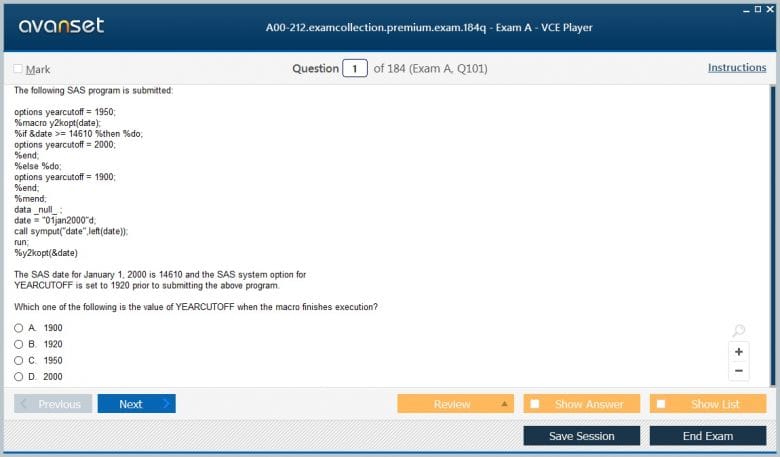
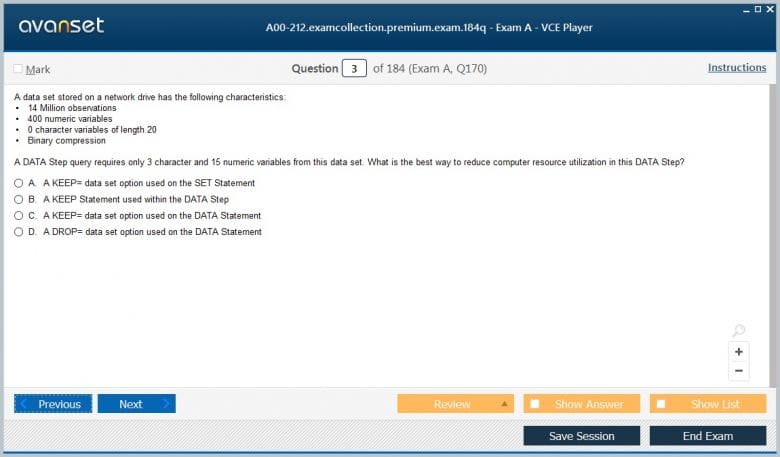
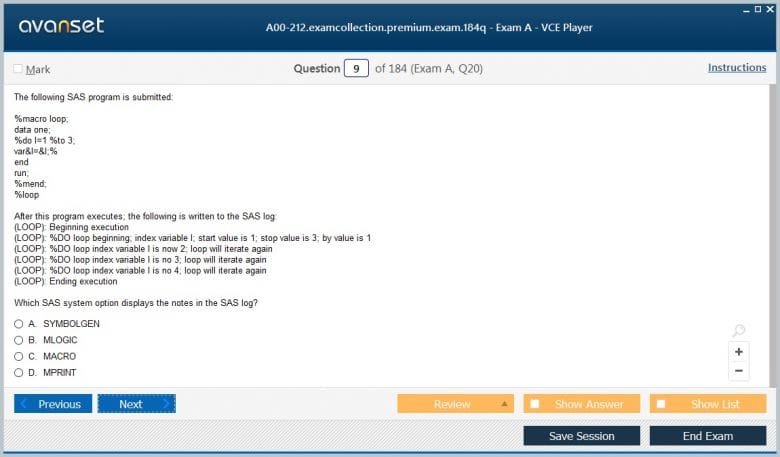
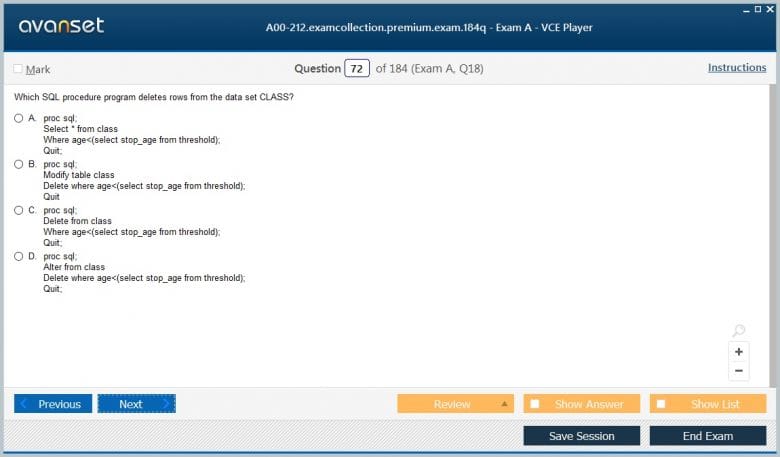
SAS Institute A00-212 Practice Test Questions in VCE Format
| File | Votes | Size | Date |
|---|---|---|---|
File SAS.Braindump.A00-212.v2022-08-14.by.sindhu.153q.vce |
Votes 6 |
Size 213.36 KB |
Date Aug 16, 2022 |
SAS Institute A00-212 Practice Test Questions, Exam Dumps
SAS Institute A00-212 (SAS Advanced Programming for SAS 9) exam dumps vce, practice test questions, study guide & video training course to study and pass quickly and easily. SAS Institute A00-212 SAS Advanced Programming for SAS 9 exam dumps & practice test questions and answers. You need avanset vce exam simulator in order to study the SAS Institute A00-212 certification exam dumps & SAS Institute A00-212 practice test questions in vce format.
A00-212 was the SAS Advanced Programming for SAS 9 exam in the earlier certification structure. SAS now uses A00-232 for SAS Certified Professional: Advanced Programming Using SAS 9.4, a performance-based assessment covering SQL, macro processing, and advanced programming techniques. The old A00-212 code is therefore legacy, but its core advanced-programming themes remain directly relevant.
Advanced SAS work begins where routine DATA step coding stops. Programmers need to choose efficient methods for joins and aggregation, generate reusable code with macros, control complex DATA step behavior, manage metadata, process groups and arrays, use hash objects or other advanced techniques, and debug problems that emerge only at scale or under unusual data conditions.
This level assumes the foundation represented by A00-211 base programming. Within SAS Institute certifications, the current A00-232 pathway still expects a valid base-programming foundation, reinforcing the idea that advanced programming is an extension of reliable fundamentals rather than a collection of clever shortcuts.
SQL can select, filter, join, aggregate, create tables or views, and query metadata. The advanced programmer should understand join cardinality, missing-value behavior, grouping, HAVING, subqueries, set operators, and how calculated columns affect query logic. A query that returns rows is not necessarily correct if the relationship between tables was misunderstood.
Before writing a join, state the expected number of rows and the key relationship. After execution, compare actual cardinality and unmatched keys with expectations. This catches accidental many-to-many joins that can inflate totals while still producing plausible-looking output.
Some problems are naturally expressed as relational queries, while others depend on row order, retained state, or sequential processing that fits the DATA step. Advanced programmers should compare methods rather than forcing every task into one style. Readability, performance, team familiarity, and output semantics all matter.
Implement the same aggregation or merge using SQL and a DATA step. Compare the code, handling of duplicates, sort requirements, missing values, and execution notes. This exercise develops judgment about technique selection, which is more valuable than memorizing which procedure is theoretically faster in every situation.
Macro variables, macro functions, conditional directives, loops, parameters, and quoting operate before generated SAS code is compiled. Confusion occurs when programmers mix macro-time and DATA-step-time concepts. A macro variable is text substitution, not a DATA step variable, and scope determines which value is visible at a given point.
Debug macros in layers. First inspect variable values, then generated text, then the SAS code that text produces. Options such as MPRINT, MLOGIC, and SYMBOLGEN can expose different stages of processing. This disciplined approach avoids treating macro errors as mysterious and reduces the temptation to add more quoting or ampersands blindly.
Global and local symbol tables determine how macro variables are created and resolved. Parameters and variables created inside macros can shadow values outside them. CALL SYMPUTX and related techniques can create values based on DATA step results, but the destination scope must be understood.
Write a nested macro example and predict which value each reference resolves to. Then inspect the symbol tables during execution. Advanced programmers should be able to explain why a variable changed, not simply know that adding %GLOBAL can make a symptom disappear.
Arrays let a program address groups of variables through indexes, which is useful for repeated transformations, validation, recoding, or missing-value handling. DO loops can iterate over values or conditions. The technique is powerful when variable groups have consistent meaning, but it can hide logic if indices and bounds are unclear.
Refactor a program containing ten nearly identical assignment statements into an array loop, then verify that variable order and bounds match the intended mapping. Use explicit comments or temporary arrays when the relationship is not obvious. Concise code is beneficial only when future maintainers can still reason about it.
Hash objects can support keyed lookups, deduplication, table matching, and aggregation without requiring a traditional sort or merge. They are useful when the programmer understands object initialization, keys, data variables, methods, and memory implications. They are not automatically superior to SQL or formats for every lookup.
Compare a small reference-table lookup implemented with a format, SQL join, and hash object. Identify which method is clearest and how each behaves with missing keys and duplicates. This builds practical method-selection judgment and prevents advanced features from becoming ornamental complexity.
Advanced programmers should understand when sorting is required, when an index can support selective access, and how BY-group logic interacts with data order. Indexes can speed targeted retrieval but carry maintenance and storage costs. Sorting large data sets can also be expensive, so access patterns should guide design.
Use an execution scenario with millions of rows but a highly selective filter. Compare a full scan, an indexed access path, and pre-sorted processing conceptually. Then consider a batch process that reads almost every row, where the index may offer little benefit. Performance decisions depend on workload shape, not slogans.
Real pipelines often need wide-to-long transformations, dynamic variable lists, dictionary-table queries, and systematic renaming or attribute changes. PROC TRANSPOSE, DATA step arrays, SQL metadata, and procedures for managing libraries can make these tasks repeatable. The risk is creating code that depends on accidental column order or naming assumptions.
Design transformations so expected metadata is validated. If a source adds a new column, decide whether the program should include it automatically, ignore it, or fail for review. Advanced programming includes making those behaviors explicit rather than allowing schema drift to change output silently.
Complex programs can fail partially: one source file may be absent, a join may duplicate rows, a macro parameter may be invalid, or an external step may return a bad status. The programmer should detect conditions early, emit useful diagnostics, and avoid publishing incomplete results as if the run succeeded.
Add assertions to a pipeline: expected row counts, unique keys, required variables, allowed missing-value rates, or acceptable return codes. Stop or quarantine output when a critical check fails. These controls turn a script into a more reliable production process and are central to professional programming.
A macro or utility program becomes infrastructure when multiple teams depend on it. Parameters should have clear meaning, defaults should be safe, validation should reject invalid combinations, and side effects should be minimized. Documentation should focus on contracts and assumptions rather than narrating every line of code.
Test reusable code with normal, boundary, and failure cases. For a macro that summarizes data, include empty input, unexpected types, and unusual variable names. This ensures reuse increases consistency instead of spreading hidden assumptions across projects.
SAS currently describes A00-232 as a performance-based advanced programming exam with major emphasis on SQL, macro processing, and advanced techniques. SAS also identifies the base credential as a prerequisite for the professional certification. That aligns closely with the durable skills behind A00-212 but changes how competence is demonstrated.
Prepare by writing code from requirements without relying on remembered templates. Build joins, macros, arrays, and advanced DATA steps; run them; inspect results; and repair defects under time pressure. The legacy exam remains useful historical context, but current success depends on producing working SAS programs and explaining their behavior.
Advanced programmers should also understand views and deferred execution. A view can store logic rather than materialized rows, which may reduce storage and keep results current but moves processing cost to each use. The design choice depends on how often the result is consumed, how expensive the logic is, and whether downstream users require a stable snapshot.
Indexes, WHERE processing, and SQL optimization all depend on selectivity and data distribution. A programmer should read execution notes and, when appropriate, inspect query plans rather than assume an index or join strategy is beneficial. Performance tuning begins by measuring the workload and identifying the dominant cost, then changing one factor at a time.
Metadata-driven programming can make large systems easier to maintain. Dictionary tables and SASHELP views allow code to inspect libraries, tables, columns, indexes, and other properties. This supports automated validation and dynamic generation, but generated logic should still be predictable and testable. Dynamic does not mean opaque.
When preparing for the performance-based successor, practice under constraints. Give yourself unfamiliar input tables, a clear expected result, and a time limit. Write the program, validate the output, and then refactor only after it works. This simulates the real skill of producing correct SAS code under pressure more closely than rereading solved examples.
Advanced programming also includes deliberate control of compile-time and execution-time behavior. Statements such as RETAIN, LENGTH, ATTRIB, arrays, and hash declarations can change how variables or objects exist before values are processed. Understanding that timing helps explain why moving one statement earlier or later can change attributes or results even when the text looks similar.
Production SAS code should expose enough diagnostics to support another person. Meaningful log messages, stable naming, checked return conditions, and small reusable components are often more valuable than compressing a program into the fewest lines. Professional-level skill is visible in code that remains understandable after the original author is unavailable.
Advanced programmers should also be comfortable reading existing code rather than only writing new programs. Trace inputs, macro resolution, generated code, and output tables in order; then state the intended result before changing anything. This reduces the risk of fixing one symptom while breaking an assumption elsewhere in a mature SAS application.
Go to testing centre with ease on our mind when you use SAS Institute A00-212 vce exam dumps, practice test questions and answers. SAS Institute A00-212 SAS Advanced Programming for SAS 9 certification practice test questions and answers, study guide, exam dumps and video training course in vce format to help you study with ease. Prepare with confidence and study using SAS Institute A00-212 exam dumps & practice test questions and answers vce from ExamCollection.
Purchase Individually
Site Search:

SPECIAL OFFER: GET 10% OFF

Pass your Exam with ExamCollection's PREMIUM files!
SPECIAL OFFER: GET 10% OFF
Use Discount Code:
MIN10OFF
A confirmation link was sent to your e-mail.
Please check your mailbox for a message from support@examcollection.com and follow the directions.

Download Free Demo of VCE Exam Simulator
Experience Avanset VCE Exam Simulator for yourself.
Simply submit your e-mail address below to get started with our interactive software demo of your free trial.