



Premium File
71 Q&A
$76.99$69.99
Avaya 6210 Exam Questions & Answers, Accurate & Verified By IT Experts
Instant Download, Free Fast Updates, 99.6% Pass Rate
71 Questions & Answers
Last Update: Sep 27, 2026
$69.99
Avaya 6210 Exam Screenshots
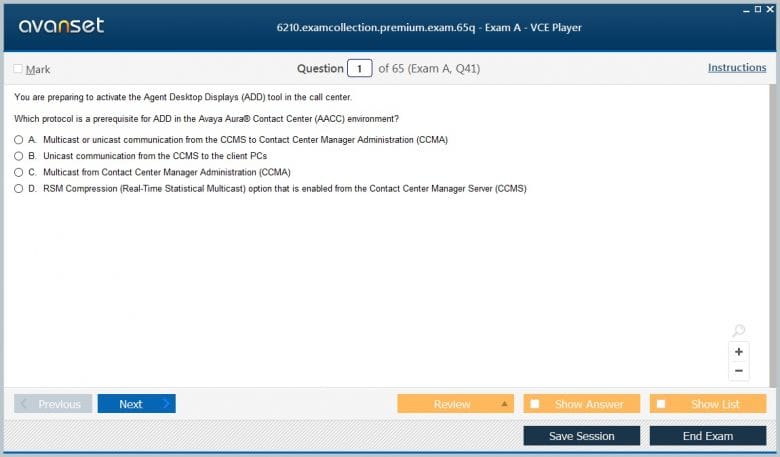
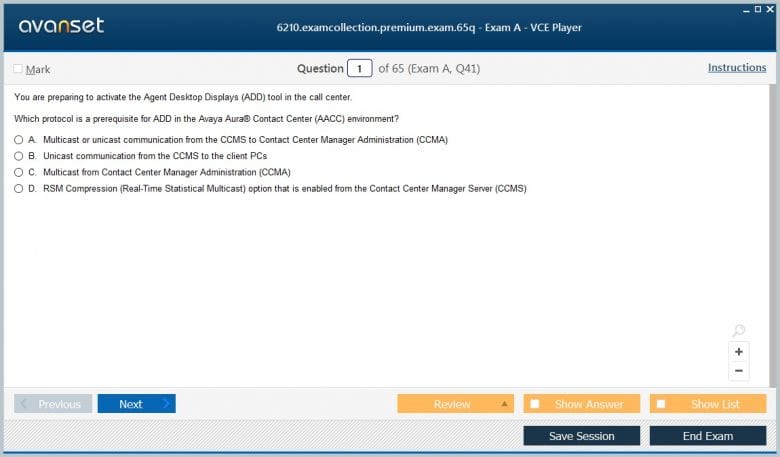
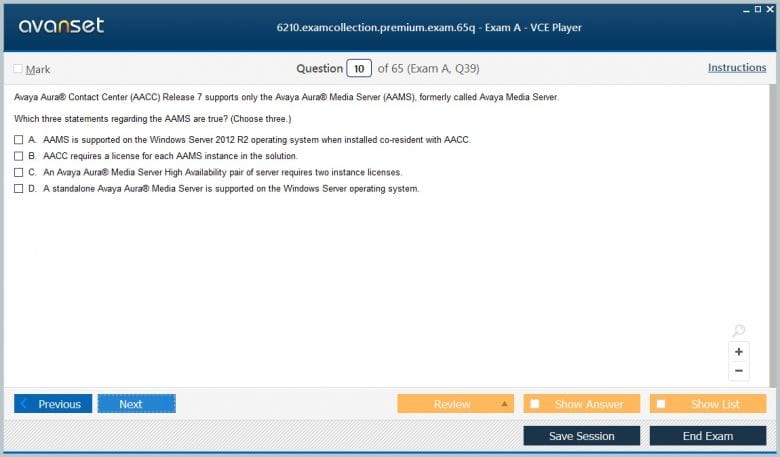
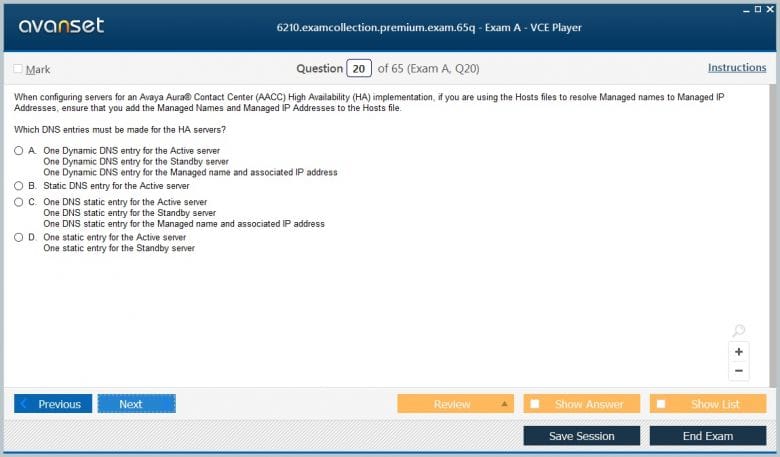
Avaya 6210 Practice Test Questions in VCE Format
| File | Votes | Size | Date |
|---|---|---|---|
File Avaya.test-inside.6210.v2026-08-25.by.archie.33q.vce |
Votes 1 |
Size 53.15 KB |
Date Aug 25, 2026 |
Avaya 6210 Practice Test Questions, Exam Dumps
Avaya 6210 (Avaya Aura Contact Center Implementation Exam) exam dumps vce, practice test questions, study guide & video training course to study and pass quickly and easily. Avaya 6210 Avaya Aura Contact Center Implementation Exam exam dumps & practice test questions and answers. You need avanset vce exam simulator in order to study the Avaya 6210 certification exam dumps & Avaya 6210 practice test questions in vce format.
6210 was the Avaya Aura Contact Center Implementation Exam tied to the ACIS-6202 implementation credential. It is retired. Avaya Learning announced that ACIS-6202, ACIS-6209, ACSS-3300, and the associated Aura Contact Center credential group would retire on May 31, 2023, and the notice listed 6210 with the same final registration and delivery date. The announcement described those credential offerings as retiring without a replacement.
That makes 6210 a historical implementation exam, not a current 2026 certification target. Its value now lies in the architecture and deployment thinking behind an Aura Contact Center implementation: preparing the environment, connecting telephony and contact-center components, creating routing and skill structures, integrating reporting and multimedia services, and proving that the end-to-end customer interaction behaves as designed.
The old exam belonged to a closely related group of Avaya certifications. 6211 covered the multimedia implementation side, while 3312 focused on administration within the support path. Avaya retired all three in the 2023 contact-center credential transition, so those links provide historical context rather than an active progression.
A contact center is a system of systems. Telephony, application servers, databases, routing logic, agent clients, identity, media, reporting, network services, and external channels have to agree on addressing, timing, credentials, and service relationships. An installer can complete successfully while the business service still fails because the surrounding dependencies are wrong.
That is why implementation knowledge starts with a topology. The implementer should be able to identify where calls or other contacts enter, which component decides what happens next, where agent eligibility is represented, how media reaches the user, where configuration is administered, and where operational data is recorded. Drawing the path before changing configuration makes later troubleshooting much faster.
Historical 6210 preparation should therefore treat product components as roles in a flow rather than as isolated definitions. Ask what the component receives, what decision it makes, what it sends next, and which dependency would break that exchange. This produces a deployment model that can survive small product-version changes better than memorizing a screen sequence.
Before deploying contact-center software, the surrounding environment has to be ready. DNS, NTP, IP addressing, routing, certificates, firewall rules, virtualization resources, storage, user accounts, and supported software combinations can all affect the outcome. A contact-center platform also depends on telephony systems that must already be reachable and correctly administered.
An implementation plan should therefore distinguish prerequisites from configuration. A missing DNS record is not a routing-script problem. Time drift is not an agent-skill problem. A blocked port is not fixed by recreating a user. Strong implementers test infrastructure assumptions early and document them, because otherwise later failures produce misleading symptoms in higher layers.
This is one of the most transferable lessons from the old 6210 scope. When a deployment fails, begin at the lowest plausible dependency and move upward. Confirm server health and network reachability, then identity and trust, then application relationships, then contact-center objects, then the agent/customer flow. The sequence reduces random changes and preserves evidence.
Aura Contact Center historically depended on the surrounding Avaya telephony environment to deliver and control voice interactions. The implementer needed to understand enough of Communication Manager, signaling, route points, agent behavior, and media handling to make the contact-center application work as part of the larger system. A routing application cannot compensate for an incorrectly built telephony path.
Voice implementation is easiest to understand as a chain. A call arrives, the telephony platform recognizes the destination, the contact-center logic receives control or context, the interaction is classified and routed, an eligible agent is selected, and media is connected. A failure at each step produces different evidence. The implementer should know where to look rather than assuming every symptom belongs inside the contact-center application.
Testing should use controlled call cases with known expected results. Verify simple inbound handling first, then transfers, hold, consultation, after-call work, and any specialized behavior. Add complexity only after the basic flow is stable. This avoids troubleshooting several interacting features at once.
Contact-center routing works only when the technical model reflects how the business actually operates. Skillsets represent categories of work or ability, while agent assignments indicate who can receive those contacts and with what priority. Poor modeling can create long waits, overloaded specialists, or calls reaching employees who cannot resolve them.
The implementer therefore needs both configuration skill and discovery skill. Business owners may describe teams, languages, products, regions, priority customers, or escalation rules. Those descriptions have to become a manageable set of skills and routing decisions. Creating one skill for every exception can make the system impossible to operate; creating too few can erase distinctions the business cares about.
Implementation validation should include test users for each meaningful combination. Place contacts that should match different skills, confirm the expected agents become eligible, and check what happens when no preferred agent is available. The goal is not only to show that a call can reach someone but to prove that the routing model behaves predictably under normal and edge conditions.
Contact-center applications evolve after go-live. Holiday treatment changes, products are added, service targets move, teams merge, and new escalation rules appear. A routing design that technically works but is opaque becomes expensive to maintain. Implementation quality therefore includes naming, structure, comments or documentation, and controlled reuse of routing logic.
A useful design separates business intent from low-level mechanics where possible. For example, the meaning of "premium customer" should be clear in the data or logic that identifies that customer, and the treatment applied afterward should be traceable. If every decision is hidden inside a long sequence of conditions, support teams will struggle to diagnose behavior months later.
Historical 6210 study becomes much stronger when candidates practice explaining the routing path aloud. If an interaction enters at a particular point, what information is inspected, which branch is chosen, which service or skill is targeted, and what fallback exists? An implementer who can answer those questions is better prepared than someone who only recognizes configuration labels.
A contact center cannot be considered implemented merely because agents can answer calls. Supervisors need reliable visibility into queues, agent states, service levels, contact volumes, and exceptions. The data model has to correspond to the configured services and skills, and reporting components need to receive the expected information.
Acceptance testing should therefore include operational questions. Can a supervisor see work waiting in the expected skill? Does an agent state change appear where expected? Are abandoned contacts and answered contacts classified correctly? Do service-level calculations use the intended population? A configuration error that distorts reporting can lead managers to make poor staffing or routing decisions even when calls continue to flow.
This also creates a useful troubleshooting feedback loop. If routing behaves incorrectly, real-time and historical data can show where contacts accumulated or which agents were selected. The implementer should learn to use those observations as evidence rather than treating reports as something that matters only after the project is complete.
The 6210 implementation path was related to, but not identical with, the multimedia scope represented by 6211. Voice contact handling and multimedia channels share concepts such as routing, skills, agents, service treatment, and reporting, but email or other digital interactions introduce channel-specific components and failure modes. Avaya maintained a separate implementation exam because those additional dependencies mattered.
For someone studying old 6210 material, the right boundary is to understand where voice implementation ends and multimedia integration begins. If a scenario requires mailbox connectivity, channel-specific acquisition, multimedia presentation, or digital-contact behavior, the historical 6211 multimedia implementation exam is the closer reference. If it concerns overall AACC deployment, telephony integration, skills, routing, and core implementation, 6210 is the more natural historical frame.
The distinction also illustrates a broader design principle: adding a channel is not just adding another queue. Each channel has its own transport, authentication, content, timing, and agent-experience considerations. An implementation plan should make those dependencies explicit.
Avaya's retirement notice is precise: the ACIS-6202 implementation credential and exam 6210 retired on May 31, 2023, together with the related AACC credential group, and the notice did not name a replacement for those offerings. That status should take precedence over current-looking third-party pages that still sell 6210 preparation material.
A retired certification does not mean every Aura Contact Center deployment disappeared on the same date. Organizations can continue to operate supported or legacy environments, and engineers may still need the product knowledge for maintenance, migration, or historical troubleshooting. The correct learning source in that situation is the documentation for the deployed release plus current vendor guidance, not the assumption that passing an old exam remains possible.
Current certification planning should start from Avaya's present learning catalog and the platform actually being supported. The 6210 code is useful for interpreting old resumes, training plans, and project documentation, but it should not be represented as a current requirement.
The most productive way to reuse 6210 material is to build a deployment checklist around architecture, prerequisites, telephony integration, routing, skills, agent behavior, monitoring, acceptance testing, and handover. For each item, identify the evidence that proves it works. That turns historical certification material into a practical engineering framework.
Then practice failure isolation. Break one dependency at a time in a safe lab or review a documented incident: DNS, time, trust, route point, skill assignment, agent state, or reporting. Predict the symptom before checking the result. This develops the causal understanding that implementation work demands.
6210 is retired, and Avaya's 2023 announcement is the status authority. The lasting value is the discipline of building a contact-center system end to end, validating it from the customer's interaction through the agent and supervisor experience, and leaving a configuration that support teams can understand after the implementation project has ended.
Go to testing centre with ease on our mind when you use Avaya 6210 vce exam dumps, practice test questions and answers. Avaya 6210 Avaya Aura Contact Center Implementation Exam certification practice test questions and answers, study guide, exam dumps and video training course in vce format to help you study with ease. Prepare with confidence and study using Avaya 6210 exam dumps & practice test questions and answers vce from ExamCollection.
Purchase Individually
Site Search:

SPECIAL OFFER: GET 10% OFF

Pass your Exam with ExamCollection's PREMIUM files!
SPECIAL OFFER: GET 10% OFF
Use Discount Code:
MIN10OFF
A confirmation link was sent to your e-mail.
Please check your mailbox for a message from support@examcollection.com and follow the directions.

Download Free Demo of VCE Exam Simulator
Experience Avanset VCE Exam Simulator for yourself.
Simply submit your e-mail address below to get started with our interactive software demo of your free trial.