

Premium File
367 Q&A
$76.99$69.99
ACSM 040-444 Exam Questions & Answers, Accurate & Verified By IT Experts
Instant Download, Free Fast Updates, 99.6% Pass Rate
367 Questions & Answers
Last Update: Sep 30, 2026
$69.99
ACSM 040-444 Exam Screenshots
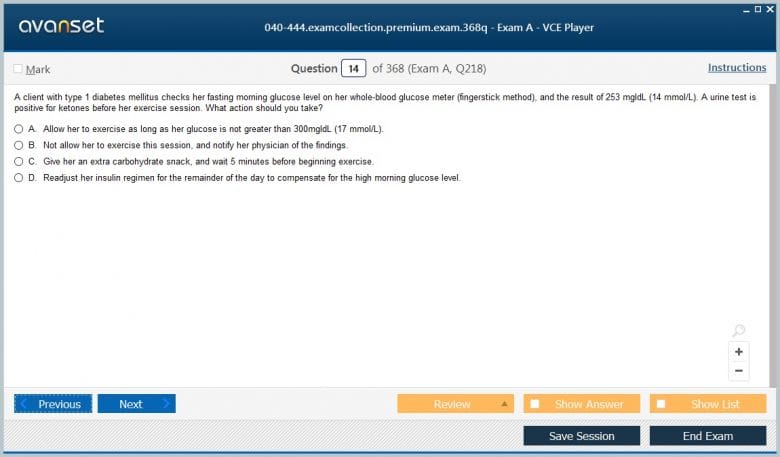
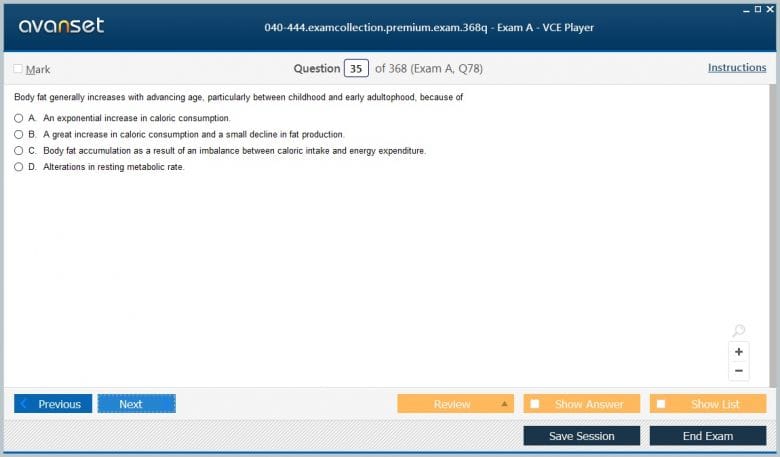
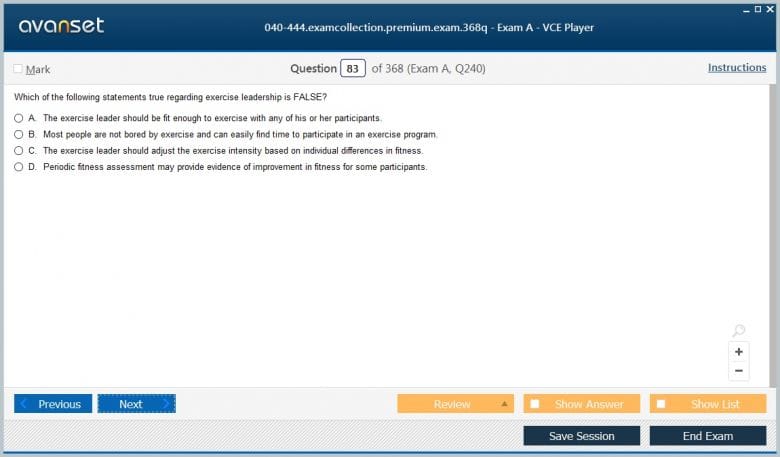
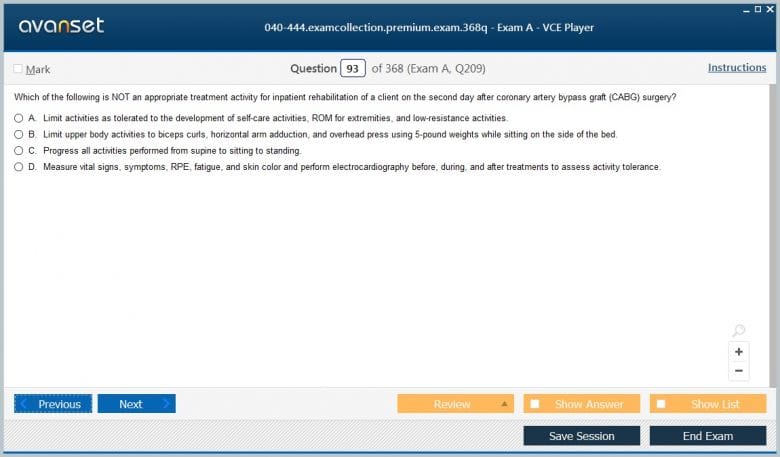
ACSM 040-444 Practice Test Questions in VCE Format
| File | Votes | Size | Date |
|---|---|---|---|
File ACSM.certkiller.040-444.v2026-08-04.by.jackson.221q.vce |
Votes 1 |
Size 1.18 MB |
Date Aug 04, 2026 |
File ACSM.Testkings.040-444.v2019-02-24.by.Aron.230q.vce |
Votes 3 |
Size 217.18 KB |
Date Feb 26, 2019 |
ACSM 040-444 Practice Test Questions, Exam Dumps
ACSM 040-444 (ACSM Registered Clinical Exercise Physiologist) exam dumps vce, practice test questions, study guide & video training course to study and pass quickly and easily. ACSM 040-444 ACSM Registered Clinical Exercise Physiologist exam dumps & practice test questions and answers. You need avanset vce exam simulator in order to study the ACSM 040-444 certification exam dumps & ACSM 040-444 practice test questions in vce format.
040-444 is a historical ACSM exam identifier associated with the Registered Clinical Exercise Physiologist pathway. It remains useful as a search and archive reference, but ACSM no longer treats RCEP as an active credential. In its current certification records, ACSM has consolidated RCEP, the former CEP designation, and ETT under the active ACSM Certified Clinical Exercise Physiologist (ACSM-CEP) credential. Candidates arriving through the old code should therefore use this page as a bridge from the legacy identity to the current clinical exercise physiology standard, not as evidence that 040-444 is still schedulable.
The current ACSM-CEP exam is materially different from an old-code study target. ACSM lists 115 total items, of which 100 are scored and 15 are unscored, with a 210-minute seat time. Its six performance domains are Patient Assessment, Exercise Testing, Exercise Prescription, Exercise Training and Leadership, Education and Behavior Change, and Legal and Professional Responsibilities. Those domains provide the current preparation framework. ACSM certifications also make clear that clinical exercise physiology sits inside a professional ladder rather than functioning as an isolated exam code.
The enduring value of 040-444 material is conceptual. Clinical exercise physiologists still need to assess patients, recognize contraindications, conduct and interpret exercise testing, prescribe exercise for chronic disease, monitor training responses, communicate with healthcare teams, and stay inside professional scope. What changes is the current blueprint, terminology, eligibility structure, and evidence base. A sound preparation plan therefore keeps valid physiology while replacing historical administrative assumptions with current ACSM documentation.
Legacy exam pages create a specific risk: a learner may mistake a surviving URL for a current registration route. ACSM has explicitly reclassified discontinued credentials as legacy and says they are no longer active or eligible for recertification. For RCEP holders, the important continuity is that the clinical practice area did not disappear; it was consolidated into ACSM-CEP. That means old RCEP content can still illuminate cardiopulmonary rehabilitation, risk stratification, testing, prescription, and clinical monitoring, but historical titles, renewal rules, or exam structures should not be carried forward automatically. Candidates should confirm current eligibility before planning a testing date because ACSM-CEP requires defined academic preparation, hands-on clinical experience, and professional-level CPR/BLS credentials. The distinction between an archived exam identity and a live credential is especially important for employers or professionals updating resumes: the old RCEP designation can be represented as historical achievement, while current competence should be described using ACSM’s present certification status and rules.
Current ACSM-CEP preparation begins with patient assessment because exercise decisions depend on the person’s diagnosis, treatment history, symptoms, medications, functional limitations, risk factors, goals, and current activity. A clinical exercise physiologist is not merely collecting a questionnaire. The professional must recognize information that changes testing or exercise, identify when additional medical clarification is needed, and synthesize findings into a safe plan. Vital signs, physical examination observations within scope, relevant laboratory values, cardiovascular and pulmonary history, metabolic disease, musculoskeletal limits, and psychosocial barriers can all change the appropriate next step. The old 040-444 context often emphasized clinical populations, and that emphasis remains highly relevant, but current candidates should frame assessment as a structured clinical reasoning task. The strongest preparation uses cases: determine what matters, what is missing, what could make exercise unsafe, and what information must be communicated to the supervising or referring healthcare team before progression.
Clinical testing is not simply choosing a treadmill protocol and calculating a result. The candidate must understand why a test is being performed, whether the patient can safely complete it, which measurements are required, how equipment and staff should be prepared, and when the test should be modified or terminated. Symptoms, ECG responses when applicable, blood pressure behavior, oxygen saturation, perceived exertion, workload, and recovery all contribute to interpretation. A useful way to study is to follow one patient through pretest review, baseline measurements, protocol selection, monitoring, termination, recovery, and communication of results. Historical RCEP material may contain familiar testing concepts, but contemporary preparation should be anchored to the current ACSM content outline and current clinical guidance. The related legacy 030-333 clinical exercise specialist material can help explain how earlier ACSM pathways converged, provided it is read as historical context rather than a second active route.
Prescription for a clinical population is more than applying a generic FITT formula. Frequency, intensity, time, type, volume, and progression need to reflect the patient’s disease state, measured capacity, treatment plan, symptoms, medications, musculoskeletal limitations, and goals. Beta blockers can alter heart-rate responses; pulmonary disease can make dyspnea and oxygenation central monitoring variables; diabetes can change fueling and glucose-management decisions; orthopedic limitations can shift modality; cancer treatment can affect fatigue and recovery. The exam candidate should be comfortable turning assessment and test findings into a defensible prescription and then adapting it as the patient responds. Study cases should include both the initial plan and a later visit where something changes. This is where rote memorization breaks down: two patients with the same diagnosis can require different programming because functional status, comorbidities, medications, confidence, environment, and treatment stage are different.
The clinical exercise physiologist is responsible for what happens after the prescription is written. Training sessions require observation of technique, symptoms, physiological response, tolerance, and adherence. The professional should recognize normal exertional responses and distinguish them from warning signs that justify modification, termination, referral, or emergency action. Leadership also includes choosing progressions that are meaningful for function and health rather than chasing arbitrary workloads. In cardiac or pulmonary rehabilitation, for example, a small gain in sustainable activity may matter more than a dramatic short-term performance increase. Candidates should practice documenting the connection between a patient’s response and the next decision: why intensity changed, why a mode was substituted, why recovery was lengthened, or why a healthcare provider was contacted. This decision trail is a stronger measure of clinical competence than the ability to recite a progression rule without context.
ACSM gives education and behavior change a distinct place in the current blueprint because a technically perfect program fails if the patient cannot or will not carry it into daily life. Clinical populations may face fear of symptoms, low confidence, financial constraints, transportation problems, competing caregiving duties, medication burden, depression, pain, or previous negative experiences with exercise. The clinician needs practical communication strategies: explain risk without frightening the patient, use understandable language, agree on achievable goals, identify barriers, reinforce progress, and support self-monitoring. Preparation should include scenarios in which the correct answer is not a different exercise but a better communication or adherence intervention. This domain also rewards attention to health literacy and shared decision-making. The purpose is not to make the patient dependent on supervised sessions; it is to build enough understanding and self-efficacy for safer long-term activity.
Clinical work occurs inside scope-of-practice, documentation, privacy, informed-consent, emergency-response, and interprofessional boundaries. A certified exercise physiologist may have deep exercise-science expertise, but that does not authorize diagnosis, medication adjustment, or clinical actions reserved for other licensed professionals. Candidates should be able to identify when a problem requires referral and how to communicate observations without overstepping. Documentation should support continuity of care by recording relevant findings, interventions, responses, and follow-up decisions rather than vague session notes. Facilities also need emergency plans that staff can execute under pressure. Ethical judgment matters when commercial pressure, patient preference, or scheduling convenience conflicts with safety. The legacy RCEP identity was grounded in clinical professionalism, and that expectation remains central under ACSM-CEP; the difference is that current candidates must apply it within today’s consolidated credential and current policies.
Anyone using a 040-444 page to plan a current credential should check eligibility before investing heavily in exam preparation. ACSM currently describes two main ACSM-CEP academic-and-experience routes: a master’s degree in clinical exercise physiology or equivalent with 600 hours of hands-on clinical experience, or a bachelor’s degree in exercise science, exercise physiology, or equivalent with 1,200 hands-on clinical hours, together with the required rescue credential. ACSM has also announced additional program-accreditation requirements effective August 15, 2027, so candidates near that transition need to verify which rule applies to their graduation and application timeline. This is exactly why a legacy code cannot serve as a complete preparation guide. The 010-111 ACSM-CPT legacy identity illustrates the same principle at another level: historical identifiers may persist, while current eligibility, blueprint, and delivery information move on.
The most reliable way to use old 040-444 knowledge is to reorganize it under the six current ACSM-CEP domains. Start with patient assessment and exercise testing because they determine what can safely be prescribed. Then connect prescription to training leadership so every program decision has a monitoring and progression consequence. Treat education and behavior change as a clinical skill rather than a soft afterthought, and keep legal/professional responsibilities active across every case. Practice with mixed scenarios instead of studying diseases in isolated silos: a cardiac patient may also have diabetes, orthopedic pain, low confidence, and medication effects that alter exercise response. When a historical study note conflicts with the current ACSM outline or current Guidelines for Exercise Testing and Prescription, the current source should control. That approach preserves the useful clinical foundation behind 040-444 while preparing for the credential ACSM actually maintains today.
Go to testing centre with ease on our mind when you use ACSM 040-444 vce exam dumps, practice test questions and answers. ACSM 040-444 ACSM Registered Clinical Exercise Physiologist certification practice test questions and answers, study guide, exam dumps and video training course in vce format to help you study with ease. Prepare with confidence and study using ACSM 040-444 exam dumps & practice test questions and answers vce from ExamCollection.
Purchase Individually
Site Search:

SPECIAL OFFER: GET 10% OFF

Pass your Exam with ExamCollection's PREMIUM files!
SPECIAL OFFER: GET 10% OFF
Use Discount Code:
MIN10OFF
A confirmation link was sent to your e-mail.
Please check your mailbox for a message from support@examcollection.com and follow the directions.

Download Free Demo of VCE Exam Simulator
Experience Avanset VCE Exam Simulator for yourself.
Simply submit your e-mail address below to get started with our interactive software demo of your free trial.