



Premium File
346 Q&A
$76.99$69.99
ACSM 010-111 Exam Questions & Answers, Accurate & Verified By IT Experts
Instant Download, Free Fast Updates, 99.6% Pass Rate
346 Questions & Answers
Last Update: Sep 27, 2026
$69.99
ACSM 010-111 Exam Screenshots
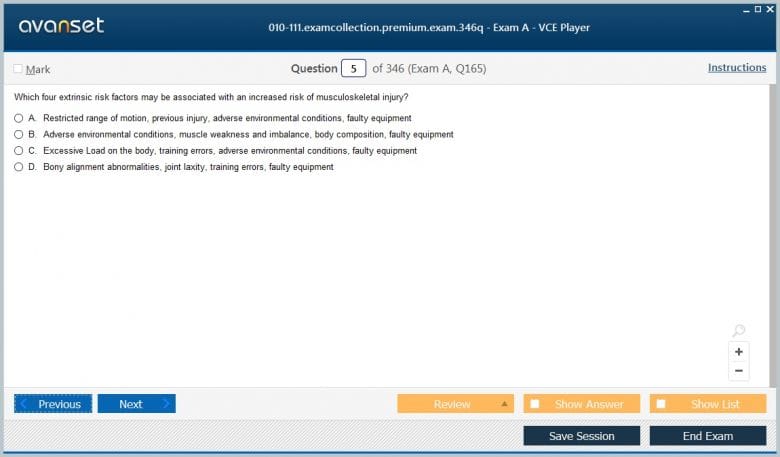
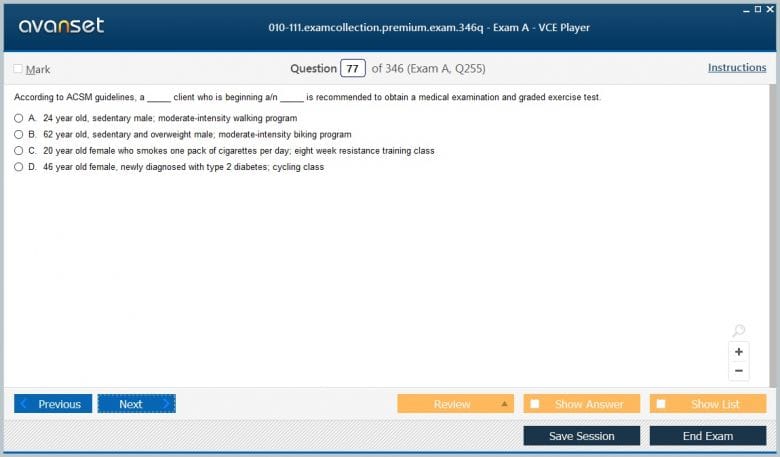
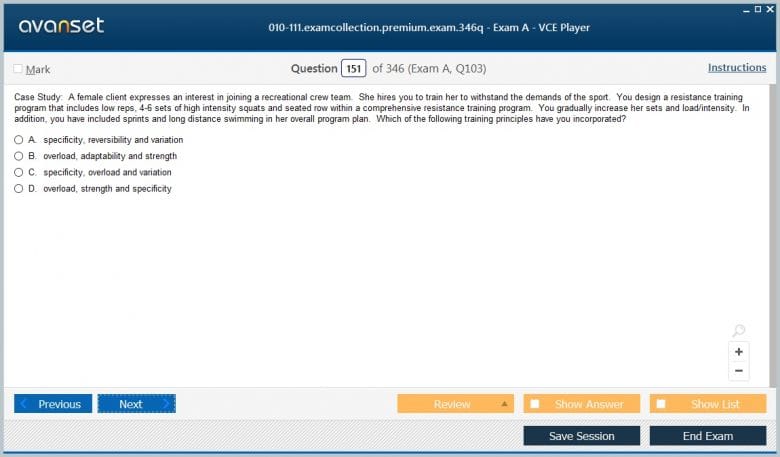
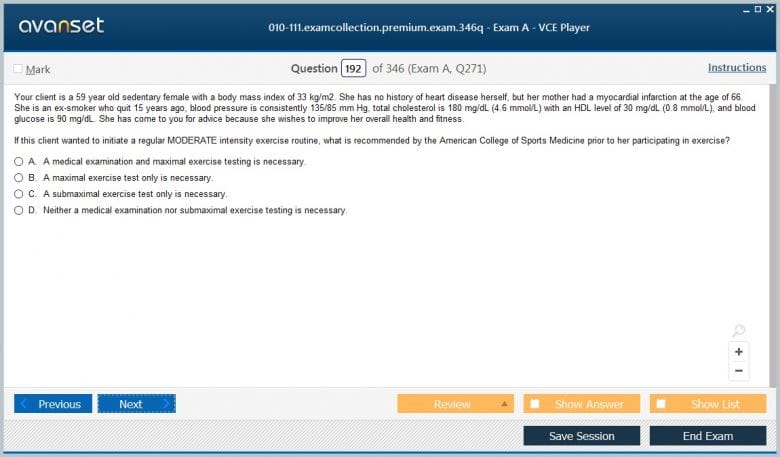
ACSM 010-111 Practice Test Questions in VCE Format
| File | Votes | Size | Date |
|---|---|---|---|
File ACSM.prep4sure.010-111.v2026-05-16.by.scarlett.190q.vce |
Votes 1 |
Size 191.37 KB |
Date May 15, 2026 |
File ACSM.Test-king.010-111.v2019-03-20.by.Andres.215q.vce |
Votes 2 |
Size 214.55 KB |
Date Mar 24, 2019 |
ACSM 010-111 Practice Test Questions, Exam Dumps
ACSM 010-111 (ACSM Certified Personal Trainer) exam dumps vce, practice test questions, study guide & video training course to study and pass quickly and easily. ACSM 010-111 ACSM Certified Personal Trainer exam dumps & practice test questions and answers. You need avanset vce exam simulator in order to study the ACSM 010-111 certification exam dumps & ACSM 010-111 practice test questions in vce format.
010-111 is a long-lived catalogue code associated with the ACSM Certified Personal Trainer exam, but it is not how the American College of Sports Medicine presents the current certification pathway. Candidates should prepare for today’s ACSM-CPT blueprint, not assume that an old-code question bank reflects the current exam simply because the credential name is familiar.
The current ACSM-CPT exam uses 135 multiple-choice items in a 150-minute seat time: 120 scored questions and 15 unscored pretest items. ACSM updated its certification exams on July 10, 2025 to align with current job-task analyses and the 12th edition of its Guidelines for Exercise Testing and Prescription. That means legacy 010-111 material can still support anatomy, screening, assessment, programming, coaching, and professional-scope fundamentals, but current official resources should control content emphasis and exam administration.
ACSM describes the Certified Personal Trainer as a professional who works with apparently healthy clients and people with stable health challenges who have been cleared to exercise independently. The credential is therefore centered on safe individualized fitness programming rather than clinical management of unstable or complex disease.
Current eligibility requires at least a high-school diploma or equivalent and current adult CPR/AED certification with a live practical skills component. ACSM indicates that first-aid requirements begin in 2027. Candidates should verify eligibility before paying for preparation resources because an old exam code does not establish today’s registration requirements.
The 030-333 represents a different historical scope. Personal training and clinical exercise practice overlap in exercise science, but current ACSM credentials define different education, experience, client, and responsibility boundaries.
A new client may arrive asking for weight loss, strength, better health, athletic performance, or relief from discomfort. The trainer’s first responsibility is not to prescribe immediately. Consultation gathers goals, activity history, readiness, preferences, schedule, barriers, medical information, and other facts that determine whether the request is appropriate for personal-training scope.
Communication skill matters because clients do not always present information in clinical language. The trainer should ask clear questions, listen for concerns, and avoid making diagnoses. When information suggests that medical clearance or another professional is needed, referral is part of competent practice rather than a failure to provide service.
The consultation also establishes informed expectations. Clients should understand the training relationship, privacy practices, scheduling, fees, cancellation rules, risks, and responsibilities. These professional foundations can appear less technical than exercise physiology, yet they shape safety and trust throughout the program.
Screening helps determine whether the client can begin or progress exercise safely and whether medical evaluation is indicated. The trainer must understand risk-related information without turning screening into diagnosis. The goal is to choose the correct next step within the professional role.
Medication use, symptoms, known disease, recent procedures, pregnancy, and other health factors can change exercise decisions. Candidates should learn how ACSM guidance frames participation and referral rather than rely on outdated rules remembered from older editions.
Emergency preparedness belongs in the same risk framework. CPR/AED credentials are not merely eligibility paperwork; trainers should know facility procedures, emergency communication, and how to respond when a client develops signs or symptoms that require stopping exercise and activating appropriate care.
Fitness assessment can include resting measures, body composition, aerobic capacity, muscular fitness, movement, and flexibility depending on the client and setting. The trainer should select tests that are safe, valid enough for the purpose, and useful for programming rather than test everything available.
Standardization matters when results will be compared over time. The same protocol, equipment setup, instructions, and conditions improve interpretability. A change in performance can otherwise reflect a different method instead of genuine adaptation.
Candidates should be able to translate results into client language. A number matters because it changes a training decision, clarifies a goal, or documents progress. Explaining results without shaming or overmedicalizing the client is part of professional communication.
A training plan should specify frequency, intensity, time, type, volume, and progression in a way that reflects the client’s goals, current capacity, preferences, and constraints. The best program is not necessarily the most advanced; it is the one the client can perform safely and consistently while creating enough stimulus for adaptation.
Progression should be based on response rather than calendar alone. A client who is recovering poorly, reporting pain, or struggling with technique may need modification even if the written plan says it is time to advance. Conversely, a client who adapts well may be ready for more volume, complexity, or intensity.
Candidates should practice balancing training variables instead of changing all of them simultaneously. If intensity rises, volume or frequency may need adjustment. Understanding the interaction between variables is more useful than memorizing isolated prescription ranges.
Recovery belongs in that design. Sleep, training frequency, previous activity, stress, and the amount of new volume introduced can influence how well a client tolerates the program. Candidates should be ready to modify a plan when recovery signals indicate that the planned workload is not producing the intended response.
Program design should also respect preference. Two exercises can train the same broad quality while differing in complexity, equipment, comfort, and adherence. When safety and effectiveness are comparable, choosing the option a client is willing and able to repeat can be the better professional decision.
Personal trainers need to recognize safe exercise setup and common technique errors across resistance, aerobic, flexibility, and functional movement. Coaching should be specific enough to change the movement without overwhelming the client with unnecessary cues.
Regression is an important professional skill. If a client cannot perform a movement safely, the answer may be to reduce load, shorten range, change position, simplify the exercise, or select another movement that trains the same objective. Forcing the planned exercise because it appears in a program is not good coaching.
Candidates should also understand the difference between normal exertion and warning signs that require stopping activity or referral. Scope of practice sets the boundary between exercise coaching and treating an injury or medical condition.
A technically excellent program has little value if the client cannot or will not follow it. Personal trainers use goal setting, self-monitoring, feedback, problem solving, social support, and motivational communication to help clients build sustainable activity patterns.
The trainer should avoid assuming that nonadherence reflects laziness. Time, cost, transportation, confidence, pain, family demands, prior experiences, and environmental barriers can all affect participation. A collaborative plan addresses the barrier the client actually has rather than applying the same motivational script to everyone.
Candidates should learn to match strategies to readiness and preference. The role is to support autonomous behavior change within scope, not to coerce clients or provide mental-health treatment beyond professional competence.
Personal trainers can educate clients about general healthy behaviors, but they should not diagnose disease, prescribe medication, provide individualized medical nutrition therapy where outside scope, or treat injuries as though they were licensed clinicians. Referral is a professional action when a problem exceeds competence.
Documentation supports this boundary. Session notes, consent, screening information, incident records, program changes, and referral communication create a record of decisions and continuity. They also help the trainer recognize patterns that should influence future programming.
Legal and professional responsibilities are part of the current blueprint. Candidates should understand negligence concepts, confidentiality, professional communication, emergency readiness, and the obligation to maintain competence rather than treat these as an afterthought.
Trainers also need professional boundaries in communication and marketing. Claims about guaranteed results, treatment of disease, or expertise outside the trainer’s actual qualifications can mislead clients even when no exercise is performed incorrectly. Ethical practice includes accurate representation of credentials and services.
ACSM’s current exam has 120 scored items and 15 unscored items mixed throughout a 2.5-hour session. Candidates cannot identify which questions are unscored, so every item should be treated seriously. Timed practice should build a pace that leaves room to reread scenario details and avoid careless interpretation errors.
Use the current exam content outline as the master study map, especially because ACSM aligned exams with updated professional standards in 2025. Legacy 010-111 questions can be supplementary when they test durable science or coaching principles, but they should not determine weighting or administrative expectations.
A strong readiness test is whether the candidate can move from client information to an appropriate decision: screen, assess, design, coach, modify, educate, document, and refer. That integrated workflow reflects current personal-training practice more accurately than memorizing the answers attached to an old exam code.
Candidates should also rehearse professional communication under time pressure. Many ACSM scenarios are not solved by selecting the most intense training option; they are solved by identifying the safest action, explaining a modification, recognizing a referral need, or choosing the response that keeps the client engaged within scope.
Go to testing centre with ease on our mind when you use ACSM 010-111 vce exam dumps, practice test questions and answers. ACSM 010-111 ACSM Certified Personal Trainer certification practice test questions and answers, study guide, exam dumps and video training course in vce format to help you study with ease. Prepare with confidence and study using ACSM 010-111 exam dumps & practice test questions and answers vce from ExamCollection.
Purchase Individually
Site Search:

SPECIAL OFFER: GET 10% OFF

Pass your Exam with ExamCollection's PREMIUM files!
SPECIAL OFFER: GET 10% OFF
Use Discount Code:
MIN10OFF
A confirmation link was sent to your e-mail.
Please check your mailbox for a message from support@examcollection.com and follow the directions.

Download Free Demo of VCE Exam Simulator
Experience Avanset VCE Exam Simulator for yourself.
Simply submit your e-mail address below to get started with our interactive software demo of your free trial.