



Premium File
3960 Q&A
$76.99$69.99
Test Prep CFA Level 1 Test Questions & Answers, Accurate & Verified By IT Experts
Instant Download, Free Fast Updates, 99.6% Pass Rate

CFA Level 1 Premium File: 3960 Questions & Answers
Last Update: Sep 05, 2026
CFA Level 1 Training Course: 49 Video Lectures
CFA Level 1 PDF Study Guide: 342 Pages
$79.99
Test Prep CFA Level 1 Exam Screenshots
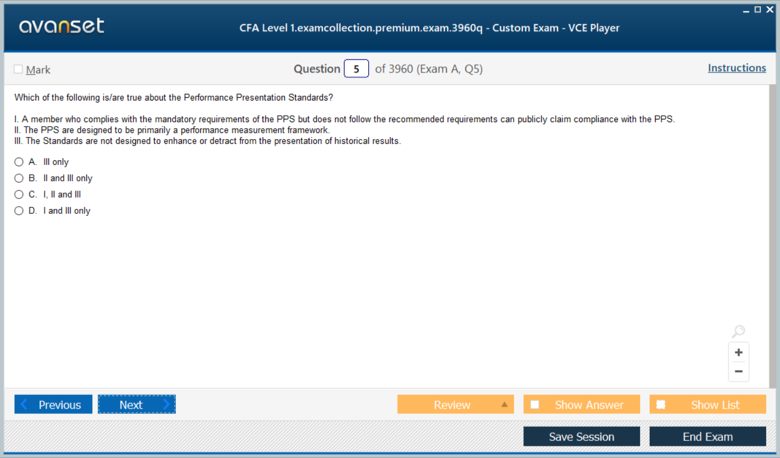
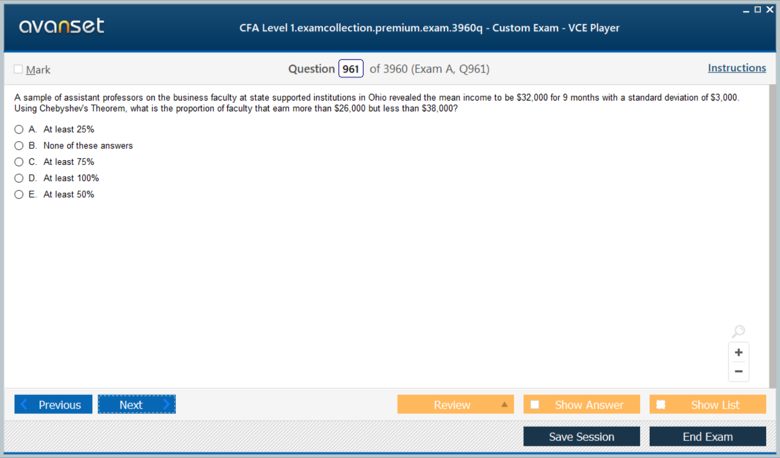
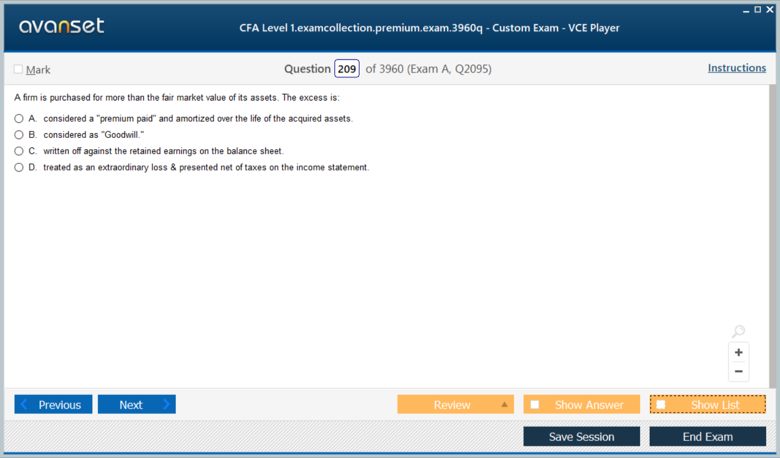
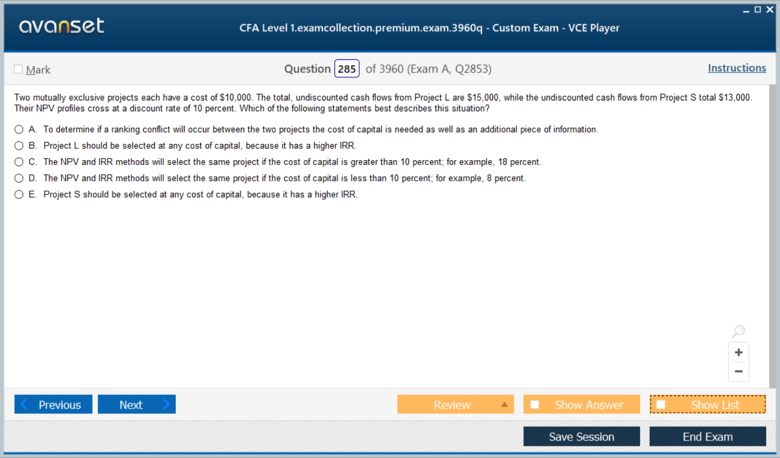
Test Prep CFA Level 1 Practice Test Questions in VCE Format
| File | Votes | Size | Date |
|---|---|---|---|
File Test Prep.passcertification.CFA Level 1.v2026-09-14.by.zeynep.2387q.vce |
Votes 1 |
Size 6.07 MB |
Date Sep 14, 2026 |
File Test Prep.testking.CFA Level 1.v2020-03-18.by.elliott.2376q.vce |
Votes 2 |
Size 6.41 MB |
Date Mar 18, 2020 |
Test Prep CFA Level 1 Practice Test Questions, Exam Dumps
Test Prep CFA Level 1 (CFA Level 1) exam dumps vce, practice test questions, study guide & video training course to study and pass quickly and easily. Test Prep CFA Level 1 CFA Level 1 exam dumps & practice test questions and answers. You need avanset vce exam simulator in order to study the Test Prep CFA Level 1 certification exam dumps & Test Prep CFA Level 1 practice test questions in vce format.
The CFA Program Level I exam is the foundation stage of a three-level investment credential. The current exam consists of 180 multiple-choice questions delivered in two sessions of about 135 minutes each. CFA Institute describes the level as testing whether candidates can learn and describe the key terms, concepts, formulas, and analytical relationships that underpin professional investment work. That breadth is the defining preparation challenge: candidates need competence across the curriculum rather than mastery of one favored finance topic.
The 2026 curriculum keeps Ethics prominent and distributes substantial weight across Financial Statement Analysis, Equity Investments, Fixed Income, Quantitative Methods, Economics, Corporate Issuers, Derivatives, Alternative Investments, and Portfolio Management. Topic weights are ranges, so a study plan built around predicting the exact number of questions in advance is fragile. The safer objective is to reach a minimum working standard in every area, then allocate additional review to high-weight and personally weak topics.
Ethical and Professional Standards carries enough weight that candidates cannot safely postpone it to the final days. The difficult questions are often not about recalling a rule name; they present a professional situation in which several facts matter and the candidate must identify which action best satisfies the Code and Standards. Small details about disclosure, independence, priority, diligence, or communication can change the conclusion.
Preparation should therefore emphasize scenario analysis. Identify the duty, the stakeholders, the potential conflict, the information available to the professional, and the action taken. Then ask which standard governs the problem and why the alternative choices fail. Repeated exposure to realistic cases builds pattern recognition far better than memorizing a list of standard numbers.
Statistics, probability, time value of money, sampling, estimation, hypothesis testing, and related quantitative tools are not isolated mathematics requirements. They reappear in valuation, portfolio analysis, risk measurement, economics, and performance evaluation. A candidate who learns formulas mechanically may manage a direct question but struggle when the same concept appears inside an investment scenario.
The useful target is interpretation. Know what an input means, how a change affects the result, what assumptions a method relies on, and when the output would be misleading. Calculation speed matters on a timed exam, but so does selecting the right method. Formula practice should therefore include short explanations of why the formula is appropriate and what the answer says economically.
Economics at Level I gives candidates a framework for understanding supply and demand, market structures, business cycles, monetary and fiscal policy, international trade, currency relationships, and macroeconomic conditions. The value is not abstract theory. These concepts help explain why discount rates, corporate revenues, inflation expectations, and asset prices may move together.
Candidates should practice directional reasoning. If policy rates rise, which channels can affect borrowing, exchange rates, consumption, investment, and valuation? If a currency changes, which companies may benefit or suffer? Questions become easier when economic models are connected to consequences rather than stored as diagrams that are remembered only in their original textbook form.
Financial statements are a major Level I domain because analysts need to understand what reported numbers mean before using them in valuation. Candidates should be comfortable with the income statement, balance sheet, cash-flow statement, revenue recognition, inventories, long-lived assets, taxes, financial instruments, ratios, and the effects of accounting choices.
The most important habit is linking an accounting treatment to the statements and ratios it changes. A question may not ask for a definition of an inventory method; it may ask how the method affects cost of sales, profit, assets, or a ratio under changing prices. Building those chains of effects turns memorization into analysis and prepares candidates for the deeper interpretation expected at Level II.
Corporate Issuers examines governance, capital budgeting, cost of capital, working capital, and financing decisions, while Equity Investments covers market organization, security characteristics, industry and company analysis, and introductory valuation. Together they show how corporate decisions and investor expectations meet in the value of a security.
Preparation should connect the company to the market. A capital project affects future cash flows; financing affects risk and required return; competitive conditions affect margins and growth; and valuation translates those expectations into a price. Candidates who study each formula separately can miss the common thread: investors are estimating the amount, timing, and risk of future economic benefits.
Bonds are conceptually simple—contractual cash flows discounted at required returns—but the details quickly become technical. Candidates need to understand pricing, yield measures, spot and forward rates, duration, convexity, credit risk, securitized products, and how changes in rates affect value. The relationship between price and yield should become intuitive rather than remain a formula remembered for exam day.
A strong routine uses timeline sketches and checks direction before calculation. If required yield rises, a plain fixed-rate bond should generally fall in price. Longer duration implies greater sensitivity to yield changes. Credit deterioration can widen spreads even if government rates are unchanged. These qualitative anchors help candidates detect calculation mistakes and choose among close answer options.
Level I introduces forwards, futures, options, swaps, and alternative investments such as real estate, private capital, commodities, infrastructure, and hedge funds. The objective is not yet to perform every advanced valuation. Candidates should understand payoff structures, risk exposures, basic pricing relationships, and why investors might use these instruments or assets.
Diagrams are particularly helpful for derivative payoffs because they make asymmetry visible. For alternatives, comparison tables can clarify liquidity, fee structures, valuation difficulty, leverage, return drivers, and diversification characteristics. The key is to avoid treating “alternative” as one homogeneous asset class; different vehicles solve different portfolio problems and carry different risks.
Risk and return are ultimately evaluated at the portfolio level. Level I introduces diversification, covariance, correlation, portfolio risk, asset allocation, and foundational models that explain the relationship between risk and expected return. These ideas connect earlier quantitative tools to the practical task of combining investments rather than judging each security in isolation.
Candidates should be able to explain why a risky asset can still improve a portfolio if its return pattern complements other holdings. That insight is more important than memorizing that diversification is “good.” The value comes from imperfect correlation and the interaction among positions. Portfolio questions therefore reward an understanding of relationships, not just individual asset statistics.
The current CFA Program also includes a Practical Skills Module requirement. Level I candidates must complete at least one eligible PSM in order to receive their exam result, even though the module itself is not tested on the exam. For 2026 candidates, available Level I options include Financial Modeling and Python Programming Fundamentals. The module takes additional time, so it should be placed on the calendar rather than treated as an administrative task to remember after exam day.
Calculator proficiency is another small skill with an outsized effect on pacing. Candidates should use an approved calculator early enough to make time-value-of-money functions, cash-flow worksheets, statistics, and basic arithmetic routine. Learning shortcuts during the final week creates avoidable risk. Practice should include clearing registers, recognizing sign conventions, and checking whether a stored value from an earlier problem could contaminate the next calculation.
Mock exams are most informative when taken under realistic session limits and then reviewed slowly. A candidate who scores poorly because of five recurring concept gaps has a different problem from one who knows the material but loses points to pacing and calculator errors. The review should identify both. A correct answer reached through an accidental shortcut should be examined just as carefully as an incorrect answer if the reasoning would not survive a different set of numbers.
The curriculum is intentionally cumulative, so interleaving becomes more important late in preparation. A session that moves from ethics to fixed income to accounting to portfolio theory may feel harder than a single-topic drill, but that difficulty is useful. The real exam requires rapid context switching, and mixed practice trains the candidate to identify the topic and method without being told which chapter is being tested.
Passing Level I opens the path to CFA Level II, where the same body of knowledge is tested through more analytical, vignette-based questions. Candidates who survive Level I by memorizing formulas without understanding the relationships often discover that the approach does not scale. The best Level I preparation already asks “why” and “what changes if” alongside “how do I calculate this?”
A practical schedule cycles through learning, question practice, error review, and cumulative revision. Weak topics should reappear frequently enough that they are not relearned from zero each month. Formula recall, calculator fluency, and timed sets matter, but the final weeks should increasingly resemble the real exam: broad mixed-topic work, controlled pacing, and careful review of errors that reveal conceptual rather than merely careless weaknesses.
Exam-day preparation should include the nonacademic details that can invalidate months of work if ignored. Candidates need the required identification, a permitted calculator, familiarity with test-center rules, and an accurate appointment record. The final days are better used to stabilize sleep, review high-yield weak areas, and rehearse the pacing of two sessions than to begin entirely new topic blocks. Level I breadth makes calm retrieval and disciplined time allocation just as important as one more late-night reading.
Go to testing centre with ease on our mind when you use Test Prep CFA Level 1 vce exam dumps, practice test questions and answers. Test Prep CFA Level 1 CFA Level 1 certification practice test questions and answers, study guide, exam dumps and video training course in vce format to help you study with ease. Prepare with confidence and study using Test Prep CFA Level 1 exam dumps & practice test questions and answers vce from ExamCollection.
Purchase Individually

Test Prep CFA Level 1 Video Course

Top Test Prep Certifications































Top Test Prep Certification Exams
Site Search:

SPECIAL OFFER: GET 10% OFF

Pass your Exam with ExamCollection's PREMIUM files!
SPECIAL OFFER: GET 10% OFF
Use Discount Code:
MIN10OFF
A confirmation link was sent to your e-mail.
Please check your mailbox for a message from support@examcollection.com and follow the directions.

Download Free Demo of VCE Exam Simulator
Experience Avanset VCE Exam Simulator for yourself.
Simply submit your e-mail address below to get started with our interactive software demo of your free trial.