



Premium File
1893 Q&A
$76.99$69.99
Test Prep ASVAB Test Test Questions & Answers, Accurate & Verified By IT Experts
Instant Download, Free Fast Updates, 99.6% Pass Rate

ASVAB Test Premium File: 1893 Questions & Answers
Last Update: Sep 11, 2026
ASVAB Test PDF Study Guide: 336 Pages
$74.99
Test Prep ASVAB Test Exam Screenshots
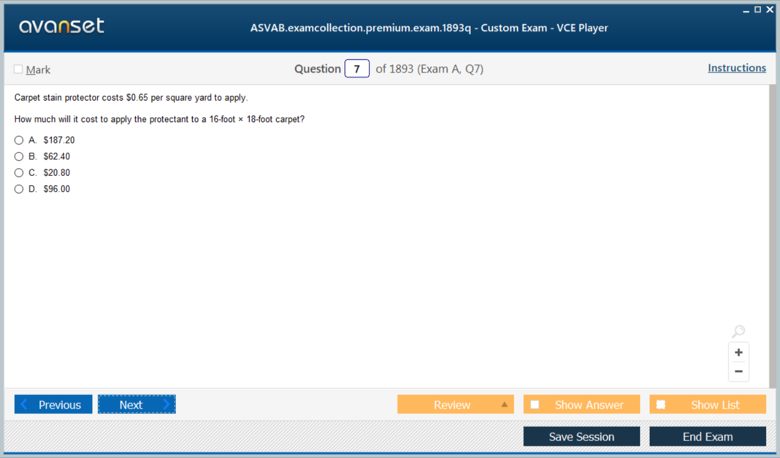
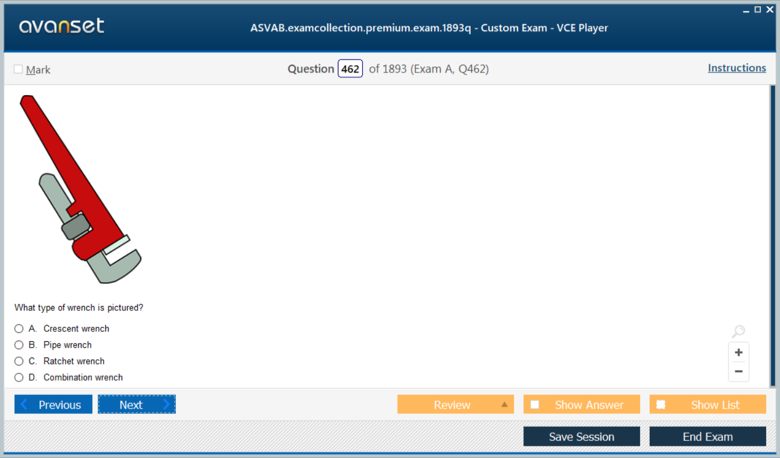
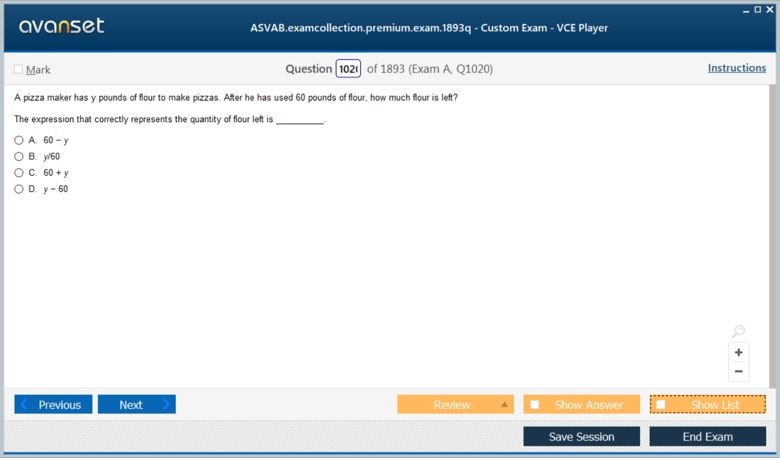
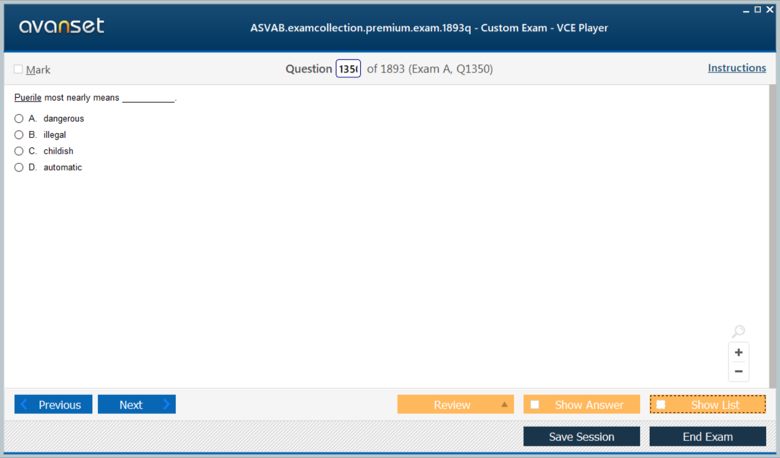
Test Prep ASVAB Test Practice Test Questions in VCE Format
Test Prep ASVAB Test Practice Test Questions, Exam Dumps
Test Prep ASVAB Test (Armed Services Vocational Aptitude Battery Test: General Science, Arithmetic Reasoning, Word Knowledge, Paragraph Comprehension, Mathematics Knowledge, Electronics Information, Automotive & Shop Information, Mechanical Comprehension, Assembling Objects) exam dumps vce, practice test questions, study guide & video training course to study and pass quickly and easily. Test Prep ASVAB Test Armed Services Vocational Aptitude Battery Test: General Science, Arithmetic Reasoning, Word Knowledge, Paragraph Comprehension, Mathematics Knowledge, Electronics Information, Automotive & Shop Information, Mechanical Comprehension, Assembling Objects exam dumps & practice test questions and answers. You need avanset vce exam simulator in order to study the Test Prep ASVAB Test certification exam dumps & Test Prep ASVAB Test practice test questions in vce format.
The ASVAB is not a conventional pass-or-fail school exam. It is a multiple-aptitude battery used by the U.S. military to support enlistment eligibility and occupational classification, which means the score report has two different jobs: part of it helps determine whether an applicant qualifies to enlist, while the broader pattern of subtest scores helps the services evaluate where that person may fit. That distinction should shape preparation. A candidate who studies only for a minimum qualifying number can miss the opportunity to strengthen the composite scores that influence job options.
The current enlistment program is offered primarily as the computerized CAT-ASVAB at Military Entrance Processing Stations, with paper-and-pencil testing still used at many Military Entrance Test locations. The underlying aptitudes are comparable, but the testing experience is not identical. Computer testing adapts item difficulty and controls navigation differently, while paper administration follows fixed forms and timing. Candidates should therefore prepare for the format they are likely to encounter instead of assuming every practice session reproduces the operational test.
The Armed Forces Qualification Test, or AFQT, is calculated from four verbal and mathematics areas: Arithmetic Reasoning, Mathematics Knowledge, Word Knowledge, and Paragraph Comprehension. The services use the AFQT to evaluate basic enlistment eligibility, with minimum requirements varying by branch and applicant circumstances. It is therefore the score most applicants hear about first, but it should not be mistaken for the whole ASVAB.
Other subtests measure areas such as general science, electronics information, auto and shop information, mechanical comprehension, and assembling objects. Those results contribute to service-specific line scores or composites used for occupational classification. A candidate interested in technical, mechanical, electronics, aviation, or other specialized military work should think beyond the AFQT and identify which aptitude combinations matter for the roles under consideration.
Word Knowledge and Paragraph Comprehension reward different reading behaviors. Vocabulary questions require a precise sense of meaning in context, including the ability to distinguish between near-synonyms. Paragraph questions ask the candidate to identify stated facts, implications, purposes, or relationships without importing assumptions that are not supported by the text. The most productive preparation is therefore a combination of vocabulary growth and disciplined evidence-based reading.
A focused review of ASVAB vocabulary and mathematical language is useful because terminology often determines whether a candidate even understands what a problem is asking. For reading, practice should emphasize paraphrasing the question, locating the relevant sentence or relationship, and rejecting choices that are plausible in the real world but unsupported by the passage. Speed develops after that reasoning becomes consistent.
Arithmetic Reasoning questions often look like simple mathematics, yet many errors occur before the arithmetic begins. The candidate has to translate a word problem into a workable relationship: rates, ratios, percentages, proportions, distance, work, averages, or basic algebra. If the translation is wrong, flawless calculation still produces the wrong answer. That is why reviewing solution structure matters more than memorizing isolated numeric tricks.
A good practice routine labels the type of relationship before calculating. Ask what is known, what is unknown, what units are involved, and whether the result should be larger or smaller than the starting values. Estimation is especially valuable because it catches misplaced decimals, inverted ratios, and implausible answers. Candidates should also rehearse solving without relying on a calculator, since the ASVAB is designed around mental and written reasoning rather than unrestricted calculator use.
Mathematics Knowledge is more direct than Arithmetic Reasoning but can expose weak foundations quickly. Algebraic manipulation, equations, exponents, roots, geometry, and other high-school mathematics topics become difficult under time pressure if every step has to be rediscovered. Preparation should therefore identify the specific rule families that cause hesitation and rebuild them through short sets before returning to mixed practice.
The goal is not to memorize hundreds of disconnected formulas. It is to recognize structure: when to isolate a variable, factor an expression, use a proportion, apply a geometric relationship, or estimate from a graph or numerical pattern. Candidates who keep an error log should separate concept errors from careless execution. A missed exponent rule needs content review; a sign error needs a checking habit. Treating both as “math mistakes” slows improvement.
General Science samples physical and biological science knowledge, while Electronics Information, Auto Information, Shop Information, and Mechanical Comprehension probe more specialized technical reasoning. These sections are not equally important to every military occupational path, but ignoring them can narrow options. A candidate who wants technical work should identify the relevant service composites early enough to give those areas deliberate study time.
The Mechanical Comprehension material is a good example of why conceptual understanding beats memorized answers. Levers, pulleys, gears, fluids, forces, and motion can be presented in unfamiliar diagrams. The candidate must infer what changes when a load moves, a gear reverses direction, or force is applied at a different point. Diagram practice should therefore include explaining the physical principle in words before choosing an option.
The computer and paper ASVAB formats assess the same broad aptitudes but feel different in practice. On a computer-adaptive test, item difficulty responds to performance and candidates generally cannot approach navigation as though they were working through a paper booklet. The best preparation is to become comfortable making a decision, checking it efficiently, and moving on rather than building a strategy around returning to large numbers of earlier questions.
Paper practice remains useful for learning content, but realistic simulations should reproduce the expected timing and response method. Candidates should also distinguish the enlistment ASVAB from school-based career exploration uses of ASVAB tools. The score information can support career exploration, yet an applicant preparing for enlistment should follow current guidance from the recruiting service and the official ASVAB program on where and how the operational test will be administered.
Candidates sometimes confuse the ASVAB with the Air Force Officer Qualifying Test. They are not interchangeable. The ASVAB supports enlisted accession and occupational classification across the services, while the AFOQT is associated with Air Force officer selection and contains a different mix of aptitude measures. Someone considering both enlisted and commissioned pathways should understand which test belongs to which application route before choosing preparation materials.
This distinction is also a useful reminder not to study by test name alone. Military testing programs are tied to personnel decisions. The practical question is what decision a score will inform: enlistment eligibility, job classification, officer selection, or another service-specific process. Once that purpose is clear, preparation can focus on the aptitudes that have the greatest impact on the candidate’s actual goal.
The ASVAB preparation material can support structured review, but the larger principle is to use practice for diagnosis. The official ASVAB program explicitly warns candidates about services claiming to possess real operational questions or guaranteed answers. Effective preparation uses representative problems to expose weak reasoning, then repairs the underlying skill so it transfers to unfamiliar items.
A broader ASVAB structure and practice review is most useful when it leads to a study plan by subtest rather than one undifferentiated score target. Track accuracy, timing, and error cause separately. Revisit weak mathematics concepts, expand vocabulary in context, practice extracting evidence from passages, and work through diagrams until the relevant mechanical or spatial relationship is clear.
Score interpretation should also be realistic. An AFQT percentile is not the percentage of questions answered correctly; it compares performance with a reference population. Service line scores are constructed differently and can emphasize different ASVAB subtests. Candidates should therefore avoid converting a practice-test raw percentage directly into a promised military qualification. Official recruiters and service guidance are the right source for current minimums and occupational standards.
Retesting should be approached with the same discipline. If an applicant must test again, the interval should be used to repair a specific skill profile rather than simply repeat full-length questions. A ten-point weakness in mathematics may call for algebra and arithmetic work, while a technical-role goal may justify extra mechanical or electronics study even if the AFQT is already acceptable. The score report should become a study map.
A candidate should leave preparation with two goals: avoid preventable weakness in the AFQT areas and build the broader aptitudes that support desired military specialties. That requires more than taking repeated full tests. Short skill sessions, mixed timed sets, careful error review, and periodic realistic simulations create a better feedback loop. When a score plateaus, the response should be to identify the recurring cause rather than simply increase question volume.
The ASVAB is ultimately a classification instrument as well as an entrance test. Strong preparation therefore broadens options. A higher verbal or mathematics result can improve AFQT standing, while stronger science, mechanical, electronics, or spatial performance may support access to technical occupational paths. Studying with that full purpose in mind makes the work more concrete: the target is not merely a number, but a score profile that accurately reflects the abilities a candidate wants to bring into military service.
Before test day, candidates should also verify identification, arrival, and recruiter instructions for the exact testing site. Administrative mistakes do not measure aptitude, yet they can disrupt an otherwise well-prepared attempt. The final review should be lighter than the main study period: a few representative problems, vocabulary refresh, and sleep are more useful than an exhausted last-minute attempt to cover every technical topic again. The objective is to arrive able to reason clearly across all subtests.
Go to testing centre with ease on our mind when you use Test Prep ASVAB Test vce exam dumps, practice test questions and answers. Test Prep ASVAB Test Armed Services Vocational Aptitude Battery Test: General Science, Arithmetic Reasoning, Word Knowledge, Paragraph Comprehension, Mathematics Knowledge, Electronics Information, Automotive & Shop Information, Mechanical Comprehension, Assembling Objects certification practice test questions and answers, study guide, exam dumps and video training course in vce format to help you study with ease. Prepare with confidence and study using Test Prep ASVAB Test exam dumps & practice test questions and answers vce from ExamCollection.
Purchase Individually

Top Test Prep Certifications


































Top Test Prep Certification Exams
Site Search:

SPECIAL OFFER: GET 10% OFF

Pass your Exam with ExamCollection's PREMIUM files!
SPECIAL OFFER: GET 10% OFF
Use Discount Code:
MIN10OFF
A confirmation link was sent to your e-mail.
Please check your mailbox for a message from support@examcollection.com and follow the directions.

Download Free Demo of VCE Exam Simulator
Experience Avanset VCE Exam Simulator for yourself.
Simply submit your e-mail address below to get started with our interactive software demo of your free trial.