



Premium File
170 Q&A
$76.99$69.99
PMI PMI-SP Exam Questions & Answers, Accurate & Verified By IT Experts
Instant Download, Free Fast Updates, 99.6% Pass Rate
170 Questions & Answers
Last Update: Sep 20, 2026
$69.99
PMI PMI-SP Exam Screenshots
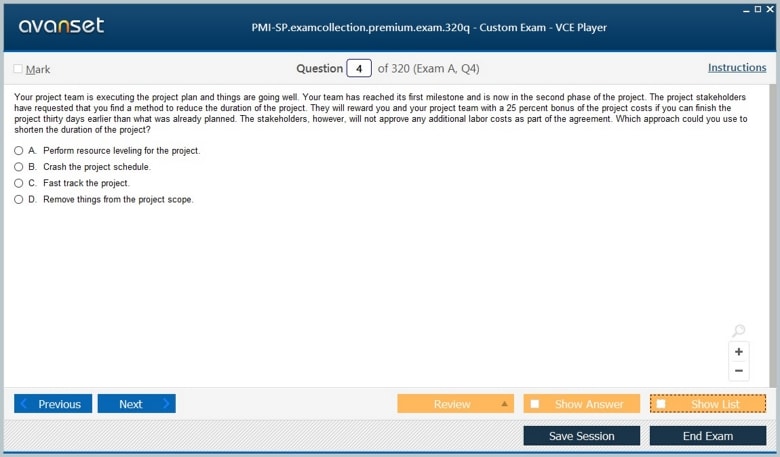
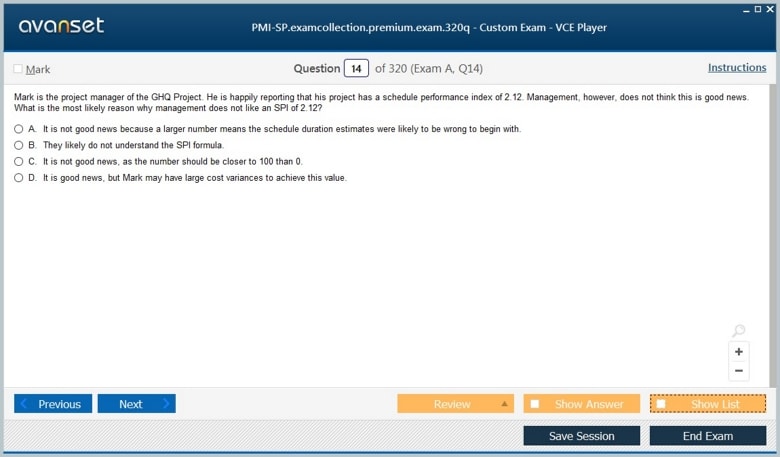
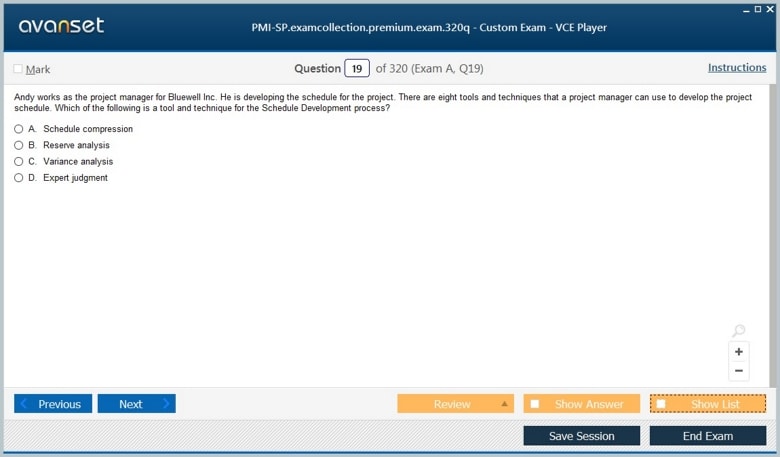
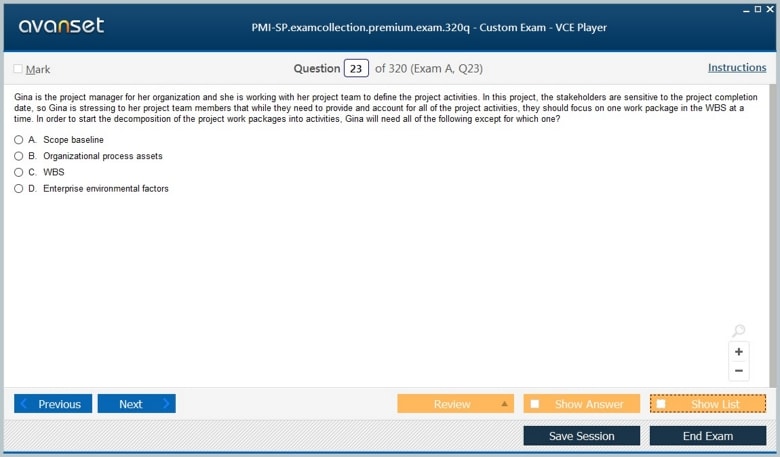
PMI PMI-SP Practice Test Questions in VCE Format
| File | Votes | Size | Date |
|---|---|---|---|
File PMI.testking.PMI-SP.v2026-08-17.by.alexander.176q.vce |
Votes 1 |
Size 1.35 MB |
Date Aug 18, 2026 |
File PMI.Train4sure.PMI-SP.v2019-02-03.by.Caleb.181q.vce |
Votes 1 |
Size 1.76 MB |
Date Feb 14, 2019 |
PMI PMI-SP Practice Test Questions, Exam Dumps
PMI PMI-SP (PMI Scheduling Professional Practice Test) exam dumps vce, practice test questions, study guide & video training course to study and pass quickly and easily. PMI PMI-SP PMI Scheduling Professional Practice Test exam dumps & practice test questions and answers. You need avanset vce exam simulator in order to study the PMI PMI-SP certification exam dumps & PMI PMI-SP practice test questions in vce format.
The PMI-SP exam validates specialized project scheduling capability. PMI currently lists 170 multiple-choice questions in 210 minutes, with content weighted toward Schedule Strategy 14%, Schedule Planning and Development 31%, Schedule Monitoring and Controlling 35%, Schedule Closeout 6%, and Stakeholder Communications Management 14%. The exam is therefore dominated by building and controlling credible schedules rather than simply operating scheduling software.
A project schedule is a model of how scope, sequence, dependencies, resources, calendars, constraints, and uncertainty combine over time. A weak schedule records dates. A strong schedule explains why those dates are possible, which assumptions support them, where flexibility exists, and what happens when conditions change.
Within the PMI certification family, PMI-SP represents a deep specialization that supports project, program, construction, and risk-management work. Scheduling professionals often provide the time-based analytical backbone that allows teams to understand consequences before commitments are made.
Not every project needs the same scheduling architecture. A small product initiative may manage work through short planning horizons, while a capital project may require a detailed integrated master schedule with contractual milestones, procurement activities, engineering packages, construction sequence, commissioning, and regulatory approvals.
Schedule strategy defines standards, tools, calendars, coding, levels of detail, update cycles, progress methods, thresholds, and integration with cost, risk, procurement, and governance. The purpose is consistency sufficient for decision-making without creating detail that no one can maintain.
The strategy should also establish ownership. Activity status is often produced by people closest to the work, but the scheduler needs authority to challenge logic, unsupported constraints, unrealistic remaining durations, and changes that distort the forecast.
A credible schedule begins with scope understanding. Work packages are decomposed into activities detailed enough to estimate, sequence, assign ownership, and measure progress. Excessively broad activities hide delay; excessive detail creates maintenance burden without improving decisions.
Activity descriptions should be clear enough that different readers understand what completion means. Milestones should represent genuine events such as approval, handover, delivery, or contractual achievement rather than arbitrary reporting dates inserted to make a plan appear structured.
Decomposition also reveals missing work. Testing, approvals, data migration, procurement, training, mobilization, permits, interfaces, and transition activities are often omitted when teams focus only on the most visible production tasks. A schedule cannot control work that was never modeled.
Activities should be connected through defensible relationships. Finish-to-start is common, but start-to-start, finish-to-finish, and carefully justified lags may represent real work more accurately. Excessive use of hard constraints can force dates into place while hiding the actual logic that drives them.
Open ends and unexplained constraints weaken the model because they prevent the network from calculating realistic consequences. A scheduler should be able to explain what causes each important activity to start and what depends on its completion.
External dependencies deserve special treatment. Regulatory approvals, owner decisions, vendor data, utilities, weather windows, and customer inputs may be outside the project team’s direct control, but they still drive the schedule. They need owners, dates, assumptions, and escalation paths rather than being treated as invisible background conditions.
The critical path identifies the sequence of activities that currently drives the project completion date under the schedule model. It can change as progress occurs, logic changes, or delays consume float. Teams should therefore treat criticality as dynamic rather than permanently attached to a familiar set of tasks.
Float is also a management signal, not free time owned by one activity or contractor. Consuming float can reduce flexibility for downstream work. Contractual rules may define ownership differently, but from a schedule-management perspective the project should understand how float use changes overall resilience.
Near-critical paths deserve attention because a small delay can make them critical. A schedule review that focuses only on the single current critical path may miss the route most likely to become the next controlling sequence.
Network logic can produce technically valid dates that are operationally impossible if the same specialist, crew, equipment, or facility is needed in several places at once. Resource analysis checks whether the plan can be staffed and whether leveling or sequencing decisions change the critical path.
Calendars need equal care. Working days, shifts, holidays, shutdown periods, weather restrictions, maintenance windows, and regional differences can materially change durations. A hidden calendar error can make a schedule look plausible while moving dates by weeks.
Resource decisions are also business decisions. Adding people does not always shorten work because onboarding, congestion, communication overhead, or limited work fronts can reduce productivity. Scheduling professionals should model the real production system rather than assume duration falls linearly as resources increase.
An update captures actual starts, finishes, remaining durations, quantities, milestones, and changes in logic or constraints. The scheduler then recalculates the network to show what the new evidence means for future dates. Recording percent complete without revisiting remaining work can preserve an outdated forecast.
Progress measurement methods should fit the activity. Physical quantity, milestone weighting, units complete, or objective completion criteria are often stronger than subjective estimates such as “90% complete,” which can remain unchanged for several reporting cycles.
Variance analysis should separate symptoms from causes. A milestone is late because something in the underlying network changed: a predecessor slipped, productivity fell, access was unavailable, scope changed, or logic was incorrect. Management needs that causal explanation to select an effective recovery action.
Deterministic schedules present one duration for each activity, but real work is uncertain. Risk analysis can model duration ranges, discrete risk events, and correlations to estimate the probability of meeting key milestones. This helps decision-makers understand whether a promised date is robust or merely possible under optimistic assumptions.
The specialized PMI-RMP exam provides the adjacent risk-management discipline. Scheduling and risk professionals should collaborate because the time impact of threats, opportunities, and mitigation actions often changes the network that drives completion.
Contingency should be explicit. Hiding buffer inside every activity makes it difficult to know where protection exists and encourages local consumption. Depending on the environment, projects may use management reserve, schedule contingency, buffers, or confidence-based dates, but the logic should remain visible enough for governance.
Executives rarely need thousands of activities. They need milestone confidence, major changes, decision deadlines, critical dependencies, recovery options, and the consequences of inaction. Work-package leaders need more detailed look-ahead information. The scheduler should tailor views without creating conflicting versions of the truth.
Schedule narratives are important because a chart cannot explain every assumption. A good narrative describes the update period, major progress, changes in the critical path, new risks, key variances, recovery actions, and decisions required from stakeholders.
This communication skill is why scheduling is not merely a technical back-office role. Schedulers influence commitments, procurement timing, staffing, contractual positions, and executive choices. Analytical accuracy only creates value when the organization understands and acts on it.
Reading scheduling concepts is not enough. Candidates should practice constructing a small but realistic schedule with scope decomposition, logic, calendars, resources, milestones, and constraints. Then update it after introducing delays, scope changes, resource conflicts, or new dependencies and observe how the forecast changes.
Ask diagnostic questions: Which activity is driving completion now? Which near-critical path has the least resilience? Where are hard constraints hiding logic? Which milestone depends on an external decision? What data would make the forecast more credible? What recovery action changes the network rather than merely changing the target date?
The PMP exam provides broader project context, while PMI-SP goes deeper into schedule mechanics and control. Candidates should retain that broader integration: a schedule is affected by scope, cost, risk, procurement, stakeholders, quality, and governance, so technically correct scheduling cannot operate in isolation.
PMI currently requires PMI-SP holders to earn 30 professional development units in each three-year cycle. Continued learning is important because scheduling tools evolve, but the more durable skill is the ability to model work logically and explain the consequence of change.
The current exam weighting reinforces that emphasis. Planning and development plus monitoring and controlling account for two-thirds of the assessment. Candidates should therefore spend most of their effort on constructing credible schedules, updating them with evidence, analyzing variance, and deciding what the forecast means. Schedule closeout still matters because final actuals, logic history, productivity data, and lessons learned become valuable estimating evidence for later work.
A strong scheduler does not merely tell the project that it is late. The professional explains which sequence is driving the outcome, why the forecast changed, where flexibility remains, what uncertainty surrounds the date, and which realistic actions could improve the result.
Baseline discipline is another important scheduling concept. A baseline should represent the approved plan against which performance is assessed; it should not be rewritten every reporting period to erase variance. When scope or strategy changes legitimately require rebaselining, the decision should be authorized and the history preserved. Otherwise the project loses the ability to distinguish a changed plan from poor performance against the original commitment.
Schedulers also need to recognize schedule quality indicators before trusting analysis. Excessive constraints, large unexplained lags, missing logic, very long activities, negative float, out-of-sequence progress, and unrealistic calendars can distort critical-path results. A sophisticated tool cannot compensate for a weak model. Quality checks should therefore precede executive interpretation, especially when the schedule is used for contractual, forensic, or high-value investment decisions where weak logic can materially distort management action.
Go to testing centre with ease on our mind when you use PMI PMI-SP vce exam dumps, practice test questions and answers. PMI PMI-SP PMI Scheduling Professional Practice Test certification practice test questions and answers, study guide, exam dumps and video training course in vce format to help you study with ease. Prepare with confidence and study using PMI PMI-SP exam dumps & practice test questions and answers vce from ExamCollection.
Purchase Individually
Top PMI Certifications

Top PMI Certification Exams
Site Search:

SPECIAL OFFER: GET 10% OFF

Pass your Exam with ExamCollection's PREMIUM files!
SPECIAL OFFER: GET 10% OFF
Use Discount Code:
MIN10OFF
A confirmation link was sent to your e-mail.
Please check your mailbox for a message from support@examcollection.com and follow the directions.

Download Free Demo of VCE Exam Simulator
Experience Avanset VCE Exam Simulator for yourself.
Simply submit your e-mail address below to get started with our interactive software demo of your free trial.
Got the questions hope its gonna give me 99% pass and I'll only add 1% of my general knowledge....can this help me with speed practicing?