



Premium File
200 Q&A
$76.99$69.99
PMI PMI-PBA Exam Questions & Answers, Accurate & Verified By IT Experts
Instant Download, Free Fast Updates, 99.6% Pass Rate

PMI-PBA Premium File: 200 Questions & Answers
Last Update: Nov 07, 2026
PMI-PBA PDF Study Guide: 812 Pages
$74.99
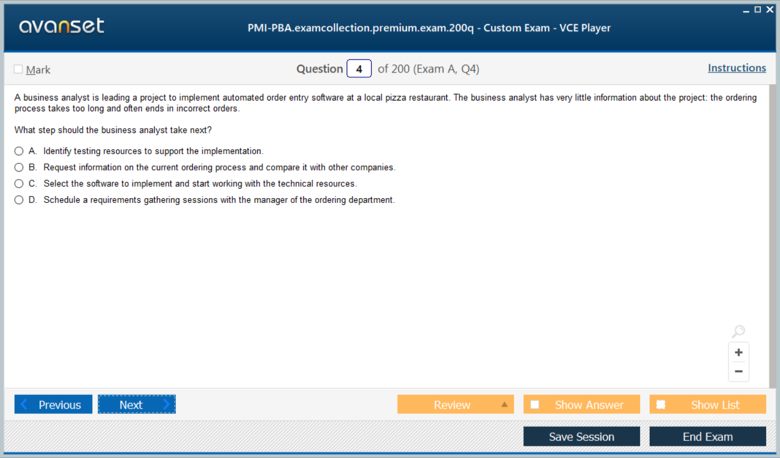
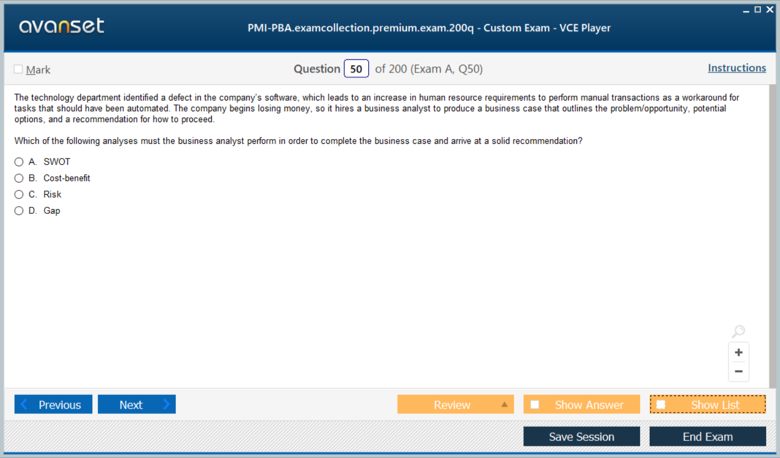
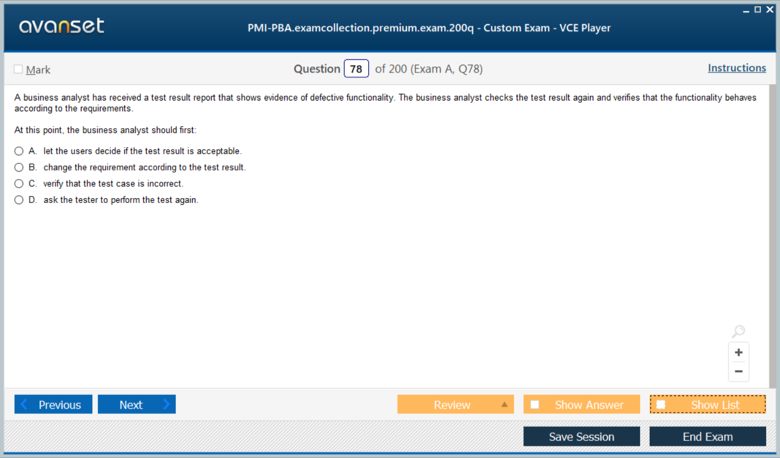
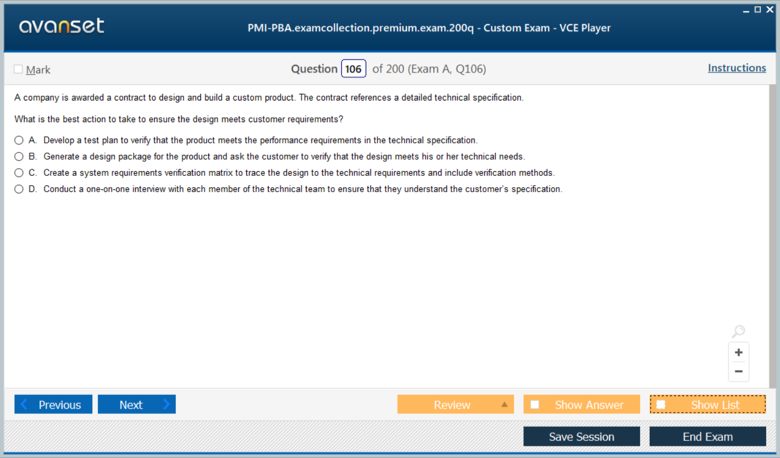
PMI PMI-PBA Exam Screenshots
PMI PMI-PBA Practice Test Questions in VCE Format
| File | Votes | Size | Date |
|---|---|---|---|
File PMI.testkings.PMI-PBA.v2026-09-16.by.luka.116q.vce |
Votes 1 |
Size 222.4 KB |
Date Sep 16, 2026 |
File PMI.examdumps.PMI-PBA.v2021-09-06.by.joseph.104q.vce |
Votes 1 |
Size 224.58 KB |
Date Sep 06, 2021 |
File PMI.testking.PMI-PBA.v2021-05-24.by.thed.120q.vce |
Votes 1 |
Size 337.65 KB |
Date May 24, 2021 |
File PMI.examanswers.PMI-PBA.v2020-12-22.by.zhangmin.120q.vce |
Votes 1 |
Size 246.51 KB |
Date Dec 22, 2020 |
PMI PMI-PBA Practice Test Questions, Exam Dumps
PMI PMI-PBA (PMI Professional in Business Analysis) exam dumps vce, practice test questions, study guide & video training course to study and pass quickly and easily. PMI PMI-PBA PMI Professional in Business Analysis exam dumps & practice test questions and answers. You need avanset vce exam simulator in order to study the PMI PMI-PBA certification exam dumps & PMI PMI-PBA practice test questions in vce format.
The PMI-PBA exam validates experienced business-analysis practice inside project and program environments. PMI currently lists a 200-question, 240-minute examination with five content areas: Needs Assessment 18%, Planning 22%, Analysis 35%, Traceability and Monitoring 15%, and Evaluation 10%. The weighting makes the center of gravity clear: candidates must know how to move from an uncertain business problem to analyzed, controlled, and evaluated requirements.
Business analysis is often misunderstood as documenting what stakeholders ask for. Strong practice goes further. Analysts investigate the underlying need, identify affected groups, explore solution options, reconcile competing objectives, define usable requirements, maintain traceability, and evaluate whether the delivered solution actually improves the business outcome.
The PMI certification family places PMI-PBA alongside project, program, portfolio, agile, risk, scheduling, and specialized credentials. Its value is specialization: it tests the discipline of understanding the problem and shaping the solution so delivery teams are solving the right problem with requirements that remain connected to measurable value.
A request such as “replace the CRM,” “automate approvals,” or “build a customer portal” already contains an assumed solution. Business analysis begins one level earlier by asking what problem the organization is trying to solve. The real need might be slow response time, poor data quality, regulatory exposure, weak conversion, manual rework, or fragmented customer history.
This distinction matters because different solutions may address the same need with very different cost and risk. A process change, policy revision, integration, training intervention, or small enhancement can sometimes create more value than a major system replacement. The analyst helps decision-makers separate the desired outcome from the first implementation idea.
Needs assessment also defines the current state, future state, gap, constraints, assumptions, and measures of success. Without that baseline, requirements can become a collection of stakeholder preferences with no coherent business rationale.
Business-analysis work depends on people who hold different pieces of the problem. Executives understand strategy, users understand daily workflow, operations teams understand exceptions, compliance teams understand obligations, technical teams understand system constraints, and customers experience the outcome. Missing one of those perspectives can produce requirements that look complete but fail in practice.
Stakeholder analysis should consider influence, impact, expertise, decision authority, availability, and potential resistance. The analyst then designs engagement around the information or decision needed from each group. A regulatory interpretation workshop and a customer usability interview should not be conducted the same way.
Conflicting stakeholder requests are normal. The analyst should expose the conflict in terms of outcomes, constraints, evidence, and trade-offs rather than acting as a passive recorder. Agreement may require prioritization, escalation, experimentation, or reframing the need so stakeholders can see a solution space wider than their original positions.
Interviews are useful, but stakeholders do not always know how to articulate everything they do or need. Business analysts also use observation, document analysis, workshops, prototypes, data analysis, process models, interface analysis, surveys, and experiments to uncover information from different angles.
The technique should fit the uncertainty. Observation is valuable when actual work differs from documented procedure. Prototyping helps when users struggle to describe an interface. Data analysis can reveal the volume and distribution of exceptions. Workshops can accelerate decisions when several stakeholders need to resolve a shared issue.
Elicitation results should be confirmed. People can hear the same discussion differently, and the analyst may misinterpret specialized terminology. Confirmation creates a shared record of what was learned while there is still time to correct the misunderstanding cheaply.
Raw elicitation produces statements, examples, frustrations, policies, exceptions, and ideas. Analysis organizes that material into a model of the problem and proposed solution. Requirements can describe business objectives, stakeholder needs, solution behavior, quality attributes, transition needs, data, rules, interfaces, and constraints.
Models help because prose alone hides relationships. Process flows reveal sequence and handoffs. Data models reveal entities and relationships. Decision tables expose business rules. State models show how an object changes over time. Use cases or user stories reveal interactions. The analyst chooses the simplest representation that improves shared understanding.
Analysis also looks for incompleteness and contradiction. What happens when data is missing? Who can override a rule? What is the response when an external service is unavailable? Which nonfunctional requirements govern security, performance, accessibility, auditability, or availability? Edge cases often determine whether a solution survives real use.
Not every requirement has equal urgency. Prioritization should consider business value, regulatory necessity, risk reduction, dependency, effort, time sensitivity, customer impact, and the information gained by delivering or testing something early. A requirement with modest direct value can still be strategically important if it removes a major uncertainty.
Priority is also dynamic. New evidence can change cost estimates, reveal dependencies, invalidate assumptions, or shift business goals. Analysts should preserve the reasoning behind priority decisions so later changes can be evaluated transparently rather than turning the backlog into a political ranking exercise.
In adaptive delivery, prioritization is frequent and incremental. In predictive environments, more scope may be baselined earlier. PMI-PBA candidates should be comfortable with both. The underlying principle is that requirements decisions should remain tied to value and constraints regardless of delivery approach.
Traceability answers why a requirement exists, where it came from, what implements it, what depends on it, and how it will be verified. That chain becomes especially important when scope is large, regulated, safety-sensitive, or distributed across multiple teams.
Good traceability allows impact analysis. If a regulation changes, the team can identify affected requirements, design elements, tests, documents, and stakeholders. If a requirement is proposed for removal, decision-makers can see which business objective or control would be affected before approving the change.
Traceability should add control, not administrative burden for its own sake. A small product team may use lightweight links in a backlog tool; a regulated program may require formal matrices and evidence. The analyst should select the level of rigor that matches risk and governance needs.
Acceptance confirms that a solution meets defined criteria. Evaluation goes further by asking whether the intended business outcome is being achieved. A feature can pass every test and still fail if users avoid it, processing time does not improve, customers abandon the journey, or operational costs rise unexpectedly.
Evaluation therefore returns to the measures established during needs assessment. Analysts may compare baseline and post-implementation performance, study usage data, gather stakeholder feedback, monitor exceptions, and identify new constraints that emerged after deployment.
If value is weaker than expected, the answer may be additional requirements, process change, training, data improvement, policy adjustment, or even solution retirement. Business analysis does not end when developers finish; it closes the loop between the original need and realized results.
The PMP exam covers broad project leadership across people, process, and business environment. Project managers and business analysts often work closely because project planning depends on clarity about needs, scope, stakeholders, risks, and acceptance.
The roles overlap in some organizations, but their primary perspectives differ. A project manager integrates delivery; a business analyst integrates understanding of the problem and requirements. When one person performs both roles, the disciplines still need to be distinguished mentally so schedule pressure does not prematurely collapse analysis into a favored solution.
The CAPM exam also includes business-analysis content and can serve as broader foundational context for less experienced practitioners. PMI-PBA is aimed at deeper professional credibility in the specialized discipline.
A useful study exercise is to choose one realistic initiative and trace it through the five PMI-PBA domains. Define the business problem and current state. Identify stakeholders and engagement needs. Plan the analysis work. Elicit information using several techniques. Model and prioritize requirements. Establish traceability, manage changes, and define evaluation measures.
Then introduce complications. A stakeholder withdraws support, a regulation changes, users reject the prototype, a technical dependency makes one requirement expensive, or the delivered solution meets acceptance criteria but does not improve the target metric. Decide which analysis activity should respond and what evidence is needed.
This creates the kind of integrated judgment the exam rewards. Memorized definitions matter less when several actions are technically possible. The strongest response is the one that preserves the relationship between the business need, stakeholders, requirements, delivery decisions, and measurable value.
PMI currently requires PMI-PBA holders to earn 60 professional development units in each three-year cycle, placing the credential alongside PMP, PgMP, and PfMP in the higher continuing-development tier.
That maintenance model fits the work. Business analysis changes as organizations adopt new technology, analytics, automation, AI, product operating models, and regulatory controls, but the core discipline remains stable: understand the real need, make assumptions visible, involve the right people, define requirements that can be verified, and measure whether the result worked.
The strongest PMI-PBA candidate treats requirements as a chain of reasoning rather than a document. Every important requirement should be explainable in terms of the need it serves, the stakeholder or rule behind it, the value or risk it affects, the solution behavior it drives, and the evidence that will show whether it succeeded.
Business analysts also need to manage assumptions explicitly. An assumption about user volume, process frequency, regulatory interpretation, data availability, or customer behavior can shape several requirements at once. If the assumption later proves false, traceability should make the affected requirements visible. Treating assumptions as testable propositions rather than hidden facts gives the project an earlier opportunity to validate them and reduces the chance that a large solution is built around an unexamined premise.
Go to testing centre with ease on our mind when you use PMI PMI-PBA vce exam dumps, practice test questions and answers. PMI PMI-PBA PMI Professional in Business Analysis certification practice test questions and answers, study guide, exam dumps and video training course in vce format to help you study with ease. Prepare with confidence and study using PMI PMI-PBA exam dumps & practice test questions and answers vce from ExamCollection.
Purchase Individually

Top PMI Certifications

Top PMI Certification Exams
Site Search:

SPECIAL OFFER: GET 10% OFF

Pass your Exam with ExamCollection's PREMIUM files!
SPECIAL OFFER: GET 10% OFF
Use Discount Code:
MIN10OFF
A confirmation link was sent to your e-mail.
Please check your mailbox for a message from support@examcollection.com and follow the directions.

Download Free Demo of VCE Exam Simulator
Experience Avanset VCE Exam Simulator for yourself.
Simply submit your e-mail address below to get started with our interactive software demo of your free trial.