
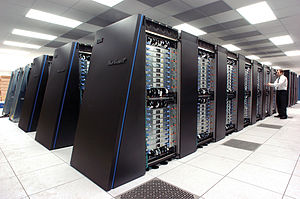
Contemporary reports described a planned system emphasizing high AI computational throughput and power efficiency. A November 2016 report explained the then-announced ambition for substantial performance at low power. Those were prospective design goals, not independent measurements of the completed machine. Reporting a proposed petaflop figure as if it were a confirmed 2017 benchmark would be misleading.
What ABCI was designed to enable
ABCI was envisioned as computing infrastructure accessible to research and industry, with AI development a central use. The focus on an accessible platform is as significant as the machine’s performance claims. A research group needs storage, reliable scheduling, software environments, and usage policies—not just a published peak number—to turn computation into usable research results.
Power consumption was also part of the story. For large systems, electricity and cooling affect operating budgets and the practical scalability of research. A design with high theoretical throughput may not be efficient for every application. Meaningful comparisons should consider workload, numerical precision, system utilization, and the energy needed to complete a particular task.
The launch actually occurred in August 2018
AIST’s official history of the ABCI service states that full-scale operation began in August 2018. AIST also records upgrades to ABCI 2.0 in May 2021 and ABCI 3.0 in January 2025. These dates replace the old planned 2017 completion window with the reported sequence of actual milestones.
An AIST research summary describes ABCI’s 2018 start and its high rankings in contemporary speed and energy-efficiency listings. These are dated outcomes, not a promise about present worldwide ranking. Today’s standing depends on currently published benchmarks and the workload used.
Why the different machines should not be conflated
Japan has supported several major supercomputing initiatives. ABCI’s focus was AI research and computing access, while Fugaku had a different development institution, schedule, and wider high-performance computing mission. They can both appear in a national history of computational science, but a 2016 article about AIST’s 2017 target should not be rewritten as though it had always been about Fugaku.
A clear technical comparison records the project owner, hardware generation, numerical precision, software environment, and evaluation period. Confusing planned half-precision AI throughput with measured general-purpose double-precision performance can produce spectacular but meaningless comparisons.
The broader lesson about technology forecasts
Technology announcements frequently use target dates and projected specifications. Those details deserve coverage as predictions at the time, but they need a later check before being repeated as facts. ABCI’s eventual launch and successive upgrades show how large infrastructure evolves through design, deployment, expansion, and changing research demand.
The lasting importance of the story is the combination of scalable AI computing and attention to efficiency. Its accurate timeline is November 2016 planning, August 2018 full-scale operation, and later platform upgrades—not an indefinitely future-tense plan to deliver a machine by 2017.
