



Premium File
52 Q&A
$76.99$69.99
Huawei H12-711 Exam Questions & Answers, Accurate & Verified By IT Experts
Instant Download, Free Fast Updates, 99.6% Pass Rate
52 Questions & Answers
Last Update: Oct 30, 2026
$69.99
Huawei H12-711 Exam Screenshots
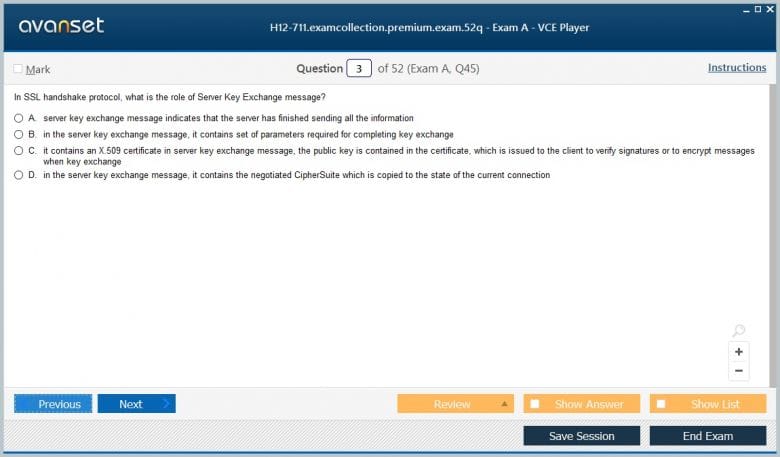
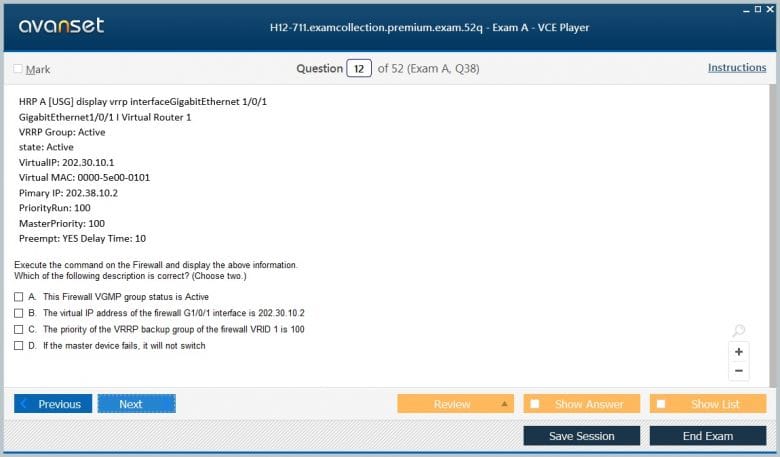
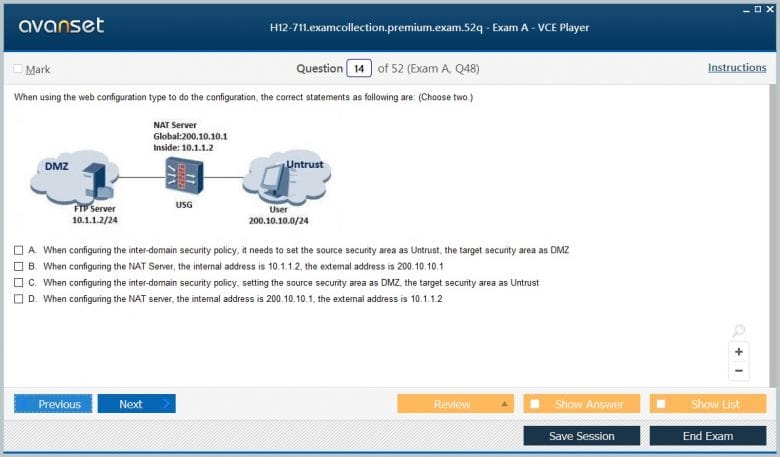
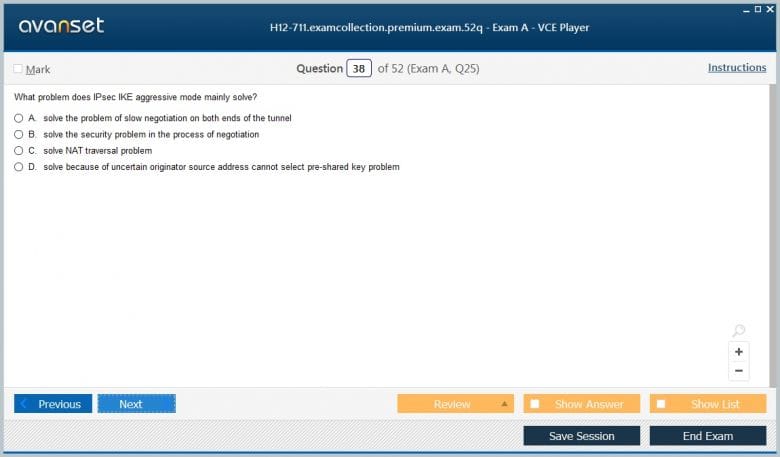
Huawei H12-711 Practice Test Questions in VCE Format
| File | Votes | Size | Date |
|---|---|---|---|
File Huawei.testking.H12-711.v2026-08-05.by.declan.28q.vce |
Votes 1 |
Size 148.23 KB |
Date Aug 05, 2026 |
File Huawei.Testkings.H12-711.v2019-02-25.by.Luke.34q.vce |
Votes 4 |
Size 171.22 KB |
Date Feb 26, 2019 |
Huawei H12-711 Practice Test Questions, Exam Dumps
Huawei H12-711 (HCNA-Security-CBSN (Huawei Certified Network Associate - Constructing Basic Security Network)) exam dumps vce, practice test questions, study guide & video training course to study and pass quickly and easily. Huawei H12-711 HCNA-Security-CBSN (Huawei Certified Network Associate - Constructing Basic Security Network) exam dumps & practice test questions and answers. You need avanset vce exam simulator in order to study the Huawei H12-711 certification exam dumps & Huawei H12-711 practice test questions in vce format.
H12-711 is a legacy Huawei security exam associated with the earlier HCNA-Security / Constructing Basic Security Network era. Huawei's security certification field remains active, but the associate track has moved forward to H12-711 V4.0 HCIA-Security. The older page therefore belongs in the site's security lineage while current candidates should prepare from the V4.0 blueprint.
The historical exam is still useful because it covers durable network-security mechanics: firewall zones and policy, authentication, VPNs, access control, and basic threat defense. Those concepts did not become irrelevant when the certification was renamed and updated. What changed is the surrounding technology, product generation, threat context, and the breadth expected from a modern associate security engineer.
A firewall decision is more than a port number. The device considers source and destination, zone, service, session state, user or identity context where available, and policy order. Candidates should understand how a session is created and why return traffic may be handled differently from a new connection. This is the foundation for explaining both allowed and blocked flows.
The distinction between stateless and stateful inspection is especially important. The editorial explanation of stateful and stateless firewalls provides useful context, but study should go further by tracing example sessions through security zones and identifying which rule creates the result.
Good firewall policy is derived from communication requirements. Identify the systems that must talk, the protocols they need, the direction of initiation, and the business reason. Then implement the narrowest rule that supports the service. Broad "any-any" rules make troubleshooting easy in the short term but weaken both security and operational clarity.
Practice by designing policies for users, servers, management systems, and internet access. Add logging where it helps investigation without generating unusable noise. Then remove one dependency and observe the failure. The exercise teaches why policy, routing, NAT, and application behavior must be considered together.
Security infrastructure often needs to know who is behind a connection. Local accounts may be sufficient for small administrative tasks, while enterprise designs use external identity systems and AAA services. Candidates should understand the difference between proving identity, authorizing actions or network access, and recording activity for accountability.
RADIUS is one common protocol in this space. The deeper discussion of RADIUS helps explain why authentication failures can come from network reachability, shared-secret mismatch, directory problems, policy, or authorization attributes. That same diagnostic discipline remains useful in the current HCIA-Security track.
Remote-access and site-to-site VPNs solve different connectivity problems, but both require candidates to understand tunnel establishment, authentication, encryption, integrity, key management, and routing. A tunnel can be up while the service is still broken because protected networks, policies, NAT, or routes are wrong.
The broader primer on VPN architecture and tunneling is useful because it separates the secure channel from the traffic it carries. In a lab, verify negotiation state, then verify routes and policy, then test the actual protected application. That sequence prevents the common mistake of equating "VPN established" with "user service works."
Certificates allow systems to bind identity to cryptographic keys and establish trust without sharing the same secret everywhere. Associate candidates should understand certificate authorities, certificate chains, validity, revocation, and the operational importance of correct time. These concepts appear across VPNs, administrative interfaces, and authentication systems.
The supporting explanation of PKI and digital certificates can reinforce the model. In troubleshooting, ask whether the certificate is trusted, valid, appropriate for the identity being presented, and reachable through the intended chain. Many "network" failures are actually trust failures.
NAT changes addressing information as traffic crosses boundaries, so policy and troubleshooting must account for the stage at which addresses are evaluated. Engineers should know the purpose of source and destination translation, why overlapping or private addressing creates requirements, and how translation can complicate logging and packet analysis.
Use packet-path exercises that include routing, policy, and NAT. Write down the addresses before and after translation and identify which device or log will show each form. This simple discipline prevents confusion during incidents and prepares candidates for the more integrated traffic-processing model expected in newer security versions.
Blocking known bad traffic is only one part of security operations. Devices also need to produce evidence that helps teams understand scans, failed authentication, policy violations, abnormal sessions, and attacks. Logs should include enough context—time, source, destination, action, rule, and identity where available—to support investigation.
Review the principles of firewall and router logging and apply them to a lab. Generate both allowed and denied traffic, then determine which events are useful and which are noise. Security operations improve when logging is designed intentionally rather than enabled everywhere without a plan.
The approved H12-711 V4.0 destination represents the current associate security path. It brings firewall policy, encryption and PKI, user management and AAA, high availability, network-security concepts, and related operational topics into a modern blueprint. Candidates migrating from older H12-711 material should map each familiar concept into the newer structure rather than assume one-to-one product coverage.
That migration is a good study exercise. Mark what is durable—stateful policy, identity, VPNs, certificates, logging—and what needs refreshed product or threat knowledge. Then use current labs to rebuild the same scenarios with modern features. This preserves conceptual depth while avoiding obsolete configuration assumptions.
The older HCIP-Security sequence included H12-721 and companion exams. The current professional destination in the approved inventory is H12-725 V4.0 HCIP-Security. That matters because a candidate following old search results can otherwise build a study plan around retired exam architecture.
Within Huawei certifications, H12-711 should therefore be treated as security lineage, not the live associate target. Use it to understand the enduring mechanics of firewalls, identity, VPNs, PKI, NAT, and logging, then validate all current preparation against H12-711 V4.0.
Routing should be included in every firewall troubleshooting exercise. A policy can be correct while the packet leaves through an unexpected interface or the return path follows a different device. Verify the route before changing security rules. In redundant environments, also check whether route convergence and session state move together during a failure.
Administrative access is another durable topic. Management interfaces should be reachable only from intended networks and protected with strong authentication and encrypted protocols. Separate the management plane from user traffic where practical, log privileged changes, and maintain recovery access that does not depend on the same failure path as normal administration.
Configuration review is more effective when rules have owners and purposes. Record why a rule exists, which application or team depends on it, and whether an expiration or review date applies. Over time this prevents old temporary access from becoming permanent technical debt. It also makes migration to a newer security platform safer because requirements can be reconstructed from intent rather than from opaque rule numbers.
Legacy study should therefore include a translation exercise. For each old feature or term, write the modern security function it represented: stateful enforcement, centralized identity, encrypted connectivity, trust management, segmentation, evidence, or resilience. Then find that function in the current V4.0 blueprint. This keeps preparation conceptually accurate even when names and interfaces have changed.
Security troubleshooting should always preserve evidence before making disruptive changes. Capture relevant logs, session state, routes, policy hits, VPN status, and authentication results first. Restarting services or clearing sessions may restore connectivity but erase the clues needed to find the real cause. A disciplined engineer separates immediate service restoration from root-cause investigation.
Rule testing should include negative cases. It is not enough to prove that an authorized user can reach a service; verify that an unauthorized user, zone, or protocol is denied and logged as intended. This confirms that the policy enforces the trust model rather than merely allowing required traffic.
When translating legacy H12-711 notes to V4.0, remove exact command syntax that no longer matches current software unless it is being kept for historical reference. Replace it with packet-flow diagrams, trust relationships, and validation steps. Those artifacts survive product evolution and make the older material a stronger conceptual bridge.
Another durable lesson is least privilege for administration. Network operators, security analysts, auditors, and automation accounts do not necessarily need the same rights. Separate roles where the platform supports it, log privileged actions, and review dormant accounts. These practices were relevant in the H12-711 era and remain essential in V4.0 because a strong data-plane policy can still be undermined by weak administrative controls.
Use old exam scenarios as packet-walk exercises rather than as answer memorization. For every flow, write source, destination, route, translation, zone transition, policy decision, authentication dependency, and expected log. If the flow fails, identify the earliest stage that contradicts the design. This method turns historical questions into current troubleshooting practice.
The strongest transition plan ends with a current-version lab. Recreate one legacy H12-711 scenario using the V4.0 security architecture, then compare policy, identity, VPN, logging, and validation. That proves you have carried forward the engineering concept rather than only the old terminology.
Current-version validation should include both successful and deliberately denied traffic so the engineer proves that the security model permits required service without silently widening access beyond the original requirement.
Go to testing centre with ease on our mind when you use Huawei H12-711 vce exam dumps, practice test questions and answers. Huawei H12-711 HCNA-Security-CBSN (Huawei Certified Network Associate - Constructing Basic Security Network) certification practice test questions and answers, study guide, exam dumps and video training course in vce format to help you study with ease. Prepare with confidence and study using Huawei H12-711 exam dumps & practice test questions and answers vce from ExamCollection.
Purchase Individually
Top Huawei Certification Exams
Site Search:

SPECIAL OFFER: GET 10% OFF

Pass your Exam with ExamCollection's PREMIUM files!
SPECIAL OFFER: GET 10% OFF
Use Discount Code:
MIN10OFF
A confirmation link was sent to your e-mail.
Please check your mailbox for a message from support@examcollection.com and follow the directions.

Download Free Demo of VCE Exam Simulator
Experience Avanset VCE Exam Simulator for yourself.
Simply submit your e-mail address below to get started with our interactive software demo of your free trial.
need for exam