



Premium File
298 Q&A
$76.99$69.99
Huawei H12-261 Exam Questions & Answers, Accurate & Verified By IT Experts
Instant Download, Free Fast Updates, 99.6% Pass Rate
298 Questions & Answers
Last Update: Oct 20, 2026
$69.99
Huawei H12-261 Exam Screenshots
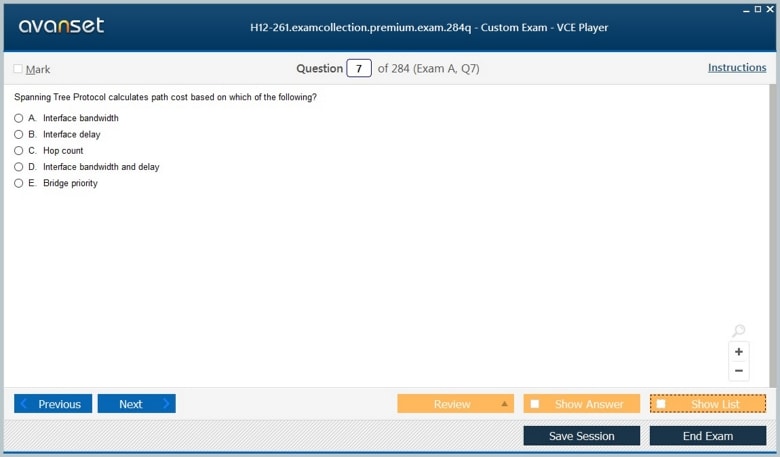
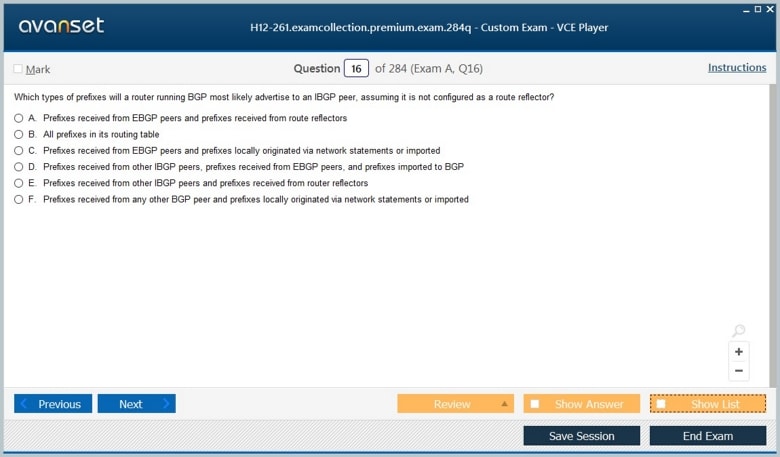
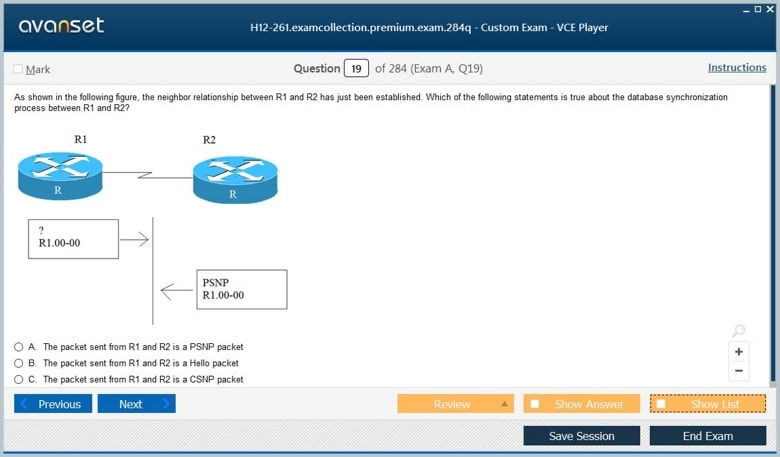
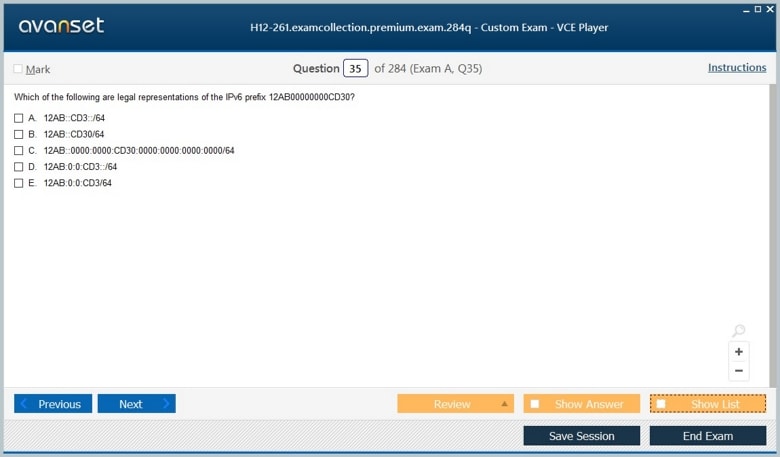
Huawei H12-261 Practice Test Questions in VCE Format
| File | Votes | Size | Date |
|---|---|---|---|
File Huawei.train4sure.H12-261.v2026-09-05.by.liuwei.164q.vce |
Votes 1 |
Size 1.92 MB |
Date Sep 05, 2026 |
File Huawei.train4sure.H12-261.v2020-06-04.by.amber.156q.vce |
Votes 2 |
Size 1.88 MB |
Date Jun 04, 2020 |
Huawei H12-261 Practice Test Questions, Exam Dumps
Huawei H12-261 (HCIE-R&S (Written) (Huawei Certified Internetwork Expert-Routing & Switching)) exam dumps vce, practice test questions, study guide & video training course to study and pass quickly and easily. Huawei H12-261 HCIE-R&S (Written) (Huawei Certified Internetwork Expert-Routing & Switching) exam dumps & practice test questions and answers. You need avanset vce exam simulator in order to study the Huawei H12-261 certification exam dumps & Huawei H12-261 practice test questions in vce format.
H12-261 was the written examination for Huawei’s HCIE Routing & Switching certification. Huawei described the credential as validating the ability to construct, optimize, and manage complex medium and large enterprise networks, with candidates expected to understand advanced routing and switching deeply enough to design and implement complete network solutions.
That certification family is now historical. Huawei launched HCIE-Datacom and stated that Datacom would replace the older Routing & Switching track; the current expert written exam in the approved inventory is H12-891 HCIE-Datacom. H12-261 therefore matters as expert-level technical lineage, while present candidates should use the Datacom blueprint for scheduling and gap analysis.
At expert level, protocols cannot be studied independently. OSPF, IS-IS, BGP, route policy, multicast, MPLS, IPv6, and reliability mechanisms interact through shared topology and policy. The candidate should be able to explain how a prefix is learned, transformed, selected, installed, advertised, and ultimately used to forward traffic across several domains.
This requires more than knowing best-path rules. Engineers need to understand how design choices affect convergence, scale, failure containment, and troubleshooting. Summarization reduces state but can hide reachability detail. Route reflection changes BGP topology and path visibility. Redistribution connects protocols but can create loops. Expert study should always attach those features to a design consequence.
Large networks need hierarchy, controlled flooding, predictable convergence, and clear policy boundaries. OSPF area types, summarization, LSA behavior, and route selection should be understood well enough to predict the effect of a topology or configuration change. IS-IS requires similar confidence around levels, adjacencies, TLVs, metrics, and route leaking.
Expert labs should include partial failures that leave neighbors established while routes are wrong. Change an area type, filter a prefix, alter a metric, or create an inconsistent summarization boundary. Then inspect the link-state database and routing table to locate where the intended topology diverged from the actual control plane.
BGP provides the tools to express traffic policy across large networks, but those tools can also create subtle failures. Expert candidates should understand iBGP design, route reflectors, attributes, communities, aggregation, filtering, multipath, and the interaction between BGP next-hop reachability and the IGP. A BGP session being established says very little about whether the policy is correct.
Labs should test policy from ingress to egress. Which routes are accepted, which attributes are changed, which are installed, and what is advertised onward? Then fail one path and observe whether backup behavior matches the design. Documenting the intended state before checking devices is one of the best ways to develop expert-level diagnostic discipline.
Classic HCIE R&S material included MPLS because expert enterprise and service networks often rely on labeled transport and VPN services. Candidates should understand label distribution, forwarding equivalence classes, LSP behavior, and how VPN routes are kept separate across shared infrastructure. The objective is to reason about both the transport label and the service context.
Troubleshooting should distinguish control-plane and data-plane failures. A label can be distributed while traffic still follows an incorrect path; a VPN route can exist while the transport LSP is broken. Expert engineers need commands and packet-level evidence that show each layer separately, then connect them into the end-to-end service.
Expert networking is not complete when unicast pings work. Multicast services depend on group membership, RPF, distribution trees, and protocol state. QoS depends on classification and actual contention. Reliability depends on how multiple mechanisms converge together. These domains reveal whether the network has been engineered for services rather than only for reachability.
A useful scenario combines them. Carry a multicast video stream through a redundant routed network, apply QoS at a constrained edge, then fail the preferred path. Observe RPF changes, queue behavior, convergence, and user impact. The exercise forces the candidate to correlate several control and forwarding systems at once—the kind of reasoning expected at expert level.
Large networks produce too much information for random command execution. The expert should begin with a small set of hypotheses based on the symptom and topology, then collect evidence that eliminates them. A missing route, wrong next hop, policy mismatch, MTU problem, RPF failure, label issue, or return-path problem each has a different signature.
Change history is part of that evidence. If a fault began after a route-policy update, the probability distribution is different from an unexplained hardware alarm. Experts should know how to use logs, configuration diffs, protocol state, counters, and packet captures together. The skill is not memorizing the largest command set; it is choosing the smallest set that can prove or disprove a theory.
Huawei described HCIE R&S as more than a troubleshooting credential. Experts were expected to design enterprise networks. That means translating requirements into hierarchy, protocol selection, failure domains, addressing, route policy, security boundaries, capacity, and operational tooling. A design should be understandable enough that another engineer can implement and support it.
Migration adds another test. Existing networks rarely allow a clean replacement. Experts need coexistence, redistribution boundaries, temporary policy, rollback, validation, and a plan for removing transitional configuration. The best design is one that can be introduced safely, not merely one that looks optimal after every old dependency has disappeared.
The current HCIE-Datacom outline preserves advanced routing and switching but adds campus network planning and deployment, WAN planning, CloudCampus, SD-WAN, CloudWAN, and network automation. This is a major reason H12-261 should be treated as a foundation rather than a current blueprint. Expert networking now includes intent, controllers, automation workflows, and cross-domain solution behavior. Practical supporting material such as network data gathering with Python automation is useful because modern expert operations depend on collecting and validating state consistently across many devices.
The modern progression begins much earlier. H12-811 HCIA-Datacom establishes the associate base, while H12-821 and H12-831 develop the professional routing-and-switching core. Candidates converting an old HCIE study plan should identify which Datacom domains were absent from the original R&S material and build those deliberately.
A productive H12-261 lab is not a collection of 30 unrelated features. Build a network with multiple IGP areas or levels, iBGP, external peers, route policy, MPLS or VPN context, multicast, QoS, IPv6, and redundant paths. Document the intended routing and service behavior first. Then inject failures that leave some protocols healthy so the root cause is not obvious.
For each incident, produce an expert-level explanation: user symptom, control-plane state, forwarding state, dependency that failed, evidence, repair, and design improvement. This exposes whether the candidate truly understands interactions. It also mirrors the operational value described in the editorial discussion of Huawei HCIE and enterprise network engineering.
Within Huawei certifications, H12-261 is now a legacy expert exam, but the discipline it represented remains relevant. Current candidates should schedule HCIE-Datacom against the live Huawei blueprint while retaining the R&S strengths that still matter: protocol depth, policy reasoning, failure analysis, design, migration, and the ability to explain complex network behavior from first principles.
Expert engineers should also understand route-scale and churn as operational limits. A design that works with a few hundred prefixes may behave differently with hundreds of thousands, especially when policies, convergence, or hardware resources are stressed. Lab environments cannot always reproduce production scale, but candidates can still reason about which tables and processes consume resources and where hierarchy or summarization reduces unnecessary state.
Time synchronization and logging are easy to overlook until a distributed failure has to be reconstructed. When routers, controllers, and services disagree on time, event correlation becomes unreliable. Expert operations therefore depend on consistent time sources, logging policy, retention, and a method for collecting evidence from several devices without overwriting the state being investigated.
Design reviews should challenge assumptions about management during failure. If the only management path traverses the same control plane that is being repaired, engineers may lose visibility exactly when they need it. Out-of-band or alternative management designs should be evaluated according to business criticality, and recovery procedures should be practiced rather than assumed.
The migration from HCIE R&S to HCIE-Datacom also illustrates a broader career lesson: expertise has to evolve without discarding fundamentals. Automation, controllers, and solution architectures change how networks are built and operated, but they still depend on accurate forwarding, routing policy, failure containment, and disciplined troubleshooting. Candidates who preserve that foundation while learning the newer domains are better positioned than those who treat each certification refresh as a completely new subject.
Expert-level troubleshooting should include cases where several observations are true at the same time but only one explains the user impact. A BGP session may be established, an IGP may have reachability, and an MPLS label may be present while policy, next-hop resolution, MTU, return routing, or service context still prevents correct forwarding. Build incident exercises that begin with the user-visible symptom and require the candidate to identify which table, counter, log, or packet observation can eliminate each hypothesis. The objective is to reduce uncertainty in a deliberate order rather than to run every familiar command. After the fault is corrected, verify convergence, path symmetry, policy intent, and monitoring state before declaring recovery. This approach captures the depth associated with the old HCIE Routing & Switching track while remaining useful for HCIE-Datacom, where expert candidates still need to connect complex control-plane behavior with end-to-end service outcomes.
Expert-level documentation should preserve intent, not only configuration. A future engineer needs to know why a route is filtered, why one region is summarized, why a community triggers a policy, and what failure condition a redundant path is meant to survive. Configuration can be regenerated from design intent far more safely than design intent can be reconstructed from thousands of lines of configuration during an outage. Intent is therefore part of the network state, not optional commentary.
Go to testing centre with ease on our mind when you use Huawei H12-261 vce exam dumps, practice test questions and answers. Huawei H12-261 HCIE-R&S (Written) (Huawei Certified Internetwork Expert-Routing & Switching) certification practice test questions and answers, study guide, exam dumps and video training course in vce format to help you study with ease. Prepare with confidence and study using Huawei H12-261 exam dumps & practice test questions and answers vce from ExamCollection.
Purchase Individually
Top Huawei Certification Exams
Site Search:

SPECIAL OFFER: GET 10% OFF

Pass your Exam with ExamCollection's PREMIUM files!
SPECIAL OFFER: GET 10% OFF
Use Discount Code:
MIN10OFF
A confirmation link was sent to your e-mail.
Please check your mailbox for a message from support@examcollection.com and follow the directions.

Download Free Demo of VCE Exam Simulator
Experience Avanset VCE Exam Simulator for yourself.
Simply submit your e-mail address below to get started with our interactive software demo of your free trial.
Have you got updated version of H12-261 exam
any one have the updated exam
can someone update this exam ?