



Premium File
328 Q&A
$76.99$69.99
SANS SEC504 Exam Questions & Answers, Accurate & Verified By IT Experts
Instant Download, Free Fast Updates, 99.6% Pass Rate
328 Questions & Answers
Last Update: Oct 24, 2026
$69.99
SANS SEC504 Exam Screenshots
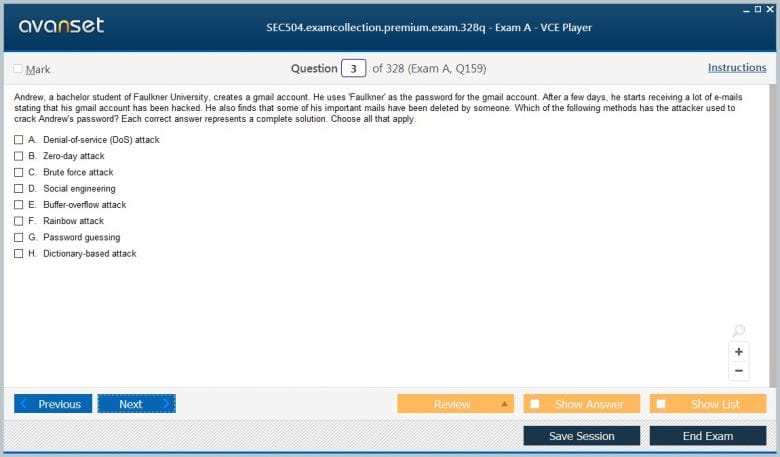
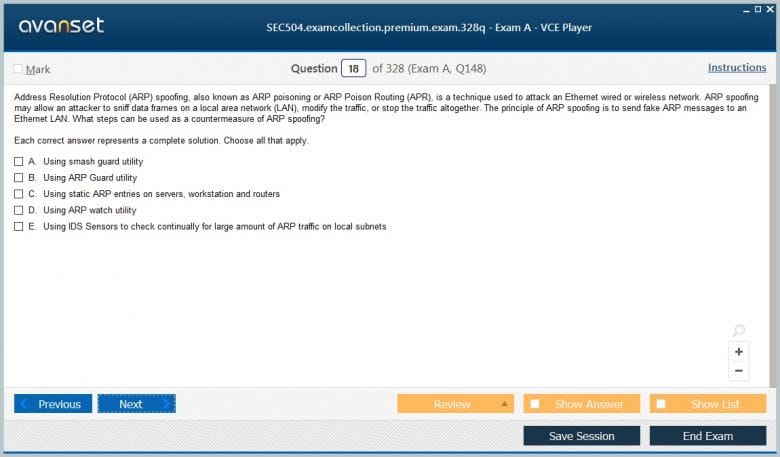
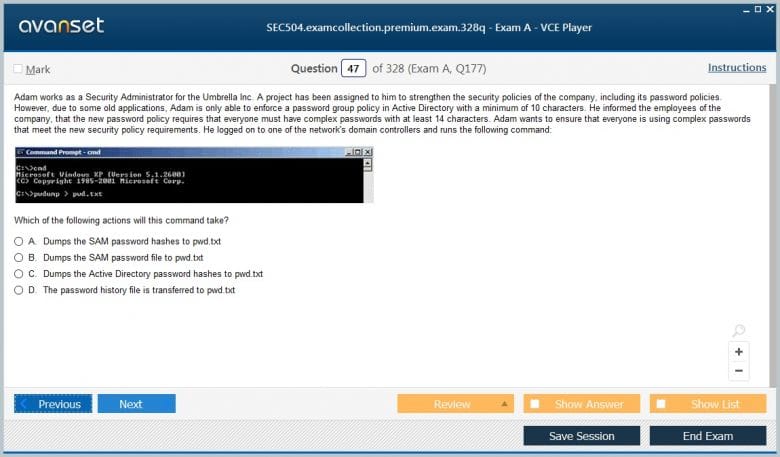
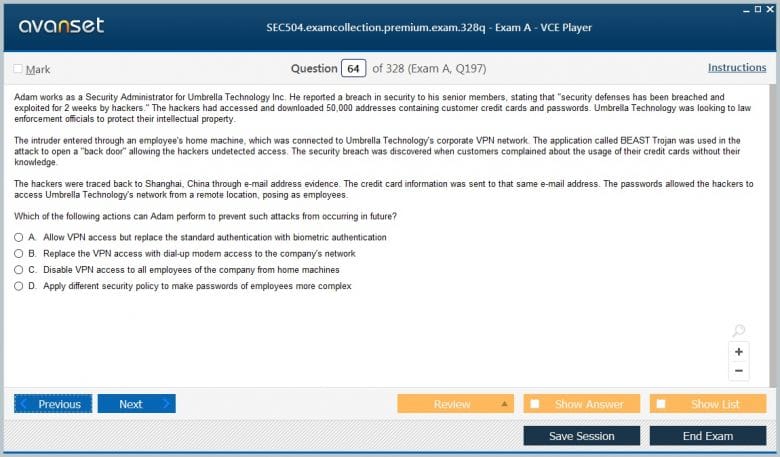
SANS SEC504 Practice Test Questions in VCE Format
| File | Votes | Size | Date |
|---|---|---|---|
File SANS.train4sure.SEC504.v2026-08-30.by.wanggang.180q.vce |
Votes 1 |
Size 212.29 KB |
Date Aug 31, 2026 |
File SANS.Braindumps.SEC504.v2019-04-02.by.Nolan.185q.vce |
Votes 3 |
Size 240.61 KB |
Date Apr 03, 2019 |
SANS SEC504 Practice Test Questions, Exam Dumps
SANS SEC504 (Hacker Tools, Techniques, Exploits and Incident Handling) exam dumps vce, practice test questions, study guide & video training course to study and pass quickly and easily. SANS SEC504 Hacker Tools, Techniques, Exploits and Incident Handling exam dumps & practice test questions and answers. You need avanset vce exam simulator in order to study the SANS SEC504 certification exam dumps & SANS SEC504 practice test questions in vce format.
SEC504 is a SANS training course rather than a stand-alone certification code, and that distinction matters for anyone planning an incident-response credential path. The course is currently titled Hacker Tools, Techniques, and Incident Handling and is designed as hands-on preparation for the GIAC Certified Incident Handler credential. Candidates who encounter SEC504 in an exam inventory should therefore connect the course to the certification it supports instead of treating the two labels as interchangeable.
The current GCIH credential validates the ability to detect, investigate, contain, and resolve security incidents while understanding how attackers actually gain access, move through systems, steal credentials, abuse applications, and hide activity. SANS continues to run SEC504 in 2026, and current course descriptions include Windows and network investigation, malware analysis, cloud credential attacks, web application abuse, post-exploitation, and the use of AI in both analysis and offensive operations.
That breadth is why SEC504 sits naturally between defensive operations and adversary tradecraft. It is not a pure forensics course, a penetration-testing boot camp, or a policy-only incident-management class. The strongest preparation combines the operational discipline of incident-response lifecycle management with enough attacker knowledge to recognize what evidence means under pressure.
An incident responder needs a structure for turning incomplete signals into defensible decisions. A suspicious authentication, an endpoint alert, an odd outbound connection, and a user report may all describe the same compromise, but they arrive through different channels and at different times. Preparation should therefore emphasize verification, scoping, containment, assessment, eradication, and recovery as connected decisions rather than isolated checklist items.
A mature process also defines ownership, escalation, communications, and evidence handling before the crisis begins. That is why a broader incident-response program matters alongside technical skill. Tools can accelerate investigation, but they cannot replace decisions about severity, business impact, legal or regulatory notification, acceptable containment risk, and when a system is trustworthy enough to return to service.
Case management is another part of that discipline. Notes should record what was observed, when it was observed, where the evidence came from, what action was taken, and why. During a long incident, this prevents analysts from repeating work or confusing assumptions with verified facts. It also lets leadership understand how confidence changed over time. A technically brilliant investigation can still create operational problems if nobody can reconstruct its decisions afterward.
Scanning, enumeration, lateral movement, command-and-control traffic, and data exfiltration each leave different patterns. A responder needs enough protocol knowledge to distinguish ordinary administrative behavior from activity that deserves escalation. That means reading connection metadata, DNS behavior, SMB use, authentication patterns, proxy or firewall logs, and packet-level clues as parts of a timeline rather than memorizing one indicator for one attack.
The important habit is correlation. A port scan by itself may be harmless assessment activity; the same scan followed by successful authentication, remote service creation, and unusual egress can become strong evidence of compromise. SEC504-style scenarios reward analysts who can connect events across hosts and data sources, identify the earliest trustworthy sign of intrusion, and explain what additional telemetry would confirm or disprove a hypothesis.
Analysts should also understand the limits of visibility. NAT, proxies, load balancers, VPNs, encrypted traffic, ephemeral cloud infrastructure, and centralized logging can change which address or timestamp is meaningful. A good investigation identifies those transformations before assigning activity to a host or user. This reduces the chance of building a confident timeline around the wrong source identity or treating a shared infrastructure address as if it represented one endpoint.
Live response is difficult because an investigator is examining a system that may still be changing. Processes, services, scheduled tasks, shell history, persistence locations, network sockets, user sessions, and memory-resident artifacts all have to be interpreted in context. The goal is not to collect every possible artifact; it is to preserve the evidence most likely to answer the immediate questions without unnecessarily destroying volatile state.
On enterprise systems, context is decisive. Administrative tools such as PowerShell, remote management utilities, SSH, and scripting interpreters can be legitimate or malicious depending on who invoked them, from where, with what parent process, and against which assets. Strong preparation therefore includes repeated practice distinguishing dual-use administration from attacker behavior and documenting why a conclusion is justified.
Collection choices should reflect incident priority. If ransomware is spreading, rapid process, network, and account containment may be more important than perfect preservation on every endpoint. If insider activity or legal action is possible, preservation requirements may be stricter. Responders need enough judgment to balance business protection with forensic value, and they should know when to escalate evidence-handling decisions to legal, compliance, or specialist forensic teams.
Credential theft is rarely confined to a single login screen. Attackers may capture reusable hashes, steal browser or cloud tokens, abuse password reuse, spray common passwords, harvest secrets from scripts, or pivot through service accounts that were never designed for interactive use. Responders need to understand both the attack mechanics and the defensive evidence left behind in authentication and endpoint telemetry.
Containment also has to account for the difference between changing a password and invalidating an attacker’s access. Active sessions, API keys, refresh tokens, cached credentials, delegated access, and privileged service identities can survive a simple reset. Incident handling becomes more reliable when the responder treats identity as a system of credentials and sessions rather than a single password field.
Injection, broken authorization, forced browsing, insecure direct object references, and API abuse become operational incidents when they alter data, expose records, execute commands, or create a foothold for later movement. The responder has to reconstruct what the application received, what the backend executed, which account context was involved, and whether the same path was exploited repeatedly.
Application logs are often incomplete, so investigation may require correlation with reverse-proxy logs, WAF events, database records, cloud audit trails, and endpoint evidence. The useful question is not simply whether a malicious request occurred. It is whether that request succeeded, what assets it affected, what persistence or follow-on access it enabled, and how confidently the organization can close the original attack path.
Responders do not always need full reverse engineering. Often they need fast answers: what the sample launches, where it persists, which domains or addresses it contacts, what credentials it touches, and whether similar artifacts exist elsewhere. The ability to move from triage into deeper malware analysis when necessary is more valuable than applying one tool to every suspicious file.
Safe handling also matters. Hashing, isolated execution, static strings, metadata, behavioral observation, and controlled sandboxing each reveal different information. Analysts should know when a result is trustworthy, when malware may be detecting the analysis environment, and which indicators are stable enough for enterprise hunting. The end product should be actionable detection and scoping guidance, not merely an interesting technical description.
An attacker who already has a foothold may dump credentials, disable defenses, establish persistence, pivot through remote services, tunnel traffic, or use legitimate binaries to reduce obvious malware signatures. Incident handlers therefore need to understand post-exploitation behavior well enough to look beyond the first compromised process. Otherwise containment can remove one artifact while leaving the attacker’s alternative access path untouched.
This is where offensive awareness supports defensive completeness. Recognizing common exploitation frameworks, covert channels, privilege escalation patterns, and lateral-movement techniques gives responders better hypotheses for hunting. It also helps them decide which adjacent systems should be isolated or reviewed even when those systems have not generated their own high-severity alert.
Current SEC504 material explicitly includes AI-assisted investigation and LLM-related offensive activity. Used carefully, generative AI can help summarize logs, draft queries, explain unfamiliar commands, normalize notes, or propose investigative branches. The benefit is speed, particularly when analysts are moving across large volumes of heterogeneous evidence and need to keep a coherent timeline.
The risk is unverified output. A confident but incorrect explanation of a command line, timestamp, or protocol behavior can send an investigation in the wrong direction. Analysts should treat AI-generated conclusions as hypotheses that must be checked against raw evidence, trusted documentation, and reproducible tests. Sensitive data handling and prompt governance are also part of operational discipline, especially during investigations involving regulated information.
The best study plan combines technical review with timed investigation. Build small cases that require choosing evidence, creating a timeline, explaining an attacker path, and deciding what to contain first. Include Windows, Linux, network, cloud, identity, web, and malware clues so that practice resembles the mixed data an incident team actually receives. Review mistakes by asking which assumption failed, not only which answer was incorrect.
Candidates should also distinguish the roles of SANS training and GIAC certifications. SEC504 develops the practical skill set; GCIH is the credential that validates it. That distinction keeps preparation current and prevents a course number from becoming the center of the study plan when the real objective is competent incident handling under realistic conditions.
An index or reference system should also be built from concepts rather than copied answers. Organize notes around attack phases, artifacts, commands, log locations, and investigative questions so information can be retrieved quickly during a timed assessment. After each lab, capture what evidence proved the conclusion and what alternative explanation had to be ruled out. That practice improves both exam performance and the analytical habits required during real incidents.
Go to testing centre with ease on our mind when you use SANS SEC504 vce exam dumps, practice test questions and answers. SANS SEC504 Hacker Tools, Techniques, Exploits and Incident Handling certification practice test questions and answers, study guide, exam dumps and video training course in vce format to help you study with ease. Prepare with confidence and study using SANS SEC504 exam dumps & practice test questions and answers vce from ExamCollection.
Purchase Individually
Top SANS Certification Exams
Site Search:

SPECIAL OFFER: GET 10% OFF

Pass your Exam with ExamCollection's PREMIUM files!
SPECIAL OFFER: GET 10% OFF
Use Discount Code:
MIN10OFF
A confirmation link was sent to your e-mail.
Please check your mailbox for a message from support@examcollection.com and follow the directions.

Download Free Demo of VCE Exam Simulator
Experience Avanset VCE Exam Simulator for yourself.
Simply submit your e-mail address below to get started with our interactive software demo of your free trial.
Please, anyone with recent success using the premium file?
Is anyone able to verify the premium file is valid?