



Premium File
60 Q&A
$76.99$69.99
HP HPE0-J58 Exam Questions & Answers, Accurate & Verified By IT Experts
Instant Download, Free Fast Updates, 99.6% Pass Rate

HPE0-J58 Premium File: 60 Questions & Answers
Last Update: Sep 15, 2026
HPE0-J58 PDF Study Guide: 992 Pages
$74.99
HP HPE0-J58 Exam Screenshots
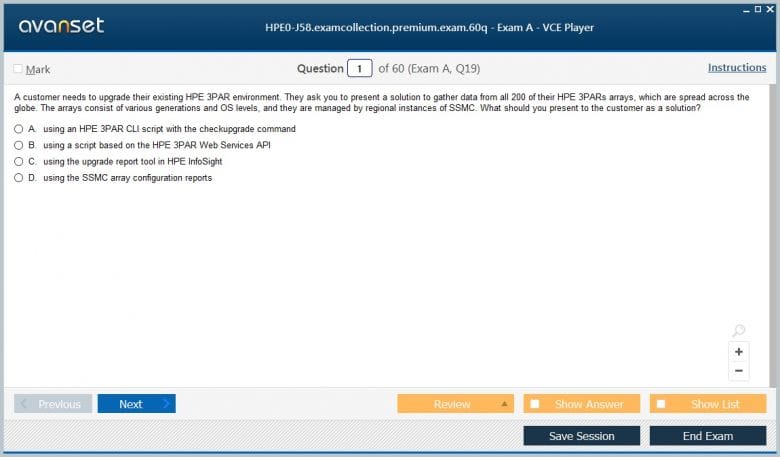
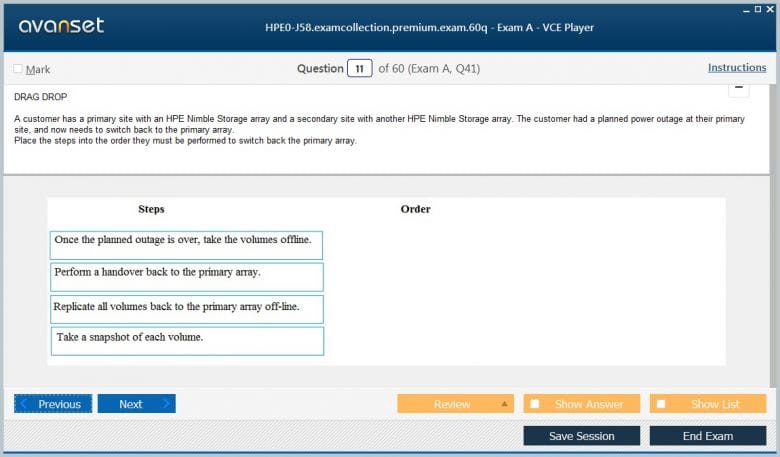
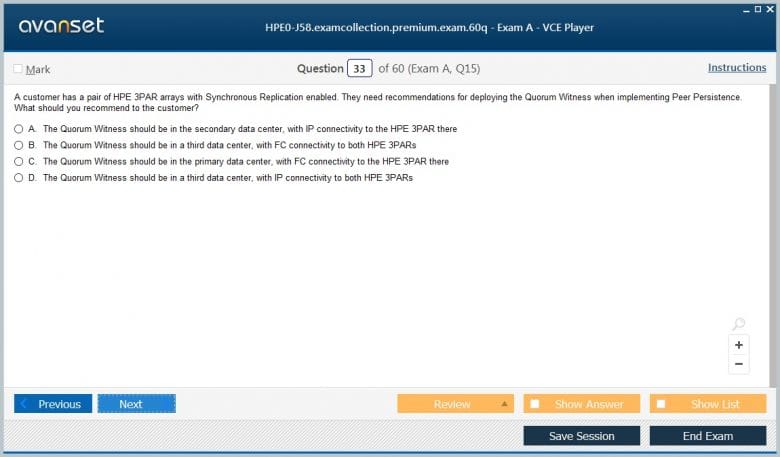
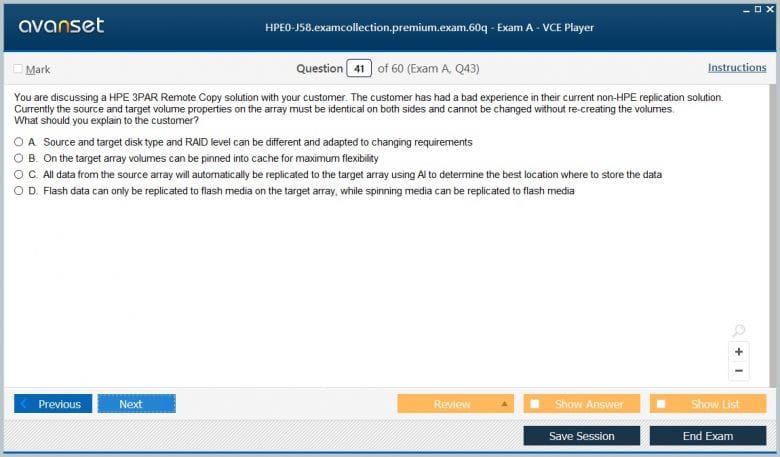
HP HPE0-J58 Practice Test Questions in VCE Format
| File | Votes | Size | Date |
|---|---|---|---|
File HP.braindumps.HPE0-J58.v2026-09-05.by.leo.36q.vce |
Votes 1 |
Size 558.4 KB |
Date Sep 05, 2026 |
File HP.Test-king.HPE0-J58.v2019-04-01.by.Grant.28q.vce |
Votes 3 |
Size 655.33 KB |
Date Apr 02, 2019 |
HP HPE0-J58 Practice Test Questions, Exam Dumps
HP HPE0-J58 (Designing Multi-Site HPE Storage Solutions) exam dumps vce, practice test questions, study guide & video training course to study and pass quickly and easily. HP HPE0-J58 Designing Multi-Site HPE Storage Solutions exam dumps & practice test questions and answers. You need avanset vce exam simulator in order to study the HP HPE0-J58 certification exam dumps & HP HPE0-J58 practice test questions in vce format.
HPE0-J58, Designing Multi-Site HPE Storage Solutions, is a legacy Hewlett Packard Enterprise exam. HPE’s certification data now marks the exam inactive, and the code belonged to the HPE Master ASE Storage Solutions Architect V3 era. That status should be explicit because third-party material can continue to label the exam as if it were schedulable long after the official certification path has moved on.
The old exam remains technically interesting because its subject—designing storage across multiple sites—has not disappeared. Architects still need to reason about replication, failure domains, recovery objectives, network distance, consistency, quorum, automated failover, and application dependencies. What has changed is the HPE product portfolio and the certification structure used to validate those skills.
Within the current HPE ecosystem, candidates should distinguish this retired Master ASE-era code from current storage exams such as HPE0-J82 Storage Architect and HPE0-J83 Storage Integrator Solutions. Those current exams reflect today’s storage products and roles, while HPE0-J58 is best used for historical design context.
A storage architect cannot select replication technology sensibly until recovery expectations are clear. Recovery point objective defines how much data loss the organization can tolerate, while recovery time objective defines how quickly service must resume. A design for near-zero data loss and rapid automated recovery looks very different from a design that accepts several hours of asynchronous lag and manual restoration.
Availability targets also need scope. Is the requirement protection from a controller failure, a rack failure, a site outage, a regional disaster, or operator error? Each failure mode changes the architecture. Multi-site design becomes expensive when every scenario is treated as equally likely and every workload is given the strictest protection class regardless of business impact.
Good exam preparation therefore begins with requirement translation. Convert business language into measurable technical constraints: distance, latency, bandwidth, data-change rate, consistency, failover behavior, failback expectations, test frequency, and dependencies outside storage. This is the same professional skill current HPE architecture exams continue to value.
Synchronous replication protects data by coordinating writes across sites before acknowledging success. That can support very small recovery points, but distance and latency become critical because application I/O may wait on remote communication. Asynchronous replication reduces that latency dependency but introduces a recovery-point window. The right choice depends on the workload and network, not on which mode sounds more resilient.
An architect should also distinguish storage replication from application consistency. Copying blocks consistently at the array level does not automatically guarantee that a multi-tier application can restart cleanly. Databases, virtual machines, middleware, and dependent services may require coordinated snapshots, consistency groups, or application-aware processes.
Network design is part of the storage design. Bandwidth must support changed data, latency must fit the replication mode, and redundant paths should avoid a single carrier or facility failure. Encryption, routing, quality of service, and monitoring can all influence whether replication meets its intended service level.
Stretch or active-active designs create a difficult problem when communication between sites fails but both sites remain powered. Without an arbitration mechanism, each side may believe it should continue serving the same resources. Quorum or witness mechanisms help decide which side remains authoritative and prevent split-brain behavior.
The placement of that third decision point matters. A witness located inside one of the protected sites may not provide independent arbitration during a full site failure. Network reachability to the witness also becomes part of the availability model. A diagram that shows three boxes is not enough; candidates should understand the failure cases each connection is meant to resolve.
Failover policy must match application expectations. Automatic failover can reduce recovery time, but it should be used only when the system can make a safe decision. Manual intervention may be appropriate where business confirmation is required or where dependencies outside storage cannot be failed over automatically.
Replication can faithfully copy corruption, deletion, ransomware-encrypted data, or an application error to the second site. Multi-site architecture therefore still needs backups, snapshots, retention policies, and recovery points that are isolated from production mistakes. Replication protects availability; backup protects recoverability across a different set of failures.
Recovery designs should specify how backups behave during site loss. Where is the catalog? Can the backup system authenticate if the primary identity infrastructure is down? Are copies stored in a separate failure domain? Can operators restore data without depending on the service they are trying to recover? These questions often expose dependencies that pure storage diagrams omit.
The strongest designs test recovery. A failover plan that has never been exercised is an assumption, not a capability. Test procedures should measure actual recovery time, verify application consistency, confirm network and identity changes, and document the steps needed for failback.
Architects often size for normal operations and forget that a failure changes where work runs. If one site must carry the surviving workload, it needs enough compute, storage performance, capacity, and network throughput to support that state. Replication catch-up after a link outage can also consume resources at the same time production demand is high.
Performance baselines help identify whether a design has headroom. Track latency, IOPS, throughput, cache behavior, data-change rates, and replication queues under normal and peak conditions. Then model the effect of losing paths or a site. A resilient architecture should degrade predictably rather than collapse because every component was sized to an average.
Modern HPE storage exams still test this kind of reasoning even though the products and exam codes have changed. The current HPE0-J68 Storage Solutions material is itself now inactive, reinforcing how quickly certification versions move while core architecture principles remain valuable.
HPE’s newer storage structure distinguishes an architect role from an integrator role. HPE0-J82 focuses on assessing requirements and architecting HPE storage solutions, while HPE0-J83 extends deeply into installing, configuring, optimizing, managing, monitoring, troubleshooting, and maintaining them. That role split is useful when repurposing old HPE0-J58 knowledge.
The design principles from J58—requirements, resiliency, replication, capacity, recovery, and multi-site tradeoffs—fit naturally into the architect mindset. Product-specific commands and feature names from old 3PAR, StoreVirtual, or earlier platform generations may not. Legacy material should therefore be filtered into durable concepts and obsolete implementation detail.
Advanced candidates can also use the approved HPE7-J02 advanced storage integrator destination to see where current high-level storage implementation work sits in the workbook. It is not a direct replacement for HPE0-J58, but it demonstrates that advanced storage expertise continues under a different role structure.
When reviewing HPE0-J58 notes, label every fact as conceptual or product-specific. Recovery objectives, synchronous versus asynchronous replication, quorum, failure domains, and testing remain broadly relevant. Exact firmware requirements, product limits, licensing names, model numbers, management interfaces, and certification prerequisites are far more likely to be obsolete.
Also check whether an old scenario assumes a product that has been replaced or repositioned. A technically sound answer for the historical exam can be a poor recommendation for a modern customer. Current certification preparation should use current HPE documentation for products and support matrices, with J58 retained only where it strengthens architectural reasoning.
The retired code still has educational value because multi-site storage is a demanding architecture problem. The correct editorial treatment is to preserve that value without misrepresenting exam status. HPE0-J58 is part of HPE certification history, while candidates seeking a current credential should use today’s storage architect or integrator path.
Network failure modes deserve particular attention in multi-site designs. A replication link can fail while both sites remain healthy, a routing event can isolate only one service network, or a WAN can remain connected but perform poorly enough that synchronous replication becomes unsafe. Designs should define how the storage reacts to degraded communication and how operators distinguish a network partition from a true site outage.
Dependency mapping should extend beyond storage. DNS, identity, load balancers, virtualization management, backup catalogs, application middleware, and external services can all prevent a recovered volume from becoming a recovered business service. A mature disaster-recovery plan identifies these dependencies and orders recovery accordingly.
Failback is often harder than failover. After running at the recovery site, data must be synchronized, the original site must be validated, and service must return without losing writes or violating application consistency. Architecture should include the failback method, expected duration, and business approval process rather than treating recovery as complete when the first failover succeeds.
Capacity planning should also account for recovery operations. Replication resynchronization, backup restores, rebuilds, and catch-up traffic can create unusually high I/O and network demand. A design that performs well only during steady state may miss its recovery objectives precisely when the environment is under the most stress.
Architecture documentation should state which system is authoritative during each recovery state. Operators need to know where writes are accepted, how replication is paused or resumed, which site owns production, and what conditions must be true before failback. Ambiguity during an outage creates a real risk of divergent data or an accidental restart at the wrong site.
Recovery exercises should include people as well as technology. Contact trees, approval authority, vendor escalation, change records, and application-owner validation can determine whether the technical design achieves its stated RTO. Multi-site storage is one layer of a business-continuity system, not the whole recovery process.
Go to testing centre with ease on our mind when you use HP HPE0-J58 vce exam dumps, practice test questions and answers. HP HPE0-J58 Designing Multi-Site HPE Storage Solutions certification practice test questions and answers, study guide, exam dumps and video training course in vce format to help you study with ease. Prepare with confidence and study using HP HPE0-J58 exam dumps & practice test questions and answers vce from ExamCollection.
Purchase Individually

Top HP Certifications


Top HP Certification Exams
Site Search:

SPECIAL OFFER: GET 10% OFF

Pass your Exam with ExamCollection's PREMIUM files!
SPECIAL OFFER: GET 10% OFF
Use Discount Code:
MIN10OFF
A confirmation link was sent to your e-mail.
Please check your mailbox for a message from support@examcollection.com and follow the directions.

Download Free Demo of VCE Exam Simulator
Experience Avanset VCE Exam Simulator for yourself.
Simply submit your e-mail address below to get started with our interactive software demo of your free trial.