



Premium File
59 Q&A
$76.99$69.99
Exin EX0-008 Exam Questions & Answers, Accurate & Verified By IT Experts
Instant Download, Free Fast Updates, 99.6% Pass Rate
59 Questions & Answers
Last Update: Sep 21, 2026
$69.99
Exin EX0-008 Exam Screenshots
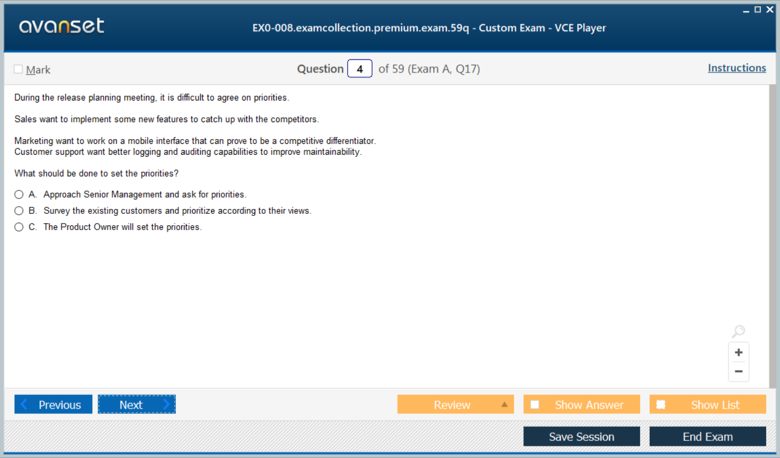
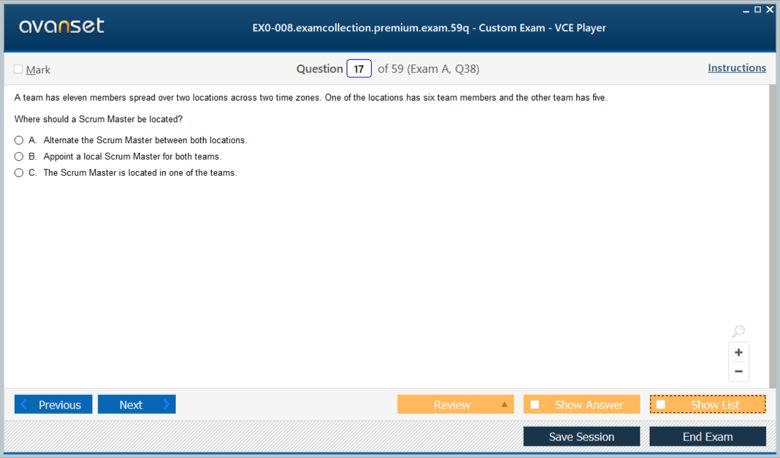
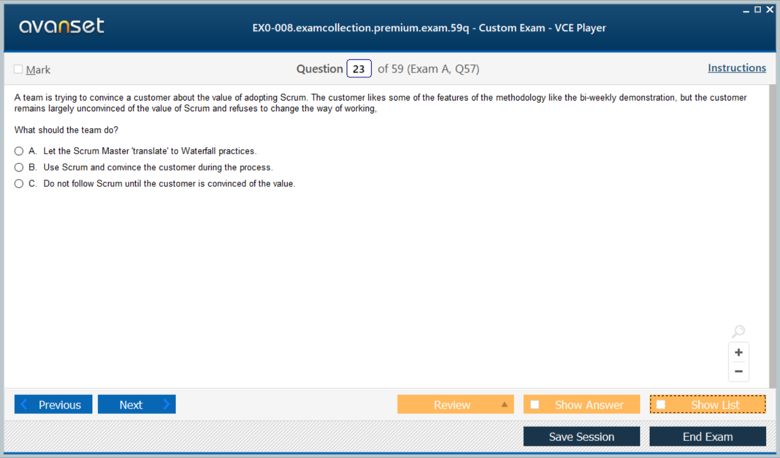
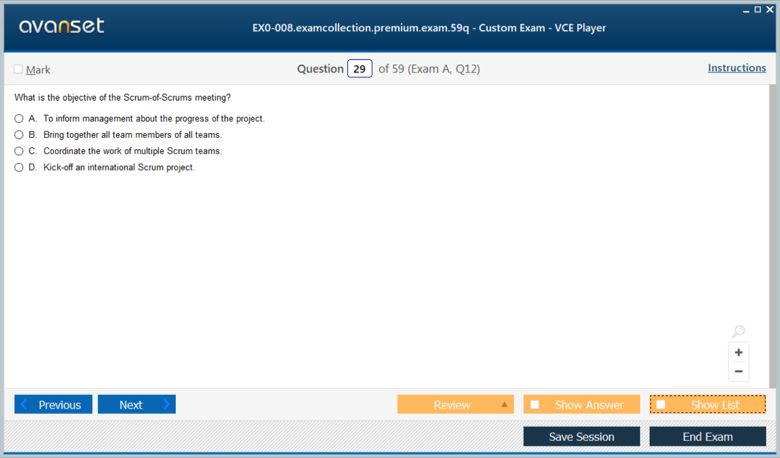
Exin EX0-008 Practice Test Questions in VCE Format
| File | Votes | Size | Date |
|---|---|---|---|
File Exin.practiceexam.EX0-008.v2026-08-09.by.lana.35q.vce |
Votes 1 |
Size 38.94 KB |
Date Aug 09, 2026 |
File Exin.Actualtests.EX0-008.v2019-02-08.by.Paul.35q.vce |
Votes 2 |
Size 35.95 KB |
Date Feb 10, 2019 |
Exin EX0-008 Practice Test Questions, Exam Dumps
Exin EX0-008 (Agile Scrum Foundation) exam dumps vce, practice test questions, study guide & video training course to study and pass quickly and easily. Exin EX0-008 Agile Scrum Foundation exam dumps & practice test questions and answers. You need avanset vce exam simulator in order to study the Exin EX0-008 certification exam dumps & Exin EX0-008 practice test questions in vce format.
EX0-008 is an older EXIN exam identifier associated with Agile Scrum Foundation. The certification itself remains current, but EXIN now presents it by name rather than asking new candidates to work from the historical code. The current EXIN Agile Scrum Foundation pathway tests the agile way of thinking, Scrum practices, planning and estimation, project monitoring, and advanced Scrum concepts. The EX0-008 code therefore separates legacy code history from the living body of knowledge.
For the current examination, EXIN lists 40 questions, a 60-minute limit, a closed-book format, and a 65 percent pass mark, with both the Agile Scrum Handbook and the 2020 Scrum Guide used as required reading. Candidates should study those current sources. EX0-008 remains useful as a search identity because many older training records and study plans still use it, but a modern learner needs to understand the behavior of an empirical product team rather than memorize an obsolete question set.
Agile methods assume that complex product work contains uncertainty that cannot be eliminated by writing a more detailed plan at the beginning. Teams therefore shorten the time between idea, implementation, feedback, and adaptation. This does not mean that planning disappears. It means planning is repeated at useful horizons so that decisions can incorporate real evidence about users, technology, capacity, and changing priorities.
The agile mindset values working outcomes, collaboration, customer feedback, and the ability to respond when facts change. A plan is still valuable because it creates alignment, but it is a forecast rather than a promise detached from evidence. Candidates should be able to explain why transparency and frequent feedback reduce decision latency and why a team can be disciplined even when its plan is deliberately adaptive.
Modern Scrum defines three accountabilities within the Scrum Team: Product Owner, Scrum Master, and Developers. The Product Owner is accountable for maximizing product value and managing the Product Backlog effectively. Developers are accountable for creating a usable Increment each Sprint. The Scrum Master is accountable for establishing Scrum as described in the Scrum Guide and for improving the team’s effectiveness rather than acting as a traditional task controller.
Those distinctions matter because Scrum relies on self-management. Developers decide how to turn selected work into a valuable Increment. The Product Owner sets product direction and ordering, not minute-by-minute implementation instructions. The Scrum Master helps remove impediments and improve the system in which the team works. The wider Scrum certification ecosystem contains different role-focused credentials, but Foundation study should begin with these accountabilities and their boundaries.
Within Scrum, the Product Backlog is an ordered, evolving list of what is needed to improve the product. Its commitment is the Product Goal, which gives the Scrum Team a longer-horizon objective. Backlog refinement adds detail, order, and understanding as items become more likely to be selected. The backlog is not a static requirements document; it changes as the team learns about customers, constraints, market conditions, architecture, and delivery results.
Good backlog management balances clarity with timing. Refining every future item to the same level of detail wastes effort because distant priorities may change. Items closer to implementation need enough shared understanding to support selection and delivery. Candidates should recognize that ordering can reflect value, risk, dependencies, learning opportunity, and urgency rather than one universal formula. The Product Owner remains accountable even when stakeholders contribute heavily to discovery and refinement.
A Sprint is a fixed-length container for the other Scrum events and for the work needed to create value. During Sprint Planning, the team develops a Sprint Goal, selects Product Backlog items, and forms a plan for delivery. The Sprint Goal gives coherence to the work and allows some scope negotiation without losing the purpose of the Sprint. Work that threatens quality should not be hidden simply to protect a forecast.
The fixed cadence reduces coordination overhead because people know when planning, inspection, and adaptation occur. It also limits risk: the team receives meaningful evidence within weeks rather than discovering after many months that assumptions were wrong. A Sprint is not successful merely because every forecast item was completed. A better measure is whether the team produced a usable Increment, learned from the outcome, and moved toward the Product Goal.
The Daily Scrum exists to inspect progress toward the Sprint Goal and adapt the plan for the next day of work. It is not primarily a status meeting for a manager, nor is it required to use a rigid three-question script. Developers choose a structure that improves focus and produces an actionable plan. Other conversations can occur during the day, but the Daily Scrum provides a regular point for collective re-planning.
This event exposes dependencies and flow problems early. If one person is blocked, another may be able to help before the impediment consumes several days. If new information makes the current approach ineffective, Developers can change their plan while preserving the Sprint Goal. Candidates should connect the event to self-management and transparency rather than memorizing a ceremonial format.
The Sprint Review inspects the outcome of the Sprint with stakeholders and considers what to do next. It is a working session about the product, environment, progress, and future direction, not simply a demonstration. The Product Backlog may be adapted as new opportunities or constraints become visible. Useful feedback is specific enough to affect ordering, design, expectations, or the Product Goal.
The Sprint Retrospective focuses on the team’s effectiveness and quality practices. Participants examine interactions, tools, processes, assumptions, and the Definition of Done to identify improvements. The goal is not to assign blame for every variance. It is to improve the way the system produces value. Teams that repeatedly hold retrospectives without changing anything are performing the ceremony without realizing its empirical purpose.
Agile Scrum Foundation material includes planning and estimation because teams still need to forecast. Estimates can support release conversations, capacity decisions, ordering, and risk assessment, but they are uncertain by nature. Relative sizing, historical throughput, decomposition, and empirical velocity can help when used consistently. The danger comes when a probabilistic estimate is converted into a personal performance target or treated as certainty.
Planning should become more accurate as work approaches and information improves. A forecast for the next Sprint can be concrete, while a six-month product forecast may need ranges and assumptions. Teams should also distinguish output from outcome: delivering more backlog items is not automatically valuable if users do not benefit. A related Professional Scrum Master I path goes deeper into Scrum understanding, but the same empirical discipline begins at Foundation level.
The Increment is usable when it meets the Definition of Done. That shared standard makes the state of work transparent and prevents teams from calling partially tested or unintegrated work complete. If several Scrum Teams work on one product, they need a mutually compatible Definition of Done so that their increments can combine into a coherent product state rather than creating hidden integration debt.
Quality is therefore not a separate phase added after the Sprint. Testing, security, integration, documentation, and other necessary work belong inside the team’s definition of completion when they are required for usability. A weak definition inflates apparent progress because unfinished risk accumulates outside the board. Foundation candidates should understand that transparency depends on a credible quality boundary as much as it depends on visible backlog items.
EX0-008 should be treated as historical metadata, not as a reason to study old role names or outdated Scrum interpretations. Current EXIN Agile Scrum Foundation required reading explicitly includes the 2020 Scrum Guide, so learners should be comfortable with Product Goal, Sprint Goal, Definition of Done, the three accountabilities, the five events, and the three artifacts as they are defined today. Where older notes conflict, the current official material should win.
The strongest preparation explains cause and effect: why short feedback loops reduce uncertainty, why the Product Owner controls ordering, why Developers self-manage, why the Scrum Master protects the framework, why events exist, and why an Increment must meet a real quality standard. The EXIN certification catalog supplies the provider context, but effective study comes from understanding how the elements reinforce empirical product development.
Scrum also depends on stakeholder discipline. Stakeholders provide domain knowledge, constraints, feedback, and changing market information, but they do not bypass the Product Owner to inject work directly into the Sprint. Protecting a single ordering authority reduces conflicting priorities and makes trade-offs visible. The Product Owner, in turn, should remain accessible enough that important questions do not sit unanswered while Developers make avoidable assumptions about value or acceptance.
Technical practices are not prescribed by Scrum, yet technical health strongly affects empirical delivery. Automated tests, continuous integration, feature toggles, observability, refactoring, and small releases can make it easier to produce a Done Increment and learn quickly. Teams are free to choose other techniques, but they remain accountable for quality. A framework that creates frequent inspection points cannot help much if the product is too fragile to change or if release work is postponed into a growing stabilization phase.
For exam preparation, scenario questions are more useful than isolated flash cards. Ask what should happen when stakeholders demand mid-Sprint changes, when the Sprint Goal becomes obsolete, when quality criteria are unmet, or when a retrospective identifies a recurring impediment. The answer usually follows from accountabilities, commitments, transparency, inspection, and adaptation. This reasoning is more durable than memorizing a preferred meeting script because it connects each Scrum element to the problem it is designed to solve.
Go to testing centre with ease on our mind when you use Exin EX0-008 vce exam dumps, practice test questions and answers. Exin EX0-008 Agile Scrum Foundation certification practice test questions and answers, study guide, exam dumps and video training course in vce format to help you study with ease. Prepare with confidence and study using Exin EX0-008 exam dumps & practice test questions and answers vce from ExamCollection.
Purchase Individually
Site Search:

SPECIAL OFFER: GET 10% OFF

Pass your Exam with ExamCollection's PREMIUM files!
SPECIAL OFFER: GET 10% OFF
Use Discount Code:
MIN10OFF
A confirmation link was sent to your e-mail.
Please check your mailbox for a message from support@examcollection.com and follow the directions.

Download Free Demo of VCE Exam Simulator
Experience Avanset VCE Exam Simulator for yourself.
Simply submit your e-mail address below to get started with our interactive software demo of your free trial.