



Premium File
50 Q&A
$76.99$69.99
QlikView QSBA2018 Exam Questions & Answers, Accurate & Verified By IT Experts
Instant Download, Free Fast Updates, 99.6% Pass Rate
50 Questions & Answers
Last Update: Sep 11, 2026
$69.99
QlikView QSBA2018 Exam Screenshots
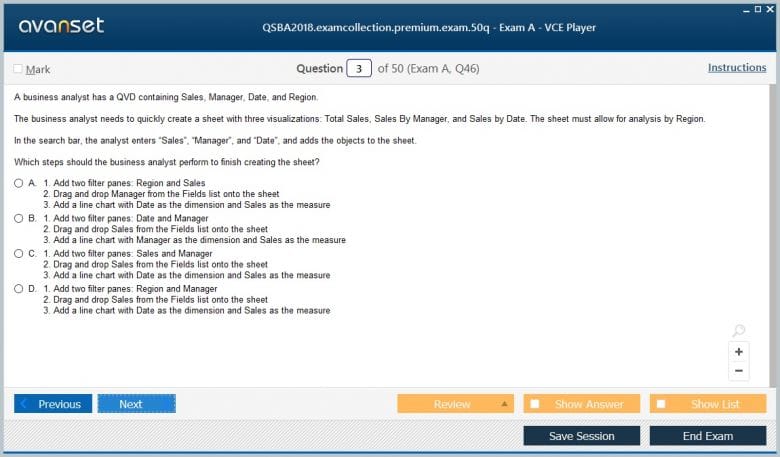
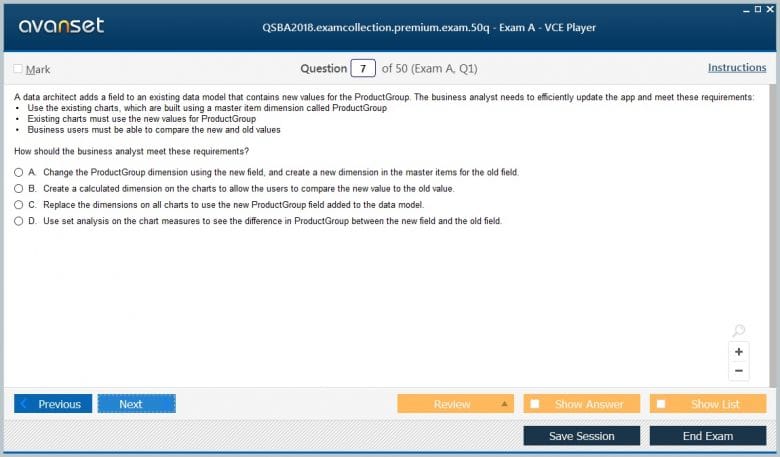
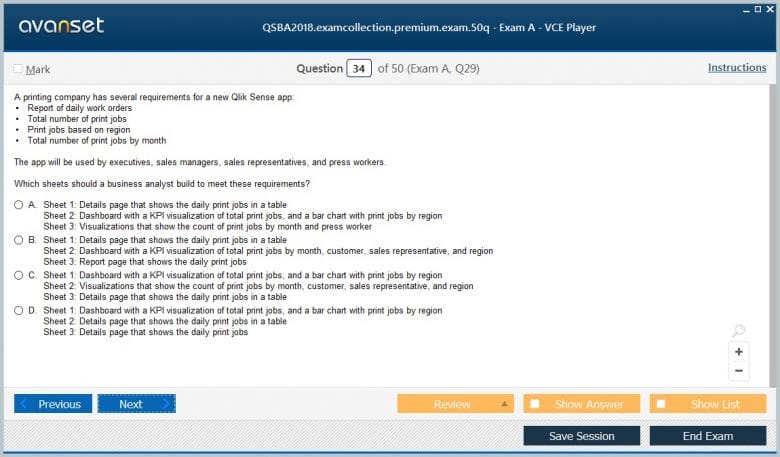
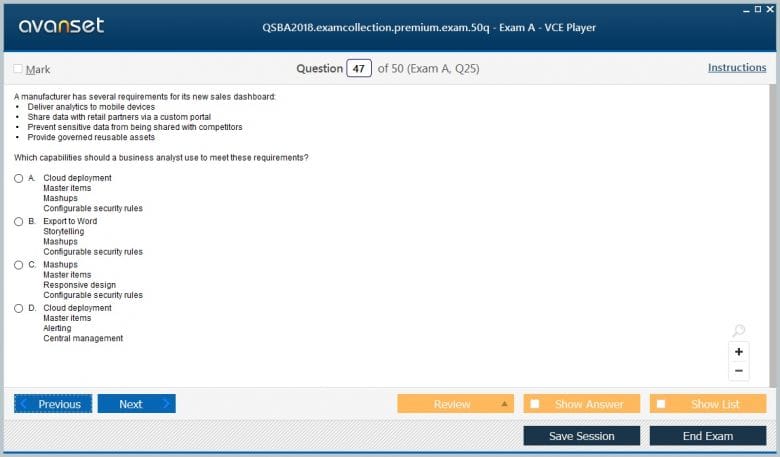
QlikView QSBA2018 Practice Test Questions in VCE Format
| File | Votes | Size | Date |
|---|---|---|---|
File QlikView.certkiller.QSBA2018.v2026-08-28.by.joseph.25q.vce |
Votes 1 |
Size 1.32 MB |
Date Aug 28, 2026 |
File QlikView.Test-king.QSBA2018.v2019-03-21.by.Alex.23q.vce |
Votes 4 |
Size 1.48 MB |
Date Mar 26, 2019 |
QlikView QSBA2018 Practice Test Questions, Exam Dumps
QlikView QSBA2018 (Qlik Sense Business Analyst Certification Exam) exam dumps vce, practice test questions, study guide & video training course to study and pass quickly and easily. QlikView QSBA2018 Qlik Sense Business Analyst Certification Exam exam dumps & practice test questions and answers. You need avanset vce exam simulator in order to study the QlikView QSBA2018 certification exam dumps & QlikView QSBA2018 practice test questions in vce format.
The QSBA2018 Qlik Sense Business Analyst exam belongs to an earlier generation of Qlik certification. Qlik launched the June 2018 Business Analyst, Data Architect, and System Administrator exams as a coordinated release, and those version-bound exams were later retired as newer versions replaced them. That historical status matters: candidates encountering QSBA2018 today should use it to understand the skills Qlik valued in that release, not as evidence that the 2018 exam is still the current registration target.
Qlik’s current Business Analyst certification has moved away from release-year branding. The present exam is platform-neutral across client-managed Qlik Sense and Qlik Cloud, while the 2018 generation was tied to the June 2018 release. The durable thread is the role itself: converting business questions into useful applications through requirements analysis, data preparation, visualization, expression logic, and deliberate interface design.
The broader Qlik certification family still separates analytical application design from deeper data architecture and platform administration. That separation is useful when studying a legacy code because it shows what not to overemphasize. QSBA2018 was not primarily a server-administration exam or a scripting-specialist credential; it centered on how a business analyst turns data into an application people can interpret and use.
Qlik’s own 2018 announcement described three new Qlik Sense certification exams based on the June 2018 release and stated that previous versions had been retired. The Business Analyst exam in that generation used 50 questions over two hours. Later releases repeated the same replacement pattern, so version numbers on old preparation material should be treated as timestamps rather than permanent exam identities.
That distinction protects candidates from mixing obsolete interface details with current concepts. A legacy question about where a property appeared in a 2018 screen can be historically accurate and still be a poor guide to today’s product. By contrast, questions about selecting an appropriate chart, building a useful measure, structuring a sheet, or interpreting user requirements remain valuable because those decisions survive product redesigns.
A strong Qlik application begins before a chart is created. The analyst has to identify who will use the app, which decisions the app should support, what level of detail users need, which comparisons matter, and which business definitions must be consistent. A request for “sales performance,” for example, is incomplete until revenue, margin, time grain, geography, product hierarchy, and exception rules are defined.
QSBA-style scenarios therefore reward candidates who can translate vague requests into dimensions, measures, filters, and navigation choices. The most useful habit is to ask what a user must be able to see or decide after interacting with a sheet. That keeps the design tied to a business outcome rather than turning the application into a collection of attractive but disconnected objects.
Qlik Sense is built around an associative selection model. Users do not simply run a fixed report; they select values and see how those selections affect possible, selected, and excluded values across the application. A business analyst must understand this behavior because it shapes filter design, object interactions, and the way users investigate unexpected relationships.
The practical implication is that an analyst should design for exploration without creating confusion. Selections need to be visible, filters should correspond to meaningful business fields, and sheets should make it clear when a surprising result comes from the current selection state. Good Qlik design makes associative exploration feel intentional rather than mysterious.
Business Analyst work in Qlik sits at the boundary between business language and expression logic. A dimension groups or categorizes data; a measure performs an aggregation or calculation. That sounds simple until the same metric must behave correctly across dates, hierarchies, selections, alternate states, and different levels of detail.
Candidates should therefore practice explaining an expression in business terms. A sum, count, ratio, set expression, or conditional calculation is only correct if it answers the intended question. Memorizing function names without understanding aggregation grain often produces plausible-looking but misleading results, which is exactly the kind of failure a production-quality dashboard must avoid.
Chart selection is not a decoration exercise. Bar charts are effective for comparing categories, line charts for change over ordered time, scatter plots for relationships between measures, tables for precise detail, and KPI objects for a small number of high-priority indicators. The analyst should choose the visual form that makes the intended comparison easiest to perceive.
Qlik applications can offer many object types, but using more objects rarely makes an app better. A well-designed sheet establishes hierarchy: a small number of primary measures, supporting breakdowns, and enough filtering to answer predictable follow-up questions. Dense screens, excessive color, and competing visual encodings increase cognitive load even when every individual chart is technically valid.
Master dimensions, measures, and visualizations are important because they allow teams to define reusable analytical objects instead of recreating logic sheet by sheet. If revenue is calculated differently in three places, users stop trusting the application. Central definitions also make maintenance easier when a business rule changes.
The 2018 exam context made these capabilities part of practical Business Analyst work, and the current Qlik Business Analyst guidance still expects experience creating dimensions, measures, and master-library objects. The durable lesson is governance at the application level: reusable definitions are a way to keep design and business meaning aligned.
Business analysts often need to load files, understand field associations, make simple transformations, and verify that the application contains the expected data. They should recognize obvious data-quality problems and know when a field is unsuitable for a chart or calculation. That working knowledge helps them build reliable applications without pretending every analyst must become a data engineer.
The deeper modeling boundary is clearer when QSBA is compared with the QSDA2018 Data Architect exam or the later Qlik Sense Data Architect certification. Data architects are expected to go further into load scripts, model structure, transformations, connectivity, and performance. Business analysts need enough data understanding to design responsibly and enough judgment to know when architecture expertise is required.
A slow dashboard is not merely a technical inconvenience. If every selection causes long waits, users stop exploring and revert to static exports or spreadsheets. Business analysts influence performance through the number and complexity of objects, expression design, data volume exposed on a sheet, and choices that trigger expensive recalculation.
Performance awareness therefore belongs in design reviews. The analyst does not need to diagnose every server bottleneck, but should recognize when a chart asks too much, when a detailed table should be narrowed, or when a calculation should be moved into the model. Responsive interaction is part of the user experience, not a separate infrastructure concern.
Business applications are rarely consumed by one undifferentiated audience. Different teams may need different sheets, data subsets, or publishing destinations. Analysts should understand the consequences of putting sensitive fields into an app and work with data architects or administrators when access controls need to be enforced below the visualization layer.
This is also where role boundaries matter. The QSSA2018 System Administrator exam focused on installation, configuration, security, and operational management of the Qlik Sense environment. A business analyst should know enough about governed publishing to make safe design choices, while server rules, nodes, services, and platform maintenance belong to administration.
For someone using QSBA2018 as a study reference, the best approach is to classify each topic. Keep enduring concepts such as requirements, dimensions, measures, selections, visual design, master items, data validation, and performance awareness. Treat exact 2018 menu locations, screenshots, and version-specific behavior as historical unless they match the current product you are actually using.
The current QSBA2024 is the more appropriate internal reference for today’s Business Analyst path. Comparing the two versions can be educational because it shows how the credential evolved from release-specific testing toward a platform-neutral role definition. The goal is not to memorize two eras at once, but to understand which analytical skills remained important as the software changed.
A business-analysis application should be tested with people who were not involved in building it. Ask them to answer a few realistic questions without coaching and watch where they hesitate. Confusing labels, hidden selections, overloaded sheets, and ambiguous measures become obvious when the designer stops driving the interface. This kind of usability testing is particularly valuable for Qlik because associative exploration can expose paths the author did not anticipate.
The review should also capture analytical misunderstandings, not only navigation problems. If two people interpret the same KPI differently, the issue may be its definition, denominator, date context, or title. Fixing that ambiguity before publication is more important than adding another visualization, because every downstream decision depends on shared interpretation.
A useful way to review legacy Business Analyst material is to test the same business question in a current Qlik Sense environment. Rebuild one small 2018-style scenario with current objects and note which concepts transfer cleanly and which interface assumptions no longer apply. This separates durable analytical reasoning from historical product navigation and prevents old screenshots or property locations from becoming accidental study objectives.
QSBA2018 is most valuable today as a snapshot of how Qlik defined the Business Analyst role around the June 2018 release. It rewards the same kind of disciplined thinking that still matters in analytics: understand the question, model the metric correctly, choose the right visual form, make selections understandable, and deliver an application that people can actually use.
For current certification work, candidates should follow Qlik’s latest Business Analyst exam details rather than treating the 2018 mechanics as active. For skill development, however, the old code still illustrates an enduring principle: successful Qlik analysis is less about filling a sheet with charts and more about designing a coherent decision environment.
Go to testing centre with ease on our mind when you use QlikView QSBA2018 vce exam dumps, practice test questions and answers. QlikView QSBA2018 Qlik Sense Business Analyst Certification Exam certification practice test questions and answers, study guide, exam dumps and video training course in vce format to help you study with ease. Prepare with confidence and study using QlikView QSBA2018 exam dumps & practice test questions and answers vce from ExamCollection.
Purchase Individually
Top QlikView Certification Exams
Site Search:

SPECIAL OFFER: GET 10% OFF

Pass your Exam with ExamCollection's PREMIUM files!
SPECIAL OFFER: GET 10% OFF
Use Discount Code:
MIN10OFF
A confirmation link was sent to your e-mail.
Please check your mailbox for a message from support@examcollection.com and follow the directions.

Download Free Demo of VCE Exam Simulator
Experience Avanset VCE Exam Simulator for yourself.
Simply submit your e-mail address below to get started with our interactive software demo of your free trial.