



Premium File
60 Q&A
$76.99$69.99
Cloudera CCA-500 Exam Questions & Answers, Accurate & Verified By IT Experts
Instant Download, Free Fast Updates, 99.6% Pass Rate
60 Questions & Answers
Last Update: Nov 14, 2026
$69.99
Cloudera CCA-500 Exam Screenshots
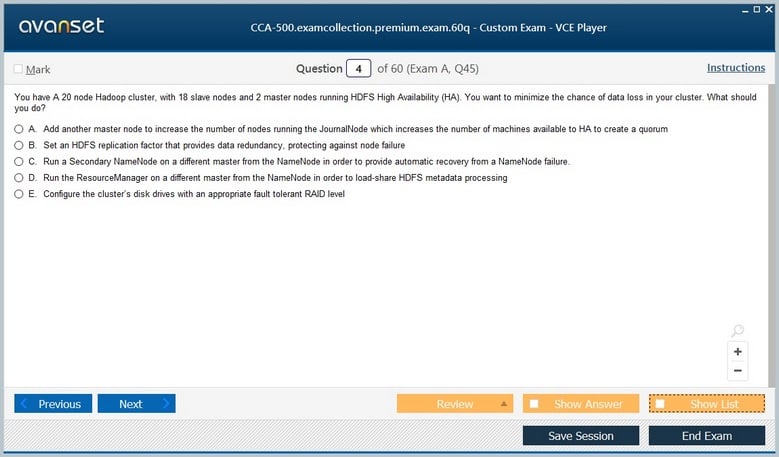
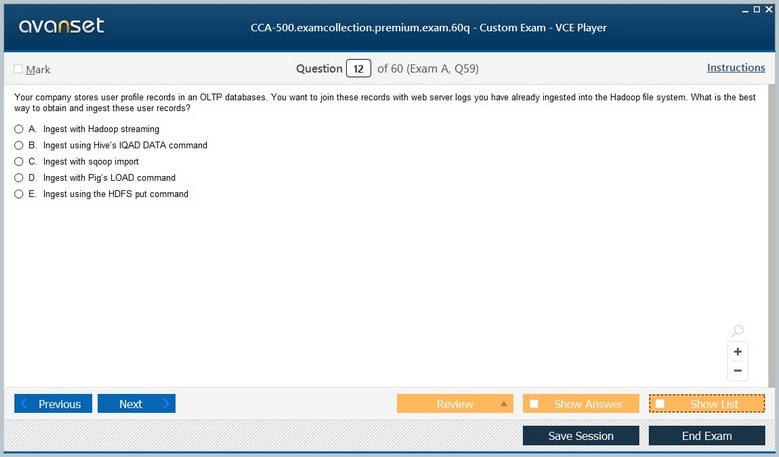
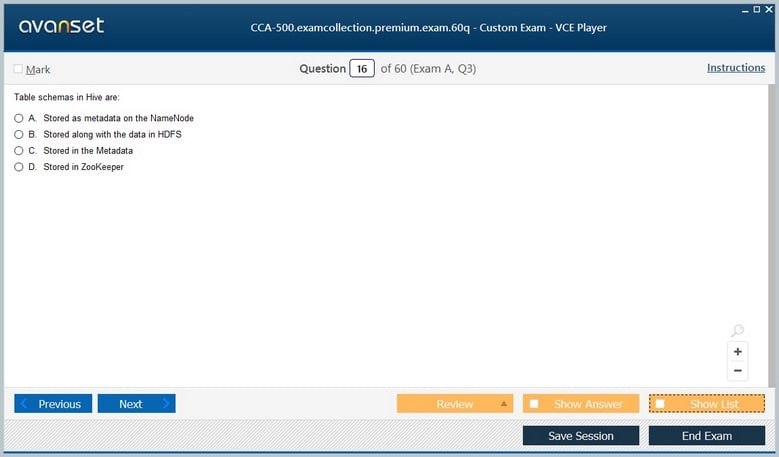
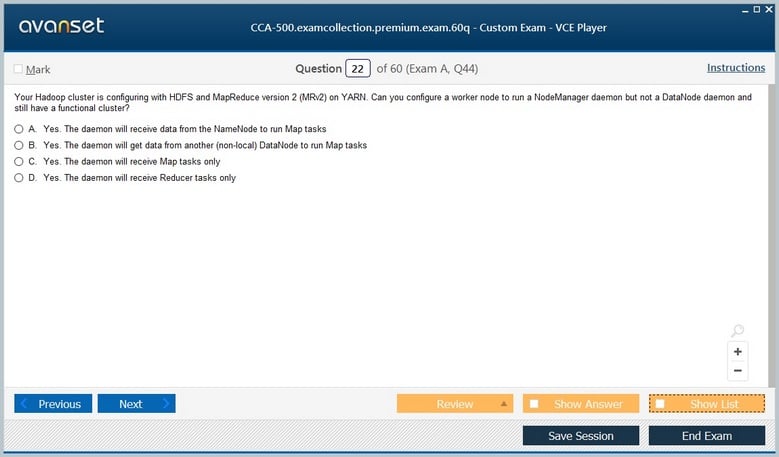
Cloudera CCA-500 Practice Test Questions in VCE Format
| File | Votes | Size | Date |
|---|---|---|---|
File Cloudera.Test-king.CCA-500.v2026-05-04.by.Salvador.68q.vce |
Votes 9 |
Size 216.8 KB |
Date May 04, 2026 |
Cloudera CCA-500 Practice Test Questions, Exam Dumps
Cloudera CCA-500 (Cloudera Certified Administrator for Apache Hadoop (CCAH)) exam dumps vce, practice test questions, study guide & video training course to study and pass quickly and easily. Cloudera CCA-500 Cloudera Certified Administrator for Apache Hadoop (CCAH) exam dumps & practice test questions and answers. You need avanset vce exam simulator in order to study the Cloudera CCA-500 certification exam dumps & Cloudera CCA-500 practice test questions in vce format.
Cloudera CCA-500 was the Cloudera Certified Administrator for Apache Hadoop (CCAH) exam. It is a retired certification path: Cloudera’s own historical certification page states that CCA-500 was replaced by CCA Administrator (CCA131), with purchases ending in April 2017 and the last exam sessions in May 2017. That means CCA-500 should now be read as a legacy Hadoop administration blueprint, not as an exam candidates can schedule today.
The legacy material remains useful because it captures the operating model of a classic Hadoop cluster: HDFS storage, MapReduce processing, cluster services, Linux administration, configuration, monitoring, troubleshooting, security, maintenance, and capacity planning. Those foundations still help explain the lineage of modern distributed-data platforms even though Cloudera’s current certification program is centered on the Cloudera Data Platform rather than this older CDH-era exam.
Within the ExamCollection inventory, the wider Cloudera certification family also includes related historical pages such as CCA-505 CCAH CDH5 Upgrade, CCB-400 Apache HBase Specialist, and CCD-410 Hadoop Developer. These codes belong to the same earlier Hadoop era and should be interpreted with their retirement context intact.
Hadoop Distributed File System was designed to store large datasets across multiple machines while tolerating hardware failure. The NameNode manages filesystem metadata and block locations, while DataNodes store the actual blocks. Administrators need to understand that distinction because a metadata problem and a data-node problem have very different consequences.
Replication protects blocks by maintaining copies on more than one node. Administrators must think about replication factor, rack awareness, disk capacity, node health, and the cost of re-replication after failures. Redundancy improves resilience, but it consumes storage and network bandwidth, so cluster design always involves tradeoffs.
The legacy exam also required candidates to understand normal filesystem operation: how files are split into blocks, how clients find data, how permissions work, and how cluster services respond when a node becomes unavailable. Those ideas remain central to understanding distributed storage even as newer platforms add object storage and cloud-native architectures.
A Hadoop installation is not one monolithic process. It contains storage services, resource-management components, job execution services, coordination mechanisms, management tools, and often surrounding projects such as Hive, HBase, or Oozie. An administrator must know which service depends on which other service and what failure symptoms appear when a dependency is unavailable.
This is why service startup order and health checking matter. A process may be running while still being functionally unhealthy because it cannot reach another required component. Administrators should inspect logs, process state, network reachability, disk space, time synchronization, and configuration rather than assuming that a “started” status means the platform is working correctly.
The broader article on the difference between big data and Hadoop is useful here because it separates the business problem of large-scale data from one particular technology stack used to solve it.
Classic Hadoop clusters typically ran on Linux, so file permissions, users and groups, processes, services, disks, networking, package management, and shell tools were everyday operational skills. An administrator who could configure Hadoop but not diagnose the host operating system would struggle when failures crossed the application boundary.
Disk utilization is a good example. HDFS may report a capacity problem whose root cause is a failed mount, an unexpectedly full local filesystem, or hardware degradation. Similarly, a service may appear unreachable because of host firewall rules, name-resolution errors, or an incorrect interface configuration rather than a Hadoop-specific defect.
Legacy preparation should therefore include practical command-line work. Examine processes, network sockets, filesystem space, ownership, logs, and service configuration. The exact commands may vary between distributions, but the diagnostic mindset remains portable.
Hadoop administration historically involved understanding how computational work was distributed as well as how data was stored. MapReduce divides processing into tasks that can run near data, and resource-management components decide where work is scheduled. Administrators need to recognize how cluster resources, data locality, queue configuration, and task failures affect throughput.
A slow job is not automatically a storage problem. It may be waiting for resources, suffering from skewed input, retrying failed tasks, or moving large amounts of data across the network. Cluster health therefore needs both infrastructure metrics and workload context.
Modern Cloudera data engineering has shifted heavily toward Spark and other services, but the reasoning remains similar: distributed work competes for CPU, memory, storage, and network capacity, and administrators need enough application awareness to interpret the pressure they see.
Distributed systems amplify configuration mistakes. A setting changed on one host but not another can create subtle failures, while an incorrect cluster-wide value can affect every workload. Administrators need controlled configuration, change records, backups, and a way to verify that intended settings actually reached the correct services.
Important configuration areas include storage paths, memory limits, Java settings, service endpoints, replication behavior, scheduler policies, logging, security, and network addresses. The correct value depends on cluster size, workload, hardware, and software version rather than a universal tuning number.
Before changing a parameter, the operator should understand what symptom it is intended to address and how success will be measured. Tuning without evidence can move a bottleneck or create instability elsewhere.
Version control for configuration and automation can make those decisions traceable. Even when older clusters relied heavily on management consoles, keeping scripts and important configuration changes under change control helped teams compare environments, review changes before deployment, and rebuild hosts more consistently after failure.
CPU, memory, disk, network, process health, JVM behavior, queue utilization, HDFS capacity, block status, and job statistics all contribute to operational visibility. The purpose of monitoring is not to collect every metric; it is to detect abnormal behavior early and provide enough context to diagnose it.
Administrators should establish baselines for normal activity. A data node using high disk bandwidth may be healthy during a planned ingestion window but suspicious at another time. A queue at 90 percent utilization may be expected during a batch period or may reveal poor capacity planning if it remains saturated continuously.
Logs are equally important. They often show the first concrete evidence of permission problems, failed connections, memory pressure, corrupt blocks, service restarts, or configuration errors. Centralizing and retaining logs makes distributed troubleshooting much easier than logging in to hosts one at a time after an incident.
Hadoop security historically involved filesystem permissions, service identities, authentication mechanisms, administrative separation, network controls, and protection of sensitive data. A large cluster may contain datasets with very different confidentiality requirements, so access should follow least-privilege principles instead of granting broad rights for convenience.
Authentication answers who the user or service is; authorization answers what that identity may do. Encryption protects information in transit or at rest, while auditing records security-relevant actions. These controls solve different problems and work best together.
The general principles from modern network security architecture remain relevant because a distributed data platform still depends on secure hosts, controlled network paths, trustworthy identity, and monitored access.
A cluster is not static after installation. Data grows, nodes fail, disks age, workloads change, and software requires updates. Administrators need procedures for adding and removing nodes, rebalancing data, protecting metadata, checking filesystem health, and planning maintenance without unnecessary service disruption.
Backup requires careful thinking because replication is not the same as backup. Replication can keep data available after a hardware failure, but it may replicate an accidental deletion or corrupt logical change. Critical data and metadata need recovery strategies that match business requirements.
Capacity planning should also look ahead. Storage consumption, replication overhead, temporary processing space, memory demand, and network throughput can all become constraints. Waiting until the cluster is full is not a capacity plan.
Change control is another administrative skill embedded in this older material. A production cluster should not become a collection of undocumented emergency fixes. Configuration changes need an owner, a reason, a validation step, and a way to reverse them. Maintenance windows, dependency checks, and post-change verification reduce the chance that one improvement silently breaks another workload.
Cloudera’s current certification program uses role-based CDP exams, including modern administrator and data-engineering paths. Those offerings focus on today’s Cloudera platform rather than the exact CDH architecture behind CCA-500. A candidate should therefore avoid using old CCAH material as if it were a current blueprint.
The historical article on Cloudera certifications can provide additional program context, but the vendor’s live certification catalog is the correct place to confirm what can be taken now. For modern work, concepts such as governance, cloud deployment, Spark, newer storage models, and current platform services require updated study.
CCA-500 is still valuable when used for what it actually represents: an administrative foundation in HDFS, distributed services, Linux operations, monitoring, security, and cluster maintenance. Those skills explain where the Cloudera ecosystem came from, while current certification paths explain where it is now.
Go to testing centre with ease on our mind when you use Cloudera CCA-500 vce exam dumps, practice test questions and answers. Cloudera CCA-500 Cloudera Certified Administrator for Apache Hadoop (CCAH) certification practice test questions and answers, study guide, exam dumps and video training course in vce format to help you study with ease. Prepare with confidence and study using Cloudera CCA-500 exam dumps & practice test questions and answers vce from ExamCollection.
Purchase Individually
Site Search:

SPECIAL OFFER: GET 10% OFF

Pass your Exam with ExamCollection's PREMIUM files!
SPECIAL OFFER: GET 10% OFF
Use Discount Code:
MIN10OFF
A confirmation link was sent to your e-mail.
Please check your mailbox for a message from support@examcollection.com and follow the directions.

Download Free Demo of VCE Exam Simulator
Experience Avanset VCE Exam Simulator for yourself.
Simply submit your e-mail address below to get started with our interactive software demo of your free trial.