



Premium File
60 Q&A
$76.99$69.99
Adobe AD0-E104 Exam Questions & Answers, Accurate & Verified By IT Experts
Instant Download, Free Fast Updates, 99.6% Pass Rate
60 Questions & Answers
Last Update: Nov 05, 2026
$69.99
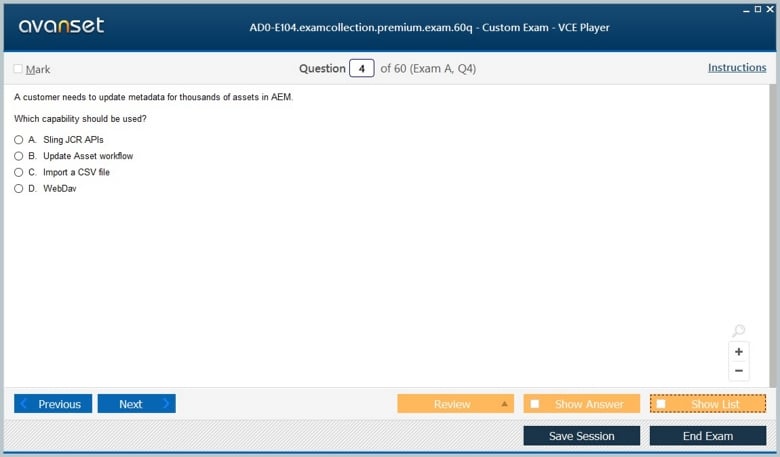
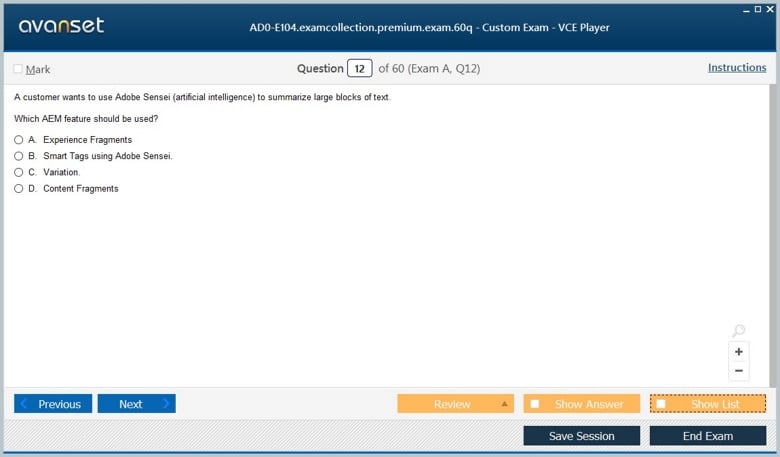
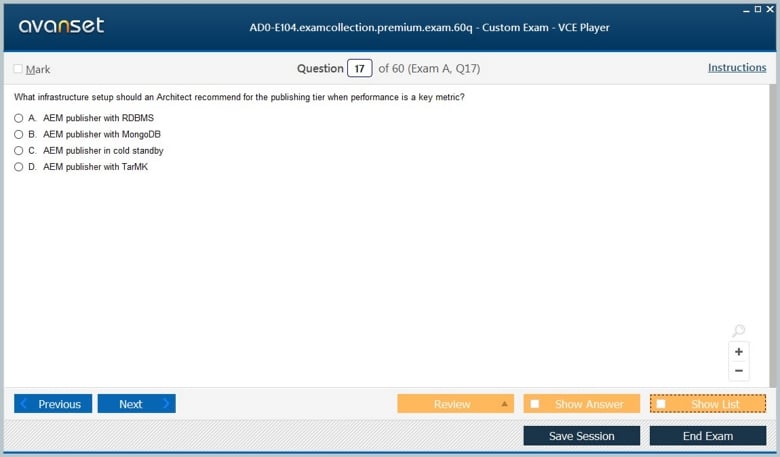
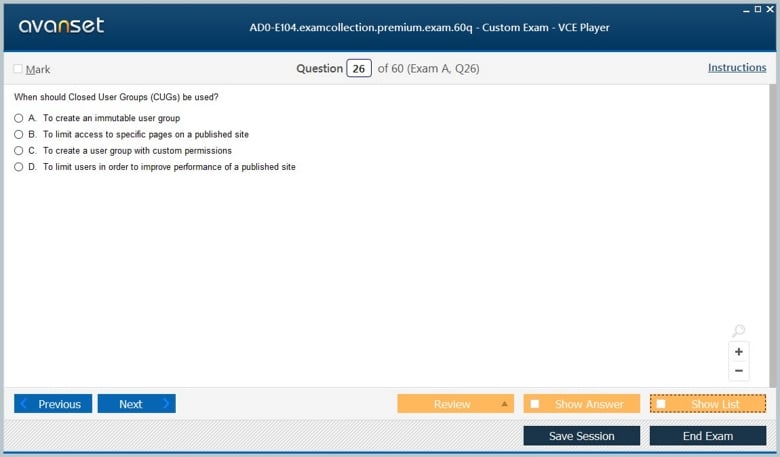
Adobe AD0-E104 Exam Screenshots
Adobe AD0-E104 Practice Test Questions in VCE Format
| File | Votes | Size | Date |
|---|---|---|---|
File Adobe.Testking.AD0-E104.v2026-08-27.by.Austin.28q.vce |
Votes 3 |
Size 112.88 KB |
Date Sep 03, 2026 |
Adobe AD0-E104 Practice Test Questions, Exam Dumps
Adobe AD0-E104 (Adobe Experience Manager Architect) exam dumps vce, practice test questions, study guide & video training course to study and pass quickly and easily. Adobe AD0-E104 Adobe Experience Manager Architect exam dumps & practice test questions and answers. You need avanset vce exam simulator in order to study the Adobe AD0-E104 certification exam dumps & Adobe AD0-E104 practice test questions in vce format.
AD0-E104 is a historical Adobe Experience Manager Architect exam identity. It was a real architect-level credential in the AEM 6.x era, but Adobe’s current Sites architecture certification is represented by AD0-E117 AEM Sites Architect Master. A current candidate should therefore use E104 to understand the evolution of AEM architecture, not as the live exam code to schedule in 2026.
Many themes that appeared around E104 remain central to current architecture: Dispatcher and caching, multi-site and localization, experience fragments, integrations, identity, repository design, deployment, scalability, security, and operational governance. What changes is the implementation context. AEM as a Cloud Service, modern delivery pipelines, cloud-native operations, and newer Experience Cloud integrations alter the way an architect should solve those problems. Adobe certifications provide the broader role map.
Architecture is the discipline of making connected choices under constraints. The architect needs to understand content teams and business goals as well as development and operations. A solution can be technically elegant and still fail if authors cannot maintain it, deployments are fragile, permissions are unmanageable, or integrations create unacceptable latency. That systems perspective is the most valuable part of an old architect exam to carry forward.
Cost and organizational capability are also architectural constraints. A design that requires continuous specialist intervention, many custom services, or unusually complex content governance may be technically possible but economically poor. Architects should account for the skills of the team that will operate the solution after launch, the release frequency the organization can sustain, and the cost of external dependencies. This is one reason current Master-level preparation benefits from scenario reasoning: there is rarely one universally “best” AEM feature. The right design is the one that satisfies the important requirements while keeping security, operability, authoring effort, and future change within acceptable bounds.
That balance between technical ambition and operational reality is a defining architect skill in current enterprise AEM programs.
Stakeholders often present implementation ideas as requirements: “we need a custom workflow,” “we need one site per business unit,” or “we need every page personalized.” The architect should step back and identify the actual outcome, constraints, users, data, scale, governance, and quality attributes. A requirement for rapid regional launches might be solved through templates and inheritance rather than duplicated sites. A requirement for approval might be handled by a simpler publishing role model rather than a long custom workflow. This discipline reduces accidental complexity. Candidates should practice converting feature requests into architectural questions: what must be true, what can vary, what performance and security boundaries apply, and who owns the process after launch? Only after those questions are answered should the architect select AEM mechanisms.
Content models, page hierarchies, component structures, fragments, and asset relationships determine how efficiently authors can work and how reliably applications can consume content. An architect should resist structures optimized only for one development team or one front-end rendering path. Localization, rollout, permissions, search, migration, and future channels can all expose weaknesses in an overly narrow model. Reuse should be intentional: experience fragments or content fragments can reduce duplication when the same concept truly appears across experiences, but forced reuse can create hard-to-understand coupling. A strong design explains ownership and lifecycle for every major content type. Candidates should evaluate whether the model can accommodate new regions, new brands, and future presentation channels without requiring widespread restructuring.
High-performing AEM delivery normally depends on caching, but personalization and authenticated experiences complicate the model. Architects need to understand what can be cached at CDN or Dispatcher layers, which requests must reach AEM, how invalidation works, and how URL design or headers affect cache behavior. If a page mixes public and user-specific content, the architecture may need to separate those concerns rather than disabling caching for everything. Traffic patterns also matter: a global campaign launch creates different pressure from a steady intranet workload. Preparation should include failure and surge scenarios, not only ideal performance. The architect should be able to explain how the solution protects the origin, how stale content is corrected, and what happens if an upstream integration becomes slow while the public site is under load.
AEM architecture may integrate enterprise identity providers, service accounts, external APIs, author groups, and publishing roles. Security decisions need to be coherent across those layers. Authentication answers who the actor is; authorization decides what that actor can do; service-to-service credentials define what integrations can access. Architects should favor group-based permissions and least privilege, avoid embedding secrets in code, and design administrative responsibilities so one compromised account does not expose the whole platform. Public delivery also requires careful Dispatcher/filter and endpoint design. Candidates should consider how a legitimate feature could be abused: unauthenticated servlets, expensive queries, overly broad asset access, or misconfigured replication paths can become security or availability problems. Security architecture is strongest when it is built into content, code, and operations together.
Enterprise AEM solutions rarely stand alone. Commerce, product information, CRM, identity, analytics, translation, search, and personalization services may all participate. The architect should define which system owns each data domain and choose integration patterns that reduce coupling. Synchronous calls are appropriate only when the user truly needs the answer immediately and the dependency can meet the required reliability. Event-driven or asynchronous approaches can protect user experience but add state and recovery complexity. APIs should be versioned and observable, with timeouts, retries, and failure behavior specified. A common architecture failure is letting an external schema leak directly into every component. A better design creates a stable internal contract so downstream changes can be absorbed in one integration layer rather than across the entire site.
AEM can support complex global content structures, but tooling cannot decide which team owns which content. Architects need a governance model for global standards, regional autonomy, translation, rollout, and exceptions. A master-copy strategy works when there is genuine shared content and a clear process for local divergence. It becomes painful when every market differs substantially but is forced into inheritance. Translation also needs source-change rules so teams know what happens when global content changes while local work is underway. Candidates should be able to compare centralized and federated models and identify where permissions, workflow, and rollout mechanisms support the chosen operating model. The technical design should make the governance policy easier to follow, not substitute for the policy.
Older E104 material often came from environments where teams managed servers directly. AEM as a Cloud Service shifts responsibility toward source-controlled configuration, automated pipelines, immutable deployment patterns, managed scaling, and cloud-native operational services. Architects must recognize when a historical recommendation depends on server-level access that is no longer appropriate. Custom code should fit supported extension points and be deployable through the current pipeline. Operational configuration should be reproducible, and environment-specific values should be handled through supported mechanisms. This does not make operations irrelevant; it changes the boundary. Architects still need to design for observability, performance, backup or continuity expectations, and incident response, but they should do so using the services the current platform exposes rather than recreating legacy infrastructure management.
A design is stronger when its assumptions can be challenged. Architecture review should identify major decisions, alternatives considered, dependencies, capacity assumptions, security boundaries, operational ownership, and failure modes. A simple decision record can prevent teams from rediscovering why a choice was made. Proofs of concept are useful when they test a real uncertainty such as integration latency or authoring feasibility; they are less useful when they simply demonstrate that an API can be called. Performance and resilience tests should reflect expected production scale and failure conditions. Candidates preparing for a Master-level role should practice explaining not only what they would build but why another plausible option is less suitable under the stated constraints. That reasoning is the difference between architecture and feature assembly.
A legacy E104 guide can still provide rich background if every topic is mapped to the current platform. Keep principles around content architecture, delivery, security, integration, localization, scalability, governance, and operational design. Revalidate implementation mechanisms that changed with AEM as a Cloud Service. Discard exam counts, historical product-version assumptions, and old administration instructions that Adobe no longer publishes for the current credential. Then use AD0-E117 as the live certification target and fill gaps from its current objectives. That sequence avoids throwing away useful architectural experience while ensuring the candidate is preparing for the Master path Adobe recognizes today. The page becomes a historical bridge with practical value rather than a misleading archive. A useful capstone is to document one AEM design decision across authoring, caching, security, deployment, and recovery, then re-evaluate it against current cloud-service constraints. That exposes whether the architecture principle survived even when the implementation mechanism changed.
Go to testing centre with ease on our mind when you use Adobe AD0-E104 vce exam dumps, practice test questions and answers. Adobe AD0-E104 Adobe Experience Manager Architect certification practice test questions and answers, study guide, exam dumps and video training course in vce format to help you study with ease. Prepare with confidence and study using Adobe AD0-E104 exam dumps & practice test questions and answers vce from ExamCollection.
Purchase Individually
Site Search:

SPECIAL OFFER: GET 10% OFF

Pass your Exam with ExamCollection's PREMIUM files!
SPECIAL OFFER: GET 10% OFF
Use Discount Code:
MIN10OFF
A confirmation link was sent to your e-mail.
Please check your mailbox for a message from support@examcollection.com and follow the directions.

Download Free Demo of VCE Exam Simulator
Experience Avanset VCE Exam Simulator for yourself.
Simply submit your e-mail address below to get started with our interactive software demo of your free trial.